For this edition running through September 5, we had the chance to speak with RYU Hye In Claire (류혜인), one of the key figures at the Korean Cultural Center in Paris, who conceptualizes and orchestrates the center’s literary and artistic events. Our written exchange on August 20, 2026, immersed us in the heart of the exhibition "One Book, A Thousand Journeys". More than a mere retrospective, this project invites visitors to journey through over a century of Korean children’s literature to understand how these stories have shaped generations amidst societal transformations.
From her very first words, Claire conveys a unique sensibility—that of a professional who builds a refuge for emotions rather than simply displaying books. For her, this exhibition is above all a space for travel. It is not about showcasing books behind glass cases, but about telling a living story. She explains how Korean youth literature has transformed to cross borders and resonate with readers far beyond the Korean peninsula. Through visual and narrative scenography, "One Book, A Thousand Journeys" offers the French public a gateway into the Korean universe—an open door to childhood, family, and universal human connection.
Throughout her answers, Claire delicately shares the vision guiding this project: creating an experience where parents, children, or curious visitors can be carried away by stories speaking directly to the heart. Beyond professionalism, a genuine passion for cultural exchange shines through. Claire creates bridges and moments of connection where Korea and France meet with gentle warmth. The exhibition was organized with the support of the Korea Publication Industry Promotion Agency (KPIPA).
1. Could you briefly introduce the concept of your exhibition and what inspired you?
RYU Hye In Claire: “The exhibition 'One Book, A Thousand Journeys' invites visitors to discover over a century of Korean youth literature, from its origins in the early 20th century to its current international reach. Our desire was to show how children's books have accompanied the transformations of Korean society while nourishing the imagination of several generations. We also wanted to design an exhibition that is very accessible to the French public. That is why we prioritized a visual and narrative approach, as well as works translated into French and available in France. The idea is that one can enter the exhibition simply for the pleasure of an image or a story, and then gradually discover the rich world of Korean youth publishing.”
2. What message or emotion do you wish to convey to visitors through this exhibition?
RYU Hye In Claire: “Above all, we would like to spark curiosity and the joy of discovery. Youth literature is a deeply sensitive entry point into a culture: it talks to us about childhood, family, history, and society. Through this exhibition, we wish to show that Korean books are profoundly linked to a specific history and culture, yet they also address universal emotions. Whether dealing with love, friendship, identity, self-discovery, or simply the pleasure of imagination, these books can touch readers young and old, far beyond Korea.”
3. How did you approach the artistic process for this project?
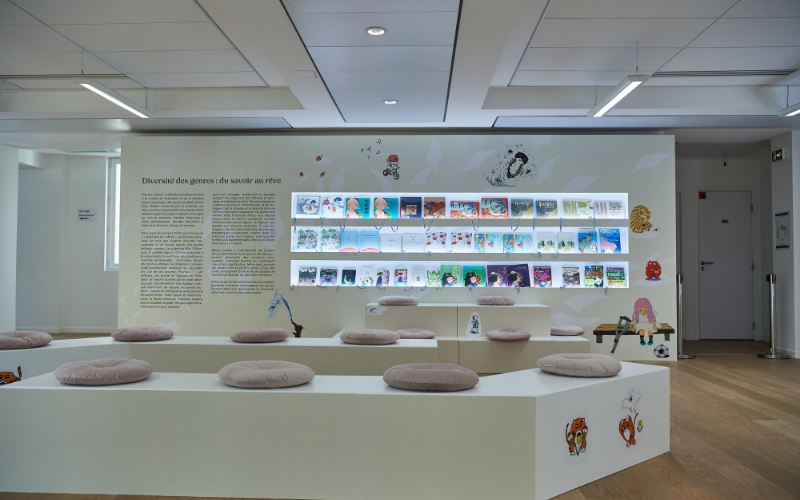
RYU Hye In Claire: “I would speak here of a curatorial and scenographic process. We began by constructing a narrative line that allows visitors to understand the evolution of Korean children's literature without turning the exhibition into a history lecture. The itinerary starts with the origins of this literature, presents the diversity of its genres—illustrated picture books, educational comics, novels for children and young adults—and moves on to heritage works and the international reach of contemporary creations. At the same time, we wanted the book cover images themselves to speak directly to readers. The goal was to keep the space living, intuitive, and suitable for both children and adults. A reading corner and wall-mounted bench steps allow visitors not only to look at the books, but also to flip through them and truly enter the stories.”
4. What place does Korean culture occupy in your creative approach?
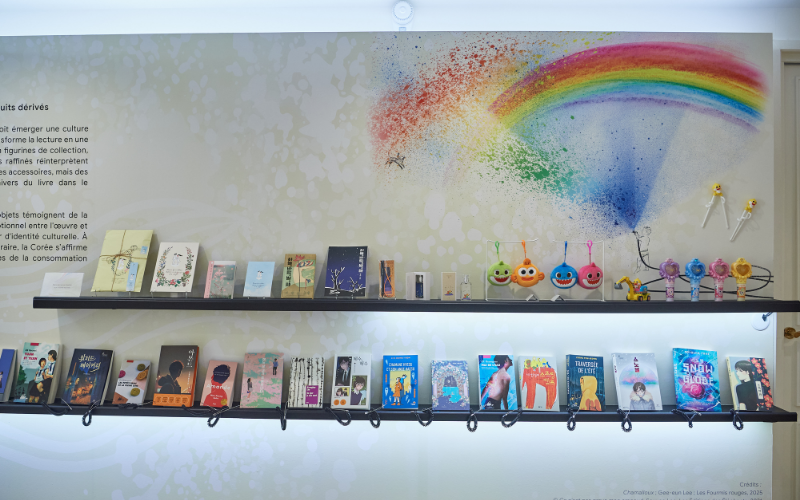
RYU Hye In Claire: “It is naturally at the heart of our work, as the mission of the Korean Cultural Center is to share Korean culture with the French public. However, our goal is not merely to showcase elements that might be labeled as 'typically Korean'. What interests us more is demonstrating how a culture is transmitted, transformed, and reinvented. In children's literature, this is very clear: contemporary authors revisit fairy tales, ancient texts, or elements of visual heritage while developing modern, personal artistic styles. This capacity to be deeply rooted in Korean sensibility while addressing universal themes and placing great importance on visual aesthetics explains, in my view, the current success of Korean picture books abroad.”
© Korean Cultural Center
5. How would you describe your experience at the Korean Cultural Center in Paris?
RYU Hye In Claire: “Working at the Korean Cultural Center in Paris means constantly building bridges between Korea and France. For a book exhibition, this dimension is particularly interesting because we address readers, families, book professionals, and visitors who may know very little about Korean literature. Paris possesses a very rich literary and publishing life. This motivates us to reflect not only on what we wish to showcase about Korea, but also on how the French public can make it their own and build their own relationships with Korean culture and its people. Presenting Korean editions and French translations side by side creates a very concrete dialogue between the two cultures.”
6. What challenges did you face during the creation or installation of the exhibition?
RYU Hye In Claire: “The first challenge was the selection process. Over a century of children's literature represents a vast heritage, and presenting everything was impossible. Moreover, many books were no longer available. We had to find a balance between different genres while taking book availability into account. Another important challenge concerned language. We wanted to ensure language would not be a barrier, so we prioritized translated books that visitors can actually find in bookstores after their visit. Finally, exhibiting books involves significant work regarding images, illustrations, and copyright, in dialogue with publishers and rights holders. We would like to warmly thank the participating authors and French publishing houses who generously granted us permission to use their book illustrations.”
7. How do you see the evolution of your artistic practice in the coming years?
RYU Hye In Claire: “In my case, I would refer to it as a programming and cultural curatorial practice rather than an artistic practice. I wish to pursue projects capable of going beyond a purely informative presentation of Korean culture. Today, audiences want to experience something, understand context, and establish a personal connection with what they discover. This exhibition moves in that direction: using the book as a cultural object to speak about history, society, education, imagination, and how children grow up in Korea. In the future, I want to continue developing such cross-disciplinary projects that allow the French public to discover Korea from unexpected angles.”
8. Do you have upcoming projects or exhibitions you would like to share with our readers?
RYU Hye In Claire: “Yes, several major projects are planned in the coming months, particularly celebrating the 140th anniversary of diplomatic relations between Korea and France. In literature, we will participate in the Salon du livre et de la presse jeunesse in Montreuil starting November 25, with a dedicated focus on Korean authors featuring meetings, workshops, and book signings. Starting in October, our performing arts programming will be exceptionally rich. Two major Korean groups, Ak Dan Gwang Chil and Chudahye Chagis, will perform in France, presenting contemporary interpretations of traditional Korean music at the Korean Cultural Center, Musée Guimet, and Opéra Orchestre national Montpellier Occitanie. We will also organize a major event at Théâtre du Châtelet highlighting Korean and French urban dance, bringing together leading dancers from both countries. Furthermore, as part of the K-Zone project, the Center will host interactive events bridging traditional heritage and contemporary creation, where visitors can try on traditional clothing, participate in interactive experiences, and take photos for a living discovery of Korean culture.”