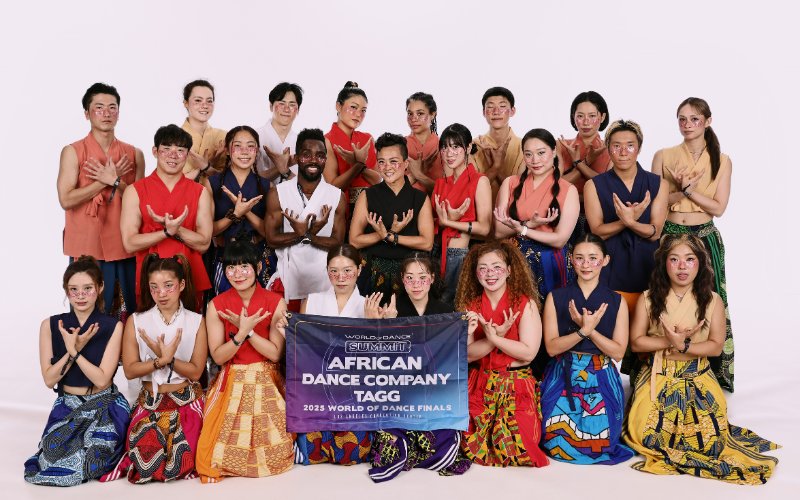
When African dance meets K-pop: TAGG, a company that reinvents the boundaries of movement. You can be against social networks, denounce their excesses, deviations, speed or permanent noise... but sometimes, you also have to recognize that they bear fruit. They become unexpected windows into events we would never have discovered otherwise. This is exactly what happened here: through a video, a share, or a performance excerpt, TAGG appeared as obvious. A company whose raw energy, freedom of movement, and artistic depth could not fail to attract attention.
TAGG is not a troupe like the others. Founded on a living dialogue between West Africa and Korea, it carries a rare artistic vision: that of a dance that liberates, heals, transforms. A dance that does not just seek to impress, but to awaken something fundamental in the viewer and the dancer. Their work, nourished by traditions, modernity, and a deep commitment to diversity, goes far beyond entertainment.
1. To begin with, could you present TAGG and share your company's artistic vision?
Eunjung Kwon-Lee: TAGG is a performance company aiming for the liberation of body and mind, deploying movement like a bird's wings. 'TAGG' means 'nest' in Wolof (Senegalese language). Under the joint artistic direction of Kwon I-eunjeong and Ahifon Sundiya Daniel, the company develops original creations connecting tradition and modernity, Africa and Korea. Through various activities—shows, education, media, international projects—TAGG widely disseminates the artistic and cultural value of African dance in Korea and abroad.
Our artistic vision is based on the idea that human beings change fundamentally before and after encountering a work, before and after stepping on stage. We challenge the marginalization of African art, which is the root of many artistic forms, due to Western-centrism. We believe artists have a responsibility to rebalance a 'tilted' society through their voices and movements.
2. What motivated TAGG to participate in the K-Pop Dance Competition this year?
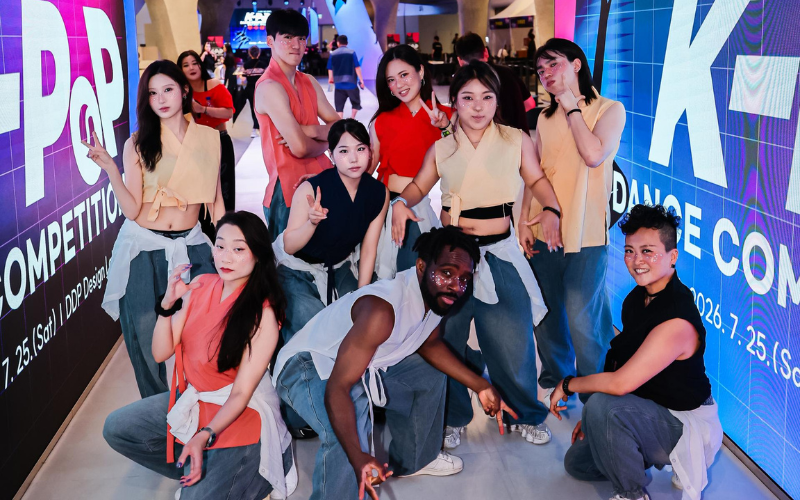
Eunjung Kwon-Lee: In 2024, we wanted to show that the energy and joy of African dance are by no means foreign to Korean sensibility. So we fused 'Arirang'—in the version created by BTS—with 'Dos Carré', a coupé-décalé music genre from Côte d'Ivoire. Even though cultures seem different, the essence of joy and vibration exploding on stage is universal. The fusion hanbok costumes made of African fabric reinforced the identity of the piece, which was hailed as the opening of a new genre: 'K-Afropop'.
This competition was the ideal place for us to show how K-pop can expand when it meets afro dance. We wanted to transform strangeness into familiarity and share the pure joy of dance with all participants.
3. What was your main objective in supervising this competition?
Eunjung Kwon-Lee: With the 9 dancers gathered for this stage, we wanted to propose a new group aesthetic, different from the 'kalgunmu' (perfect synchronization) dominating the Korean scene. Rather than aiming for technical uniformity, we highlighted the distinct personalities and raw artistic passion of each dancer.
Our goal was to create a show that doesn't just impress, but makes the audience's heart beat to the point of wanting to get up and dance immediately. When individualities break rigid frameworks and come together into a primordial energy, an immediate force of liberation is transmitted to the public.
4. What struck you the most in the participants' performances?
Eunjung Kwon-Lee: Despite experiencing many competitions, we had never felt such a fresh shock. The backstage was not filled with competition-related tension, but with incredible human warmth. Participants cheered for every performance, dancing along to every choreography from start to finish, without calculation or restraint.
Having grown up more in African music than in K-pop, seeing these dancers sincerely celebrate their competitors and live every piece with their entire body was overwhelming. This pure passion reminded us of the fundamental reason why we started loving dance.
5. In your opinion, what defines an 'excellent K-Pop dance performance' today?
Eunjung Kwon-Lee: For the public, K-pop is spectacular entertainment. For creators, it's a battlefield where artistic survival is at stake. You have to feel the trends without getting lost in them, and above all defend a clear artistic identity.
The essential criteria are:
• Uncompromising originality: refusing ready-made formulas and revealing the artist's singularity.
• The courage to break frameworks: proposing a new direction despite market caution.
• Impeccable technical mastery: proving on stage that one's choices are right.
Striking performances never stem from conformity, but from boldness and conviction.
6. How did you select and prepare members for this competition?
Eunjung Kwon-Lee: Among the 20 dancers who participated in the 'Afro Arirang' journey, we selected those whose schedules matched the contest date. They are all veterans used to working together, with such trust that a single glance is enough to understand each other's intention.
Each competition imposes different musical formats (3:30, 5 min, 6 min...). This time, we had to completely recompose the structure for a 4-minute format. Thanks to their experience, the dancers were able to quickly adapt to changes in movements and construction, achieving optimal quality despite constraints.
7. TAGG brings together dancers of various cultural backgrounds. How does this diversity influence your view of K-Pop dance?
Eunjung Kwon-Lee: Our main strength is diversity: origins, languages, ages (from early twenties to forties). We value a culture where differences are neither feared nor rejected, but naturally welcomed.
We favor:
• Mutual support and professional reality: we don't lock dancers inside the company; we support their outside activities.
• Sustainable survival over immediate results: the goal is to dance for a long time, without injury.
• The role of 'nest': a space where everyone can recharge, grow, and return to enrich the collective.
This diversity enriches our vision of K-pop, reinforcing flexibility and the ability to cross borders between genres.
Credits: TAGG
8. Do you observe trends in how young dancers approach K-Pop choreography today?
Eunjung Kwon-Lee: In the past, an invisible hierarchy separated street dance and commercial dance. Today, this boundary is fading. K-pop has become a natural part of many dancers' paths.
Major developments:
• End of prejudices against commercial dance
• Organic circulation between genres
• Flexibility to cross stylistic borders
K-pop does not flatten genres: it creates a huge meeting point where dancers from different backgrounds can exchange and evolve.
9. What projects is TAGG currently preparing, in Korea and internationally?
Eunjung Kwon-Lee: TAGG is preparing several projects: hybrid shows, international collaborative workshops, community educational programs. We continue original creations blending traditional movement philosophy and contemporary performing arts, while developing artistic exchanges between Korea and world stages. Festivals, dance films, and masterclasses are also in preparation.
10. What message do you want to convey to dancers dreaming of participating in a K-Pop competition or joining a company like TAGG?
Eunjung Kwon-Lee: Never forget the pure joy felt when you started dancing. Technique, training, and physical fitness are essential, but your most powerful weapon is your singularity. Keep an open mind, cultivate your curiosity, and trust your journey. On stage, let your inner energy express itself fully.