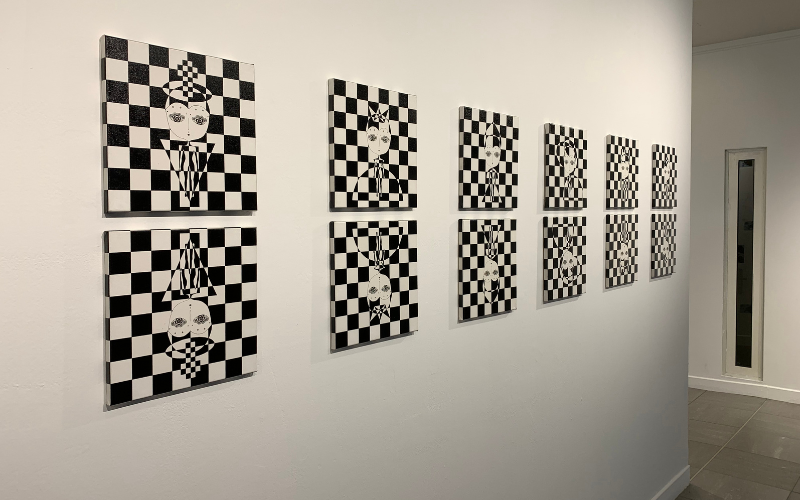
There is in SungYeon Hong's work a gentle and attentive way of looking at the world, as if every detail could become the beginning of a story. When talking with her, one quickly understands that her work is not a mere succession of pieces, but rather an inner thread she has been following for years—a thread made of questions, sensations, and subtle strangenesses that emerge when the familiar mixes with the new.
Based between Seoul and Paris, she moves forward without seeking to freeze herself in a single style or form. She observes, listens, returns to an idea, and lets it change with time, materials, and lived experience. Her works are never definitive answers: they are steps, fragments of an ongoing conversation with herself, the world, and those who observe her work.
What strikes most about her is this quiet sincerity. She does not try to impose a message or guide the viewer. Instead, she prefers to leave space, a breath, where everyone can deposit their own memories, emotions, and questions. Her art is not here to explain: it is here to open.
Participating in the Seoul–Paris Artistic Bridge project fits naturally into her journey. She belongs to those artists who live between two cultures, two languages, two ways of seeing—and who transform this crossing into artistic material. With SungYeon Hong, everything becomes a possibility: a forgotten fabric, a returning image, a word that resonates differently depending on the moment.
To encounter her work is to accept not understanding everything right away. It means allowing oneself to be touched by something discreet yet deep. It is entering a space where one can also look at things differently. We had the chance to interview her by email on August 8 to learn a little more about her.
1. Could you tell us about a recent project or creation that holds a special meaning for you?
SungYeon Hong: “Rather than choosing one specific recent work, I feel it is more accurate to view my creations as a continuous whole. They may take different forms and approaches, but they all stem from the same themes and core interests. I often explore an idea or a question from several angles, layering, separating, or transforming them in order to see them differently. This is also the case in my recent works. I reflect on the possibilities offered by a theme or an image, and how it can evolve depending on the material, scale, or the moment I return to it. Works that seem very different can actually carry the same underlying thought. The Vujade series best illustrates this way of working. It developed over a long period across several pieces. It is not about making a single piece: it is an ongoing exploration of a concept, revisited over time and expressed through changing forms. What interests me about the word Vujade is that it reflects my creative process. I am drawn to that slight strangeness that appears when something familiar is overlaid with something new—when a past experience meets an as-yet-unknown one. In this sense, Vujade goes beyond the framework of a single series: it could describe my entire practice, made of recurring themes that overlap, separate, and transform, allowing new perspectives and resonances to emerge.”
2. When you create, what emotions or messages do you hope the audience feels or takes away?
SungYeon Hong: “I do not want to tell viewers exactly what they should feel or think. I prefer to leave a space where they can bring their own experiences. We all perceive the world through our memories and emotions, so the exact same work can resonate in a completely different way from one person to another—and I find this difference precious rather than problematic. I would like my work to serve as a bridge to the viewer's inner world: an emotion rising to the surface, a question being born, or perhaps a forgotten memory reappearing. A work does not need a fixed message to exist. What matters is the possibility that each viewer leaves with something different—something they discovered themselves.”
3. Collaboration is often essential in the arts. Are there artists or groups you have recently worked with that have significantly influenced you?
SungYeon Hong: “Living and working in France naturally led me to meet other artists and creative communities—especially Korean artists based in France, as well as artists from AJAC. Group exhibitions showed me how differently each artist can look at the same world. Even when we share a culture, our experiences, mediums, and ways of expressing things can be vast and varied. Exhibitions bringing together Korean artists living between Korea and France were particularly important to me. They allowed me to discover perspectives shaped by lives spanning multiple places and cultures. These encounters did not change what I create, but they changed how I look at it. Seeing how other artists approach their work encourages me to step back and reconsider my own.”
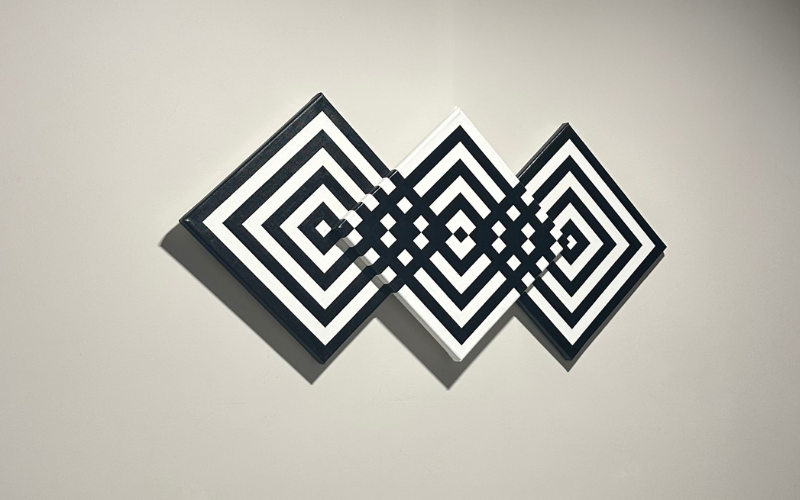
Another perspective of SungYeon Hong's artistic work © SungYeon Hong
4. What challenges have shaped your artistic journey, and how have they helped you grow?
SungYeon Hong: “My path has not been a series of obstacles to overcome, but rather a continuous exploration of myself through my work. Just as I hope viewers can reconnect with their own experiences through my works, these pieces have become a way for me to reconnect with myself—a way to discover what attracts me and which questions keep returning. For me, artistic practice is not simply about creating something. It is looking anew at who I am through what I do, and noticing things I hadn't seen before. And as I am constantly changing, the way I understand myself through my work changes too. These evolutions become part of the work and open up new questions. Art, deep down, is a way to remain in conversation with myself—and staying in this conversation is a large part of what drives me to keep creating.”
5. What projects or goals do you wish to explore in the coming months?
SungYeon Hong: “I would like to develop my practice in a natural way while exploring new materials and new ways of expressing the ideas that accompany me. My work in fashion left me with a large amount of unused or set-aside fabrics over the years. At first, I simply kept them, thinking they might be useful one day. Over time, I began to imagine that they could become the starting point for a new body of work. After COVID Jardin—a piece made from masks collected during the pandemic—I would like to create new works from these fabrics. I haven't defined the exact form or method yet; I am still reflecting on how these materials could connect with the images and ideas present in my previous works. It is not simply recycling. I want to give these materials—already used and intended to be discarded—a new meaning and a new life. Through them, I wish to explore materiality, time, memory, and the way I look at objects that already carry their own history. Being in this reflection phase is precisely what makes this project exciting. I don't know yet what shape it will take, but I want to stay open to this uncertainty and see where it leads me.”
6. Finally, is there anything you would like to share with readers in Korea, France, or elsewhere who will discover your work through this interview?
SungYeon Hong: “I hope readers approach my work through their own eyes and their own experiences. Just as we grow and change throughout our lives, artists change too. New people, new experiences, different emotions and thoughts—all of these transform us little by little, and these transformations are naturally reflected in our work. For this reason, I don't think an artist should stay bound to a single style or way of working. What matters is accepting the person you become and honestly expressing what you see and feel at each moment. For me, art is not a process that leads to a final answer. It is a process of questioning, observing, experiencing, and expressing—while discovering new ways of seeing. Wherever you encounter my work—in Korea, France, or elsewhere—I hope it leaves room for your own emotions, memories, or thoughts. And I hope you will continue to observe my changes and the way they are reflected in what I create next.”