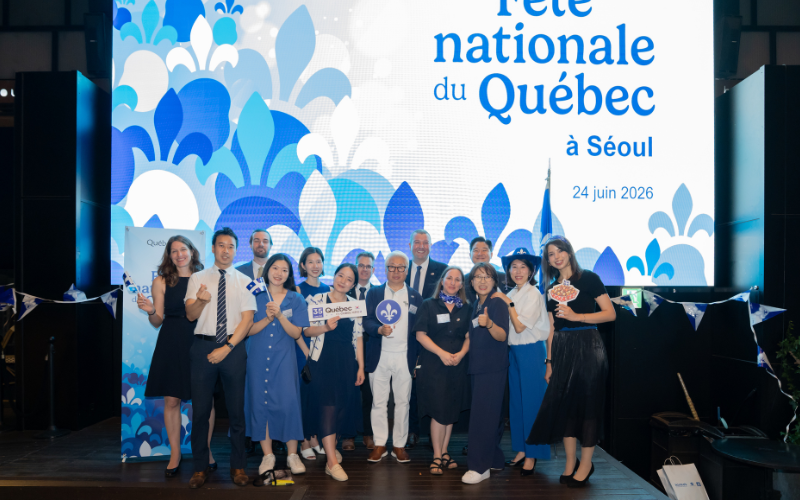
On August 17, a written interview was conducted with Mr. Damien Pereira, Delegate of Quebec in Seoul. This exchange highlights a resolutely pragmatic approach on the ground. Quickly, it becomes apparent that the Delegation is not merely an institutional anchor point: it constitutes a space of realization where artists, researchers, entrepreneurs, and organizations find support to establish themselves in Korea and build lasting partnerships.
Beyond sectors of activity, it is the networking of ecosystems that commands attention. The Delegation acts as an active bridge, allowing Quebecers to understand Korean realities while introducing the Quebec offer on-site. No grand abstract speeches, then, but tangible initiatives driven by the desire to collaborate and undertake together.
Throughout the interview, Mr. Pereira reflects on recent projects, key milestones, and bilateral challenges, anchored in trust and creativity as Quebec celebrates 35 years of presence in Korea.
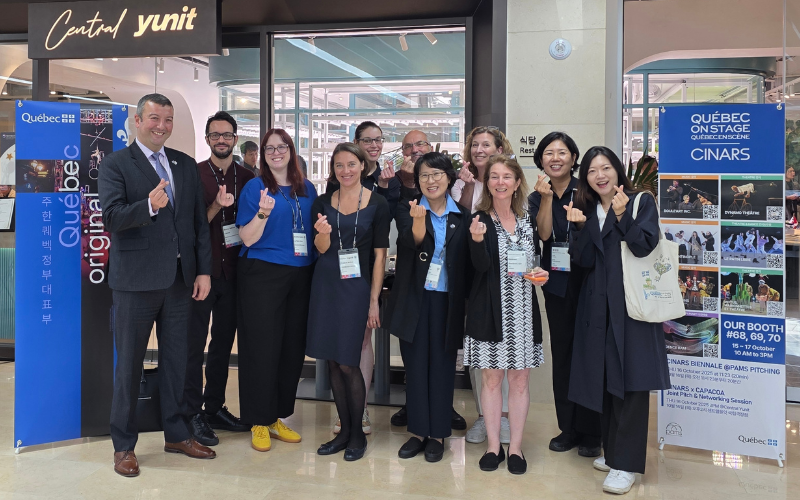
Photo provided by the Quebec Delegation in Seoul
1. To begin, could you present your role as Delegate of Quebec in Seoul and explain what your mandate covers?
Damien Pereira:
I head the Quebec Delegation in Seoul, a team of twelve people whose mandate covers the promotion of trade, innovation, education, culture, and investment between Quebec and the Republic of Korea. Concretely, our role is to create meeting and collaboration opportunities between Quebec and Korean actors: we support companies, universities, research centers, cultural institutions, and organizations wishing to develop projects with partners in Korea.
2. What are the main objectives of the relations between Quebec and the Republic of Korea, particularly in culture, innovation, and institutional cooperation?
Damien Pereira:
What strikes me in the relations between Quebec and Korea is the ease with which exchanges develop. Our two societies attach great importance to education, knowledge, and innovation. In culture, our goal is to multiply gateways between Quebec and Korean artistic scenes. Regarding innovation, coproduction like 'Wings of Memory' between Cirque Eloize and Samsung C&T is a fine example of artistic and collaborative innovation.
3. What recent projects or collaborations between Quebec and the Republic of Korea seem particularly significant to you?
Damien Pereira:
I think first of 'Focus Quebec', presented during the International Symposium on Electronic Art (ISEA 2025) in Seoul, bringing together some thirty artists, researchers, and cultural representatives. I would also cite 'Quebec Special' at the Bucheon International Fantastic Film Festival (BIFAN) 2026, which allowed the Korean public to discover immersive Quebec works.
4. How does your team support Quebec artists, creators, and organizations wishing to develop projects in the Republic of Korea?
Damien Pereira:
We support Quebec artists, creators, and organizations from partner identification to concrete collaborations. Our work begins with a good understanding of the local terrain, supported by the Ministry of Culture and Communications of Quebec, the CALQ, and SODEC. Our added value lies above all in our field knowledge and our network of trust.
5. Conversely, what types of Korean initiatives attract Quebec's interest in your missions?
Damien Pereira:
We closely follow Korean successes in artificial intelligence, robotics, and creative industries. Entertainment and digital content platforms in Korea open new creative possibilities, aligning with Quebec's excellence in AI, video games, animation, and visual effects.
6. How do you perceive the evolution of cultural and bilateral relations between Quebec and the Republic of Korea in recent years?
Damien Pereira:
Since the opening of Quebec's first representation in Seoul in 1991, our presence has evolved into a Delegation in 2024. Beyond institutions, relations were forged during the Korean War with Quebec soldiers from the Royal 22e Regiment, and reinforced during the COVID-19 pandemic and the 2023 forest fires when Korea sent 150 firefighters. This year marks 35 years of Quebec's presence in Korea.
7. What are the main challenges and opportunities in developing exchanges between our two societies?
Damien Pereira:
Global recompositions require us to rethink exchanges. The challenge is to translate our solid foundation into strategic partnerships in innovation, energy, critical minerals, and artificial intelligence. Regional relations—like Montreal-Seoul-Busan, Sherbrooke-Busan, and Trois-Rivieres with Gyeongsangbuk-do—demonstrate that Quebec's regions are innovative and open to the world.
8. Cultural diplomacy plays an important role in your mandate. How do you integrate it into your actions and priorities?
Damien Pereira:
Culture is often the first gateway to a lasting relationship. Korea already knows Quebec in a special way thanks to popular culture, such as the drama 'Guardian: The Lonely and Great God' (Dokkaebi), which allowed millions of viewers to discover Quebec City's architecture and landscapes.
9. Are there upcoming projects or initiatives you wish to highlight for the coming months?
Damien Pereira:
Upcoming months include CINARS professionals at the Busan Performing Arts Market (BPAM) in October, PAMS in Seoul, Alain Thibault taking artistic direction of the Unfold X festival, and welcoming twenty Korean professionals to the CINARS Biennale in Montreal in November 2026.
10. Finally, what message would you like to address to Korea.net readers, the Korean public, and Quebecers interested in the Republic of Korea?
Damien Pereira:
To Korean readers, Quebec is closer than you might think, built on mutual respect and trust. To Quebecers, come discover Korea not just as a market, but as a society. This year marks 35 years of Quebec's presence in Korea—an opportunity to look toward the future together.
35 Years of Quebec's Presence in Seoul
Celebrating over three decades of diplomatic, cultural, and economic cooperation, fostering vibrant ties between Quebec and South Korea.