 Jason Edwards – Interviews

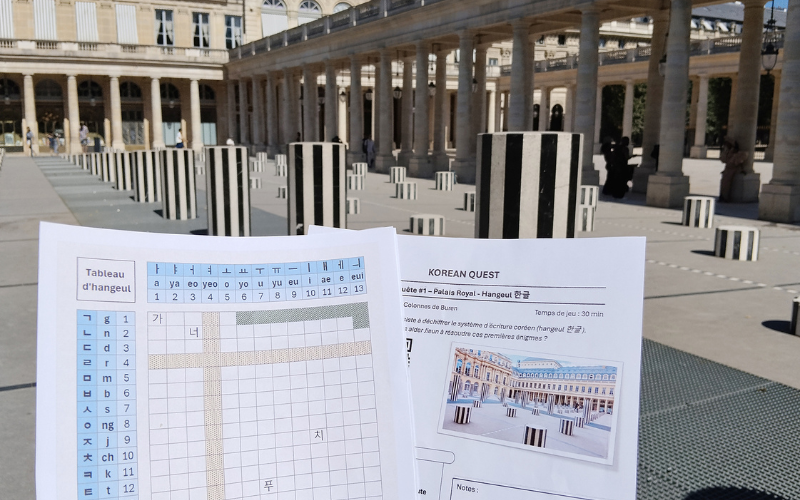
Korean Quest is a cultural adventure born from a simple observation: francophone audiences want to discover Korean culture in ways other than the usual formats. After several years highlighting Korean events in France through the platform Cultu’Corée, its creator felt the need to go further and imagine an experience that would be more immersive, more narrative, and more active.
The idea emerged in 2025, during a very ordinary moment: a music video, a striking visual universe, and the impression that culture could also be transmitted through story and play. This spark opened the way to Korean Quest, a cultural treasure hunt mixing riddles, mythology, storytelling, and exploration of Paris.
Today, the project gathers several hundred participants in France, attracted by this playful and sensitive way of discovering Korean culture. To understand how this adventure was designed, we collected the answers of its creator.
1. Could you briefly present Korean Quest and Cultu’Corée?
Cultu’Corée is a platform dedicated to promoting Korean cultural events in France. It highlights exhibitions, concerts, festivals, workshops, screenings, or gastronomic events, with a clear objective: showing the diversity of Korean culture beyond clichés. The project is interested as much in heritage, history, and traditions as in contemporary forms.
Korean Quest follows this continuity, but with a more participatory dimension. Where Cultu’Corée informs, Korean Quest invites people to live an experience. It is a free cultural treasure hunt composed of weekly quests mixing online riddles, storytelling, and exploration of Paris. Participants must follow clues to find a hidden gumiho in the capital. Each quest allows them to discover an aspect of Korean culture in a playful way.
2. What inspired you to create a Korean cultural treasure hunt?
Promoting Korean events in France allowed me to meet passionate organizers and highlight initiatives that deserve to be known. But over time, a more personal desire appeared: creating a project that truly belonged to me, in which I could put my sensitivity and my way of transmitting Korean culture.
The spark came in July 2025, when I discovered the music video Stellar Paradox by J.Fla. Its fictional, highly visual universe immediately inspired me. I felt that culture could also be transmitted through story, quest, and progression. From there, ideas followed: an adventure, a heroine, a gumiho, riddles, a mysterious notebook, and a reason for players to return each week.
J.Fla influenced the project far beyond this video. Her journey, her values, and some of her songs nourished the creation of Jieun, the heroine of Korean Quest. The music used in the official video of the project is also a discreet homage to this inspiration.
3. How does Korean Quest work, and how do you combine Korean culture and riddles?
Korean Quest works through weekly quests published on KoreanQuest.org. Each quest explores a specific cultural theme: a historical element, a tradition, a mythological figure, an aspect of the Korean language, a cultural object, an artistic practice, or a topic related to gastronomy.
Participants solve a series of riddles to obtain clues that make them progress in the story and bring them closer to the gumiho. The game offers two modes:
• online, accessible everywhere in France;
• on-site, in Parisian locations linked to Korean culture or project partners.
The balance between game and pedagogy is essential. A riddle that is too academic makes the experience less fun; a riddle that is too abstract makes the cultural content disappear. The goal is for learning to happen naturally through solving.
4. Why did you choose a story around Jieun and the Gumiho?
I wanted to avoid a simple succession of independent riddles. A guiding thread, a universe, a reason to return each week was necessary. That is how Jieun, the heroine of the story, was born. She arrives in Paris with a mysterious notebook linked to a gumiho. This notebook becomes the starting point of the adventure.
The gumiho, a nine-tailed fox, is a fascinating character in Korean mythology. Ambiguous, mysterious, sometimes frightening, sometimes moving, it allows the creation of an atmosphere between tale, mystery, and emotion. It also symbolizes the link between tradition and fiction, between imagination and reality. Thanks to it, Korean Quest can approach Korean culture without remaining in a purely documentary format.
Jieun embodies the gaze of travel, discovery, and transmission. Through her, players follow a story that expands with each quest and opens the door to a larger universe.
5. Why did you choose Paris as the setting of the adventure?
Paris naturally imposed itself. The city concentrates a very rich Korean cultural activity: exhibitions, concerts, festivals, screenings, workshops, restaurants, bookstores, shops, and actors involved in promoting Korean culture in France.
Paris also has an ideal narrative dimension for a treasure hunt. Each neighborhood, each street, each place can become a setting. By adding a story inspired by Korean culture, an interesting dialogue between France and Korea is created.
Korean Quest does not turn Paris into a tourist backdrop. The idea is to reveal a “hidden Korea” in the city: places, communities, initiatives that the public does not always know. Participants do not simply visit a place: they look at it differently, through a riddle, a story, or a cultural symbol.
6. What type of audience participates the most in Korean Quest?
I did not want to create a game reserved for Parisians. Korean culture interests people throughout France, and it would have been a shame to exclude those who cannot travel.
This is why Korean Quest offers an online mode and an on-site mode. Today, two main audiences stand out:
• Parisian or Île-de-France participants, who discover Paris differently;
• participants across France, who follow the quests online week after week.
What touches me most is the diversity of profiles: fans of Korean culture, curious people, puzzle lovers, occasional players. Some come for the game, others for Korea. Seeing several hundred participants follow the adventure is very encouraging.
7. Do you have a memorable anecdote with a participant?
Since the game takes place mainly online, I rarely meet players directly. This is a strength — everyone participates freely — but also a difficulty, because I do not always see reactions in real time.
The most memorable moment came at the end of season 1. I received many messages of thanks, encouragement, and even impatience for season 2. After months of solitary work, discovering the enthusiasm of players was very moving.
I also learned that Korean Quest allowed fans of Korea to meet each other. The game then went beyond what I had imagined: it not only allows people to discover a culture, but also to create connections between people who might never have met otherwise.
8. What are your plans for the future of Korean Quest?
Even though the 2026 edition is not finished, I am naturally thinking about the future. Korean Quest is a living project, evolving with participants, partners, and ideas that appear along the way.
The project allowed me to explore a great diversity of roles: puzzle creation, writing, website development, video production, communication, partnerships. The site contains more than 10,000 lines of code, but beyond the number, it is this complete dimension that fascinated me.
If a sequel happens, it will be different. I do not want to repeat the same formula. I would like to strengthen the storytelling, develop Jieun’s universe further, make the experience more immersive, and offer richer game mechanics.
9. What message would you like to convey to participants?
The first word is simple: thank you.
When I started Korean Quest in 2025, I did not know if anyone would play. Seeing so many participants follow the adventure today touches me deeply. Behind each registration, each answer, each message, there is a person who accepted to enter this universe.
Messages of support were precious, especially during moments where the work was intense. If Korean Quest makes someone want to discover a traditional song, a myth, a dish, a Korean word, or simply look at Korea with more curiosity, then the project has succeeded.
To follow the adventure or discover associated cultural projects, readers can visit the official websites:
Korean Quest: https://koreanquest.org/
Cultu’Corée: https://cultucoree.fr/