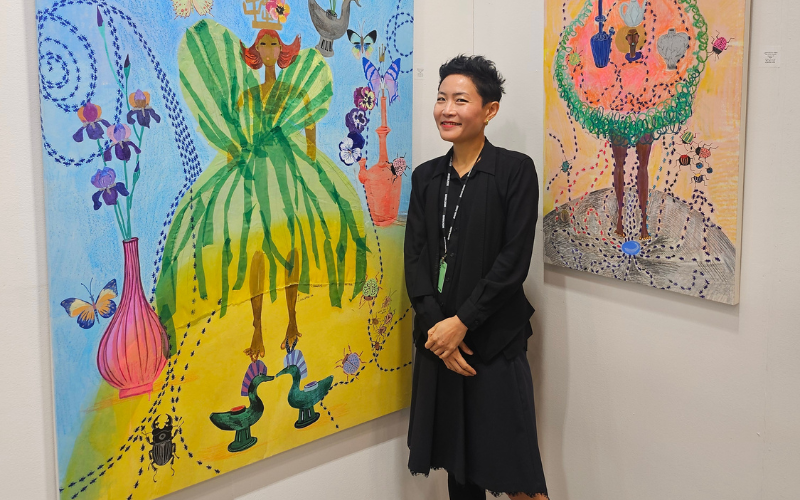
Writing from Luxembourg provides a certain distance from Korea while still allowing a close interest in its cultural field. This position makes it natural to follow creators who work between countries. Among them is Kim Soo‑young, a scholar and artist whose research examines fashion through the body and its cultural meaning.
Her background immediately stands out. She approaches fashion as a narrative shaped by physical form rather than as a sequence of trends. Her career has taken her between Seoul and Paris, where she has worked in academic institutions, archives, studios, and classrooms. She combines research and artistic practice, using both to study how societies assign meaning to the body.
Her recent book led to an email interview on June 29. The publication looks at how different periods have focused on specific parts of the body and turned them into symbols of desire, norms, or social expectations. These themes extend beyond fashion and reflect broader cultural questions.
The project began with a small object she found in a Paris flea market. This detail became the starting point for a question she had been considering for years. It illustrates how her work often emerges from close observation and attention to everyday materials.
1. Could you briefly introduce yourself?
Hello, my name is Kim Soo‑young. I am a scholar and artist who studies fashion through the lens of the body, desire, and history. I graduated from Ewha Womans University with a degree in Fashion Design, then completed a Master’s in Fashion Management at Institut Français de la Mode (IFM) in Paris, a Master’s in Design at Sorbonne University, and finally earned my PhD in Art Philosophy at Paris 8 University. I also worked as a visual designer at KENZO, part of the LVMH Group. Currently, I teach at Ewha Womans University, Sungshin Women’s University, and Dankook University while working between Seoul and Paris. My research explores the intersection of aesthetic form, philosophical thought, and social context in fashion, expanding fashion into the realm of cultural studies. Alongside academic writing, I also work as a visual artist, creating drawings that translate fashion-related ideas into images.
2. What motivated you to publish this book? What is its core message?
The book began with a small discovery at a flea market in Paris. That moment triggered a long‑standing question I had carried within me: “Why do we obsess over certain parts of the body and turn them into style?” Studying fashion history reveals that each era highlights specific body parts — the neck, the waist, the legs — as objects of desire. I realized these shifts were not mere trends but reflections of power, gender, morality, and class inscribed onto the body. So I approached fashion not as the history of clothing, but as the history of desire surrounding the body. My core message is that fashion records how we perceive and assign meaning to our own bodies and the bodies of others. Style is not just fabric or silhouette — it is the condensed expression of desire and gaze.
3. What was the most challenging and the most enjoyable part of writing this book?
The biggest challenge was weaving vast primary sources into one coherent narrative. The French National Library’s digital archives contain centuries of scattered texts and images. Finding a consistent thread of “body and desire” and shaping it into a persuasive structure took much longer than expected. Some sections that connected historical narratives with contemporary fashion had to be cut due to length, which I still feel slightly regretful about. But that regret became motivation for my next project — a book on men’s fashion. The most enjoyable moments were when unexpected connections emerged between old illustrations or documents. When fragments from different eras suddenly aligned into one meaning, it felt like completing a puzzle.

© Kim Soo‑Young
4. How is the Soo Exhibition Project connected to this book?
Soo Exhibition Project is my personal exhibition practice as a visual artist. I am represented by Bruno Massa Gallery in France and participate in various international art fairs. Although the project is not directly linked to the book, I see writing and drawing as two forms of the same creative root. Academic writing builds ideas through logic and sources, while drawing expresses the sensory and intuitive side of those ideas. In the book, I explored the history of the body and desire through structured argumentation. In my exhibitions, I explore the same themes — body, gaze, desire — through images without formal constraints. For me, research, writing, and artistic practice are not separate fields but different languages for the same questions.
5. Which part of the book reveals your most personal perspective?
The book is primarily academic, analyzing Western fashion culture through body parts. But the most personal section is the chapter on skin, where I discuss the origins of the Korean “tte‑miri” exfoliating towel. Korea’s rough exfoliation culture contrasts sharply with France’s softer bathing tools. This difference reflects deeper cultural attitudes toward skin, cleanliness, and the body. Having lived between Korea and France allowed me to notice this contrast — a perspective that blends scholarly analysis with personal experience.
6. How do Korean readers react differently compared to overseas readers?
The book is written in Korean, so strictly speaking, there is no broad “French reader response” except for a few who can read Korean. What is interesting, however, is that although the sources are Western, the interpretation and audience are Korean. Korean readers encounter familiar Western fashion images through an unfamiliar lens — the body and desire — and many said they discovered a new way of reading fashion. If the book had been written in French, this analytical distance might not have been possible. I hope future translations will allow readers from other cultures to engage with this perspective.
7. Could you share your upcoming projects or ideas for your next book?
I am currently working on a new book about men’s fashion. While the previous book traced Western fashion history through body parts, the next one will explore how masculinity and the aesthetics of the “beautiful man” have evolved from early modern Europe to today, using iconic male fashion figures as anchors. The project will draw on theories of masculinity, gender performance, and the relationship between power and style, while maintaining a comparative perspective between Western and East Asian contexts.
8. What do you hope readers will feel or think after reading your book?
The book is based on rare archival materials not easily accessible online. As a professor, my hope is that readers will develop their own perspective on fashion and the body. Rather than simply absorbing historical facts, I want them to question the clothes they wear and the bodies they see around them. That ability to ask questions is what I hope to inspire in both my students and my readers.
9. Do you have a message for international readers, especially those reading through Korea.net?
Having lived between Korea and France for many years, I realized that fashion is ultimately a mirror of how a society views the body and the human being. Rewriting Western fashion history through a Korean scholar’s perspective was a way of making the familiar unfamiliar — and discovering questions that only someone standing between two cultures can see. To international readers encountering this story through Korea.net, I want to say: Questions about fashion, the body, and desire are not limited to any one culture. I hope this book encourages you to reflect on how your own culture has shaped the way you look at bodies and style. And I sincerely hope this research will one day be translated into more languages, reaching readers around the world.