Titled “Hangeul, the Will of a King,” this exhibition presents to the French public an alphabet that occupies an essential place in Korea’s history. Created in collaboration with the Champollion Museum, this article shares the story behind this landmark event.
Co-organized by the Champollion Museum – World Writing Systems in Figeac and the National Museum of World Writing Systems in Incheon, the exhibition forms part of the celebrations commemorating 140 years of diplomatic relations between Korea and France. This bilateral cooperation lends a special dimension to the event, underscoring the richness of cultural exchanges between both nations. Hangeul was created in 1443 by King Sejong with a clear ambition: to enable the entire population to learn to read and write. At the time, Chinese characters were used exclusively by the elites, strictly limiting access to knowledge. Hangeul transformed this paradigm. The exhibition revisits this context, illustrating the driving forces behind the script's creation.
The museum journey introduces the fundamentals of Hangeul in a simple and accessible manner. Explanatory panels detail the structure of consonants and vowels, as well as the logical principles underlying the alphabet. Visitors can quickly grasp how the writing system functions, even without prior knowledge of the Korean language. The exhibition also demonstrates how Hangeul spread throughout Korean society and accompanied the nation's cultural developments.
Hangeul is far more than a historical alphabet. It flourishes in daily life—on signage, books, posters, and across contemporary creation, including design, fashion, and popular culture. Its clean geometric shapes and visual organization make it an inspiring motif for many contemporary artists. By featuring this current dimension, the exhibition highlights Hangeul’s ongoing vital role. Its presence in a French museum specialized in world writing systems reflects the growing interest in Korean culture across Europe. The Champollion Museum regularly collaborates with international institutions to showcase writing systems from the globe. Hosting this exhibition reinforces cultural ties between France and Korea while revealing a fundamental aspect of Korean identity.
“Hangeul, the Will of a King” offers a meaningful opportunity to understand the history of a script that profoundly marked Korean society. It demonstrates that behind an alphabet lie vision, human necessity, and philosophical choices. Designed to be universal and accessible, Hangeul played a pivotal role in democratizing knowledge. By presenting this script in France, the exhibition allows visitors to grasp its central importance to Korean culture.
To learn more, I conducted an email interview on July 20, 2026, from Paris with Stéphanie Lebreton, Deputy Director and Head of Collections at the Champollion Museum. She shared the origins of the project, the partnership with Korean institutions, curatorial choices, and what this exhibition brings to a French audience discovering Hangeul for the first time.
1. What motivated the choice to dedicate an exhibition to Hangeul?
Stéphanie Lebreton: “Since 2007, the Champollion Museum has been dedicated to the history of world writing systems. Prior to this exhibition, no documents written in Hangeul were presented in our collections. The idea was born within the framework of the 140th anniversary celebrations of French-Korean diplomatic relations, and the exhibition was designed in partnership with the National Museum of World Writing Systems (MOW) in Incheon. It fulfills a dual purpose: introducing Hangeul to the French public and highlighting our institutional collaboration with the MOW.”
2. What objectives do you hope to achieve with a French public that is largely unfamiliar with Hangeul?
Stéphanie Lebreton: “The exhibition aims to introduce Hangeul, as well as aspects of Korean culture that remain lesser-known in France. Historical artifacts illustrate the birth of Hangeul and movable metal type printing, while contemporary elements showcase Hangeul's vibrant graphic vitality in modern-day Korea.”
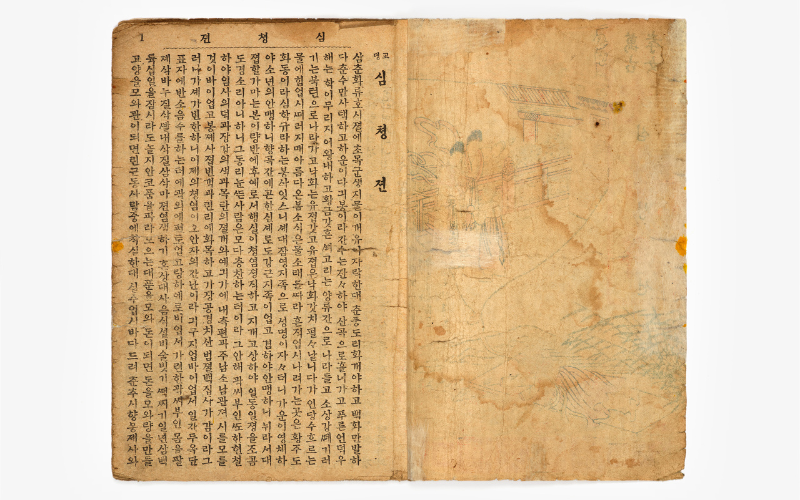
Artifact from National Museum of World Writing Systems (MOW) Incheon © MOW
3. How did you choose to portray King Sejong?
Stéphanie Lebreton: “King Sejong is presented as a visionary monarch who designed a writing system tailored for his people, despite opposition from his court administration. An animated documentary, produced by our Korean colleagues at the MOW, retraces the creation of Hangeul and King Sejong's role. It is broadcast continuously throughout the exhibition space.”
4. Which elements do you consider essential for understanding the creation and spread of Hangeul?
Stéphanie Lebreton: “The museum presents a rare copy of the Hunminjeongeum, the founding document of Hangeul and a unique milestone in world writing history. The MOW lent major works: woodblock prints, movable type pieces, and artifacts linked to Korean printing history—developed centuries before Europe. Loans from French institutions (Quai Branly, Guimet, Cernuschi, Sèvres, BULAC…) immerse visitors in Joseon Dynasty society. Additionally, contemporary works illustrate ongoing artistic creativity centered on Hangeul.”
5. Could you explain the collaborative efforts undertaken with Korean institutions?
Stéphanie Lebreton: “Since 2023, the Champollion Museum has maintained a partnership agreement with the National Museum of World Writing Systems (MOW). An exhibition curated in Figeac, Script Girl, was presented at the MOW in 2024. The Hangeul exhibition is co-organized with the MOW, with Mr. Donghyun Kim, Curator in charge of International Affairs, serving as co-curator alongside Ms. Céline Ramio. The exhibition is officially certified by the Embassy of the Republic of Korea in France.”
6. What challenges did you face when designing an exhibition dedicated to a foreign writing system?
Stéphanie Lebreton: “Hangeul is thoroughly documented scientifically, but remains relatively unfamiliar to European audiences. The main challenge was placing its creation within its historical and societal context while clearly illustrating its evolution up to the present day.”
7. What do you hope visitors remember most from their visit?
Stéphanie Lebreton: “We hope they recognize the ingenuity and remarkable originality of Hangeul, an exceptionally unique writing system in world history.”
8. Does the museum plan future projects related to Korean culture?
Stéphanie Lebreton: “Our exchanges with the MOW have been extremely fruitful and will certainly continue. Future collaborative projects are currently under consideration. The museum also hopes to incorporate Hangeul permanently into its core collections in the near future.”