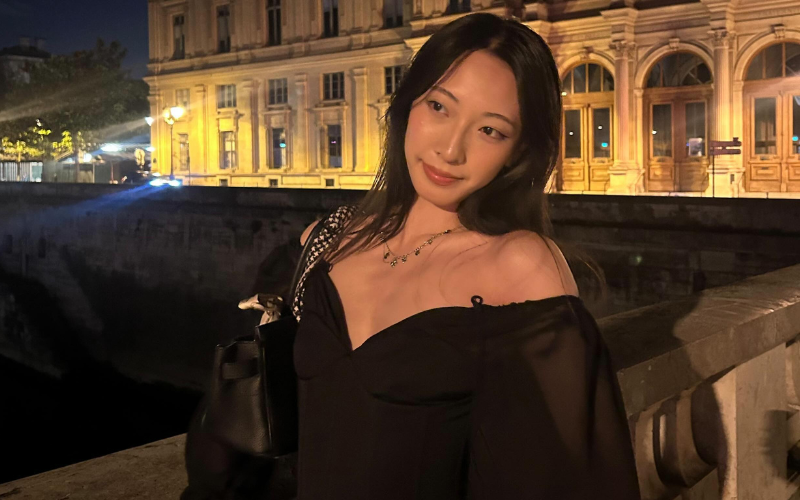
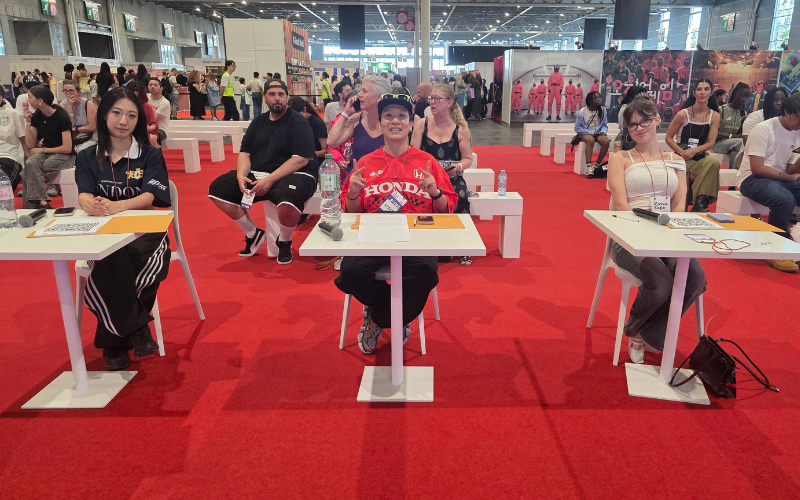
This year’s jury featured an exceptional lineup:
• JCO, Korean dancer and choreographer based in Germany
• Louna, rising figure of the French K‑Pop scene
• Delphine, dancer and instructor known for her experience and dedication
After intense performances, the results were announced:
• MIX’IN – First Prize
• UNLEASH – Second Prize
• JustYoungz – Audience Award
The other groups — Victory, YND, X‑CAPE, and La Vida Loca — also delivered remarkable performances, each bringing their own identity and style to the stage.
After the awards ceremony, we spoke with Delphine, jury member and founder of Novakill Studio, to gather her impressions and professional insights.
1. Could you briefly introduce yourself and look back on your background in K-Pop dance?
“I’m Delphine, dancer and instructor specializing in K-Pop dance, and founder of Novakill Studio, now recognized as the benchmark K-Pop dance studio in France. K-Pop has been part of my life since childhood, thanks to my sister who introduced me to this universe. I started with covers of Korean artists, then trained in various styles to refine my technique and develop my own artistic approach. Over the years, I’ve participated in many projects related to Korean culture, which allowed me to gain solid experience, both on stage and as a teacher. Today, what matters most to me is transmission: sharing work, creativity, stage performance, and above all, the joy of dancing.”
2. After more than eight years of practice and performances, what continues to motivate you in this world?
“Everything. Dance has always been my passion. I never imagined making it my job — I was originally studying engineering — but at 21, I took the crazy gamble of creating my own studio. Novakill Studio isn't even a year old and it has already become a benchmark, which is an immense source of motivation. What feeds me is diversity: artistic projects, stages, collaborations, weddings… each performance is an adventure. And then there is K-Pop itself, which is exploding in France. More and more people want to dance to their favorite artists, which creates events, competitions, a real community. But what touches me most are my students: seeing them progress, blossom, surprise themselves… that's what makes me want to continue every day.”
3. You teach K-Pop to children, teenagers, and adults. How do you adapt your pedagogy to each audience?
“Adaptation is at the heart of my profession. With children, the approach is playful: simplified choreography, repetition, kindness. The goal is for them to want to come back and experience the class as a moment of pleasure. With teenagers and adults, you need to know how to read your audience: some come to let off steam, others to progress seriously. So I create classes that speak to both: a motivating atmosphere, music they love, but also precise advice, personalized feedback, and full availability. Every student must feel that they can ask a question, rework a step, be supported.”
4. What characterizes the spirit of your school and your way of supporting students?
“The Novakill spirit is an energy: kindness, good mood, mutual support. Each class ends with a camera run where everyone gives their all, which creates a real collective pride. What sets us apart is also the quality of the supervision: all our teachers are professional dancers recognized in the K-Pop scene, but above all real pedagogues. We offer a space where students can live their passion seriously: progress, be challenged, but also be supported with rigor. Progression requires personal investment, and that's what we cultivate together.”
5. As a jury member, what were the main criteria you observed in the participants?
“I observe several levels. Individually: technique, precision, mastery… but above all energy. What the dancer exudes often makes all the difference. In a group: synchronization, of course, but also cohesion — feeling that they dance together, not just side by side. And then there is this criterion that is harder to define: the ability to surprise. A performance that captivates from start to finish, that dares something, that leaves a mark.”
6. What impressed you the most in the performances of this edition?
“The general level. Honestly, it was above what we usually see in K-Pop competitions. You could feel that the groups came to win, and that changes everything. What touched me was the visible investment: weeks of rehearsals, work, adjustments… all of that was felt on stage. It's this kind of performance that shows why the K-Pop scene in France is growing so fast.”
7. In your opinion, what elements are essential for a successful K-Pop performance on stage?
“Collective work: regular, serious, complete rehearsals. Technique alone is not enough: you have to manage stress, rely on your team, deal with the unexpected. And above all, determination. In K-Pop, details matter: music, outfits, overall visual… A memorable performance is thought out in its entirety.”
8. What message would you like to send to the groups who participated in the contest, whether they won or not?
“I felt your passion in every performance. I know what preparing for a competition represents: rehearsals, doubts, D-day pressure. You gave so much, and it showed. Keep performing, pushing yourselves, giving even more. Every performance like yours helps write the history of K-Pop in France.”