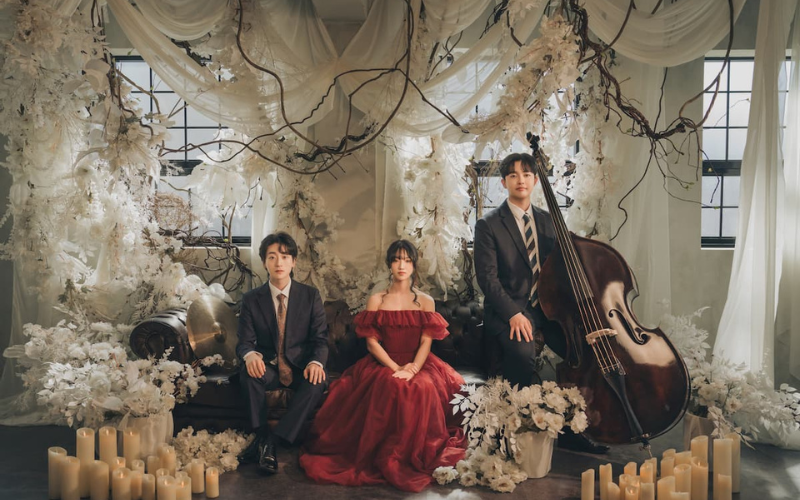
Cozy Jazz Office appears first as a discreet presence, almost silent, even before the music begins. The trio does not seek to occupy space by force or impose an image. Their way of being, like their way of playing, relies on a form of assumed gentleness, a way of slipping into the moment rather than disrupting it. When you discover them, you quickly realize that their relationship with jazz is neither theoretical nor demonstrative. Their music settles like an intimate conversation, a simple gesture, something that resembles an invitation rather than a performance.
This impression was confirmed during our exchange, an interview conducted by email on August 26. The three musicians never speak of their work as a technical exercise or a quest for virtuosity. They evoke scenes, glances, atmospheres. They recount moments when a listener, who had never listened to jazz before, confided in them that they had felt something new, sweet, and familiar. They remember concerts where an unexpected reaction in the audience was enough to direct the energy of a piece. Their music is not born in an isolated studio or an idea laboratory: it is built in real life, in exchanges, in tiny emotions that sometimes go unnoticed but which, with them, become notes.
This South Korean trio has chosen a particular path in a jazz landscape often dominated by the pursuit of novelty or technical demonstration. Their approach relies on familiarity. They start from melodies people already know, tunes that have crossed the years, songs that have accompanied life moments. They do not seek to radically transform them, but to reinterpret them with a delicacy that allows the public to enter jazz without feeling lost. This way of doing things, almost pedagogical but never condescending, reveals a deep understanding of what it means to 'share' music.
Talking with them, one understands that their ambition is not to revolutionize jazz, but to make it closer. More human. More accessible. They want people to feel welcomed, not tested. They want music to be a place, not a challenge. In a world where everything must go fast, where everything must be spectacular, their way of slowing down, listening, and creating a warm space appears as a form of gentle resistance — an invitation to rediscover the simple pleasure of being touched by a sound.
How would you like to introduce Cozy Jazz Office to someone discovering your universe for the first time?
Cozy Jazz Office: “We would like to introduce ourselves as a warm and accessible jazz group, wishing to show that jazz is neither difficult nor elitist, but a music that everyone can easily enjoy. We rearrange familiar melodies for many people, adding a jazz touch, to present them to the public. In a way, we are a group that plays music serving as a bridge between the general public and jazz.”
Is there an experience or an artist that has influenced your current musical identity?
Cozy Jazz Office: “The main reason Cozy Jazz Office has this identity is because we are musicians gathered around a common goal: reducing the distance between the public and jazz. Rather than citing a particular artist or experience, we believe that the members of the group, as well as the spectators we met and exchanged with during our concerts, are the greatest sources of inspiration for our current musical identity. In this sense, our members and our audience are our greatest artists and our most striking experiences.”
What is your approach to modern jazz, which is constantly evolving?
Cozy Jazz Office: “We approach music by focusing on 'familiarity'. We start from melodies known to the public, to which we add jazz arrangements and interpretations. Our goal is to allow people to enjoy jazz in a simpler and more natural way. By presenting familiar pieces in a new form, we hope to offer an opportunity to get closer to jazz.”
What emotion or atmosphere do you wish to convey through your music?
Cozy Jazz Office: “As the name Cozy Jazz Office indicates, we hope that those who listen to our music feel more 'cozy', more comfortable. We attach great importance to transmitting a warm and soothing atmosphere. During concerts, we add the energy and pleasure specific to live performance.”
How is a new piece born?
Cozy Jazz Office: “The work is generally led by our pianist. Based on everyone's inspirations, we first define the general direction of the piece. Then, the drummer and bassist add their ideas and musical interpretations. We often start with a basic arrangement, then we develop the piece naturally by playing together.”
Which element occupies the central place in your work: rhythm, harmony, improvisation, narration?
Cozy Jazz Office: “Improvisation is probably the most central element. We attach great importance to rhythmic and musical ideas spontaneously proposed by the members, as well as the development of the piece through improvisation. Rather than strictly following the initial arrangement, we often integrate ideas discovered during rehearsals and performances. Improvisation and musical communication between members are therefore essential in our work.”
Is there a landmark moment that influenced your artistic direction?
Cozy Jazz Office: “The most striking moment is undoubtedly the Jeongdong Night Walk festival. We had prepared covers of popular Korean songs and international pop, and the public's reaction was incredible. We still remember very clearly the energy of that day. This performance gave us the certainty that we were on the right track. The energy and confidence received that day became a driving force to continue our activities.”
Is there an artist you have collaborated with who particularly marked you?
Cozy Jazz Office: “We haven't collaborated with other artists yet. But great opportunities and proposals are coming, and we will soon realize superb projects with wonderful artists.”
How do you perceive the current jazz scene in Korea?
Cozy Jazz Office: “The Korean jazz scene today shows a lot of bold and varied attempts. As someone who loves jazz before being a musician, I am very happy to see these developments. Many artists create their own musical color by combining jazz with other genres or reinterpreting the traditional codes of jazz.”

Credits: © Cozy Jazz Office
According to you, what distinguishes Korean jazz from other countries?
Cozy Jazz Office: “It is difficult to define a single characteristic, but the ability to quickly absorb various musical elements and reinterpret them in their own way is one of the charms of Korean jazz. Combining jazz naturally with Korean popular music or traditional music is also a peculiarity of Korean jazz.”
Can you present a current or upcoming project?
Cozy Jazz Office: “We will present a special concert on October 9 at Cheongna Blue Nova Hall in Incheon. This concert will have the theme of the Korean script 'Hangeul', and we are preparing a fusion between jazz, Korean history, and traditional music. It's a new attempt for us, and we have high expectations for this project.”
Is there a concert, release, or collaboration you are particularly looking forward to?
Cozy Jazz Office: “The concert we are looking forward to the most is precisely the one at Blue Nova Hall. Thanks to the support of the Incheon Cultural Foundation, it will be free, allowing many people to come without hesitation and discover our new music. We are preparing with enthusiasm, and we hope for your support!”
Do you have a message for the international readers of Korea.net?
Cozy Jazz Office: “Dear Korea.net readers around the world! We are very happy to introduce Cozy Jazz Office through this interview. No matter where you are, we hope you are always happy. And we hope that one day, somewhere in the world, we can meet you and share our music with you. Thank you!”
What emotion do you want international audiences to feel through your music?
Cozy Jazz Office: “We hope our music conveys comfort, joy, and warmth, beyond differences in language and culture. And if our music can accompany even a small happy moment in your life, we would be truly delighted.”