
Literature holds a special place at this moment. We see it in figures, but also in conversations, fairs, and bookstores: readers are seeking something else—a way to feel, understand, and travel differently. Between 2021 and 2025, over 3.5 million Korean books were sold in Europe, a figure that speaks volumes. It reflects a growing interest in voices from Korea, for that very special sensibility found in its stories, poems, seasons, and silences.
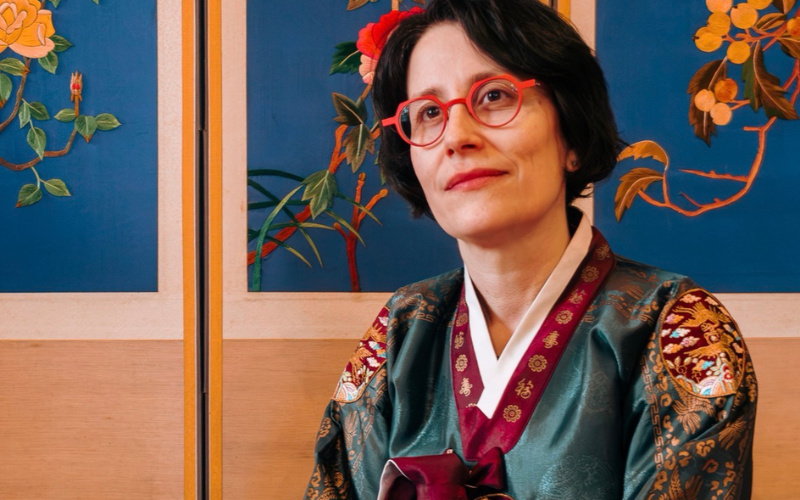
In my series dedicated to writers participating in this cultural dialogue between France and Korea, I wanted to highlight an author whose work touched me immediately: Céline Yula. An archivist, poet, and Korean language enthusiast, she has spent several years exploring what words can reveal about a country's soul. Her books do not talk about Korea through its monuments or major dates, but through its nuances, emotions, words, and seasons. An intimate, delicate, and almost meditative approach.
What struck me about her work is how Korean words open doors. Some of them seem to contain more than just a definition: a story, a way of thinking, a way of being in the world. Céline Yula transforms them into poetry, reflection, and breath. This is precisely what makes her writing so unique. We conducted an email interview with the author on July 22 to understand what led her to write Mots de Corée, what inspires her, how she perceives the public's response, and what she is preparing for her upcoming book set to be released on August 28. A remote encounter, yet filled with sensitivity, gentleness, and depth.
Céline Yula: My name is Céline Yula, and I am an archivist and author. For several years, I have been passionate about Korea: its history, culture, and language. What started as simple curiosity became a true source of inspiration. The more I learned, the more I discovered a country of incredible richness, where words, stories, and even seasons tell a unique way of seeing the world. I discovered sijo, a traditional Korean poetic form composed of three lines, and this form of writing deeply touched me. In very few words, it suggests more than it tells and leaves space for the reader. This demanding simplicity suited me. That is how my first two collections were born, Les saisons invisibles and Le retour des saisons intérieures, entirely composed of sijo. As I continued learning Korean, I realized that certain words contained far more than a simple definition. They spoke of emotions, human connections, and a way of observing the world. Some stayed with me for days. I told myself they conveyed something we all feel, but rarely express in French. This reflection gave birth to Mots de Corée, a book guided by Korean words and rhythmized by the twenty-four traditional solar terms, the jeolgi. They illustrate an idea I cherish: the deepest transformations are often the most subtle.
Céline Yula: What inspired me most was the impression that Korean words keep a touch of mystery. We often try to translate everything word for word, but certain terms lose something when we attempt to find an exact equivalent. They carry a story, a way of thinking, sometimes even a way of being in the world. These words invite us to feel rather than define. They open up reflections rather than providing ready answers. This idea deeply marked me. The jeolgi also inspired me. In Korea, attention is paid to almost imperceptible changes: the awakening of insects, the first dew, the rain that nourishes crops. This way of observing the world touched me. It reminds us that the most significant transformations are often the quietest ones. With Mots de Corée, I wanted to extend this sensibility by letting Korean words guide each poem. They became the thread of the book, messengers between language, culture, and emotion.
Céline Yula: I didn’t want to convey a message in the sense of convincing anyone. I wanted to share an experience. When learning a foreign language, you discover vocabulary, but sometimes also a new way of thinking. That’s what happened to me with Korean. I would like readers to feel this: that a single word can be an open door to an entire culture. The Korean language often invites us to pay attention to what is discreet: a silence, an unspoken emotion, a bond built over time, a season changing almost unnoticed. In our daily lives, we easily pass by these small things, even though they are often the most important. If the book makes people want to slow down, look at their surroundings differently, or discover Korea with a more sensitive gaze, then I will have achieved my goal.
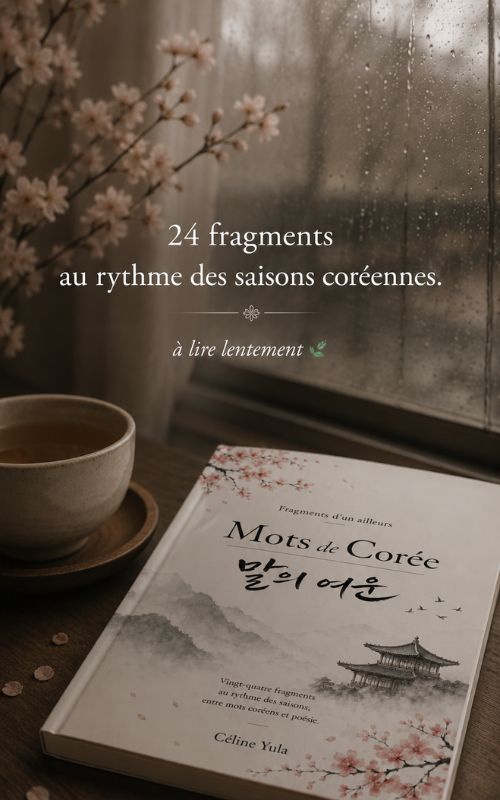
Céline Yula: I did not expect to receive so many messages. The sijo is an ancient, precious, yet little-known poetic form in France, and sometimes even in Korea. Yet, many readers wrote to tell me they discovered a side of Korea they didn't know. Some shared that they open the book at random, read a few pages, and close it to return to it later. That is exactly how I had imagined it. What touched me most were readers who said they wished some poems would continue. That is one of the features of sijo: it suggests more than it tells, leaving room for the reader, their imagination, and their story. Two people can read the same poem and find completely different meanings. It is a universal form of language. These exchanges are my favorite part. Some readers talk about a word that struck them, others have started learning Korean, and others want to know more about the culture. A book continues to live through those who read it.
Céline Yula: This is probably the hardest question, because I really want to talk about it... but also want to keep the surprise! What I can say is that it will be different from my first three books. This time, it’s not poetry. I wanted to explore another way of writing and another way to share Korea. This new work mixes history, beliefs, culture, and everything passed down on the margins of major historical events. It is a project that accompanied me for many months, involving extensive research and emotion. It will be able to touch a wider audience, both enthusiasts and those who wish to discover Korea differently. For the rest, I prefer to let readers discover it on August 28. There is something very pleasant about opening a book without knowing exactly where it will take us.
Céline Yula: A book allows you to discover a country in a very unique way. When traveling, you see landscapes, taste cuisine, visit places. But books bring us into something more intimate: how a people tells its stories, views the world, and transmits its values. Literature reminds us that even if our cultures are different, human emotions mirror each other. We can be touched by a story from the other side of the world because it speaks of universal truths. If my books make people want to discover Korea differently, with curiosity and without preconceived ideas, then I will have added my small stone to this dialogue between our two cultures.
Céline Yula: I would tell them to take their time. Today, we often want to discover everything very quickly. Korea is a country that deserves to be savored. The more you get to know it, the more you realize how much remains to be discovered. I do not consider myself someone who holds absolute knowledge about Korea. I am above all a person who continues to learn. That is what fuels my desire to write. I hope my books inspire readers to follow their own path: learn a few words, read Korean authors, take an interest in history, or perhaps prepare a trip. Korea taught me that a word can sometimes open an unexpected horizon. I hope my books do the same: open a door. Then, everyone chooses their own path.
Connect with Céline Yula
Follow her creative journey and literary explorations on Instagram:
Céline Yula Instagram (@tutti_korea)