
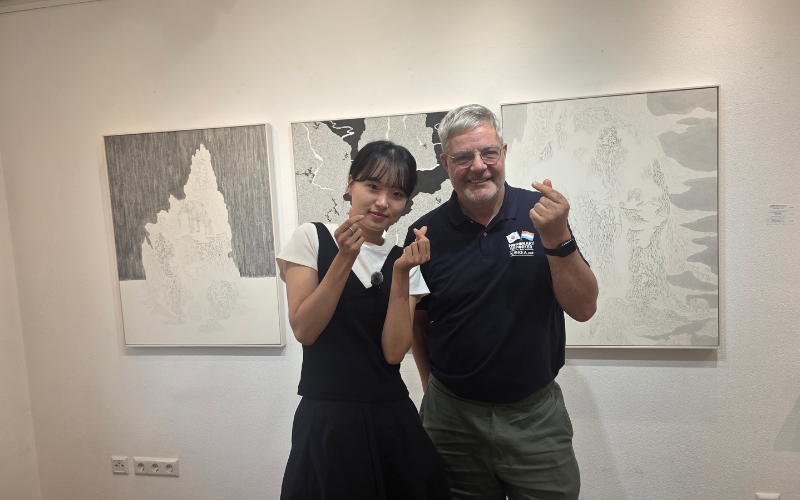
The gallery was calm and welcoming, and her presence added a quiet sincerity to the experience. Speaking with her in person revealed an artist who approaches both nature and memory with sensitivity, and whose works carry this same gentle and thoughtful energy.
Her paintings — elephants resting in open landscapes, monochrome scenes created with traditional ink — invite viewers to slow down and observe without pressure. The balance of forms, empty spaces, and textures reflects a way of seeing that is both simple and deeply emotional. This exhibition, prepared during her first visit to Europe, marks an important moment in her artistic journey.
1. How would you describe the core theme and message of the exhibition “RESONANCE”?
Bogyeong Choi: “The title RESONANCE carries the meaning of two artists with different artistic worlds meeting in one shared space — ArtsKoCo Gallery — and creating a new resonance together. Each artist uses different materials and methods of expression, but when their works are placed side by side, they create a new atmosphere. I hope visitors can feel the new resonance created by the two artists.”
2. What meaning is carried by the recurring forms and colors in your works?
Bogyeong Choi: “Elephants appear repeatedly in my work. They serve as a way to step away from a human-centered perspective and to think about the lives of other beings. For color, I mainly use traditional East Asian ink, expressing my works in black and white. When I look at a painting or a landscape, I tend not to remember the colors vividly. Over time, memories remain like old black-and-white photographs with the colors faded. This personal way of remembering naturally led me to work with ink.”
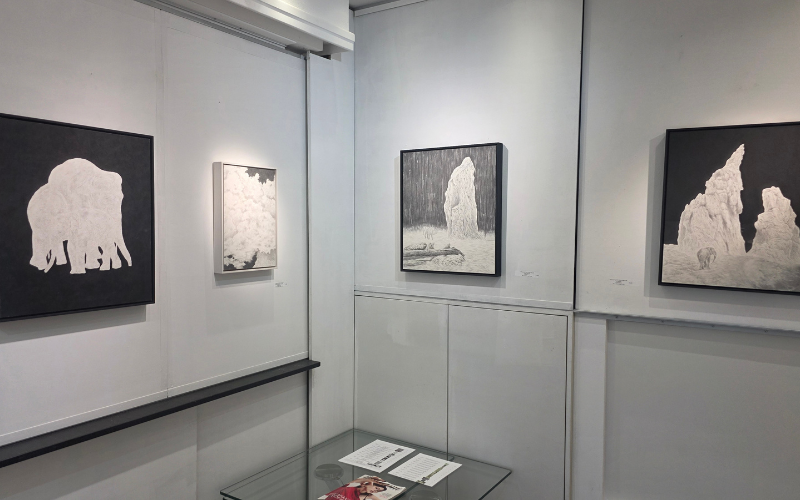
Exhibition space view © Jason Edwards
3. What is the most important element for you when creating a piece?
Bogyeong Choi: “The most important element for me is composition. The atmosphere of a piece changes depending on how the elephant, mountains, water, and empty space are arranged in terms of position and size. I especially consider the overall flow and balance so that the viewer’s gaze can move slowly across the image.”
4. What led you to choose the title “RESONANCE”?
Bogyeong Choi: “Although the two artists’ works are different, I believe there is a point where they connect in their attitude toward nature and life. Each work has its own independent voice, but I hoped that, within one shared space, they would influence each other and create a new sensory experience. That is why I chose this title.”
5. What was the most challenging part of preparing this exhibition?
Bogyeong Choi: “This exhibition was my first visit to Europe and my first residency program, so preparing the exhibition in an unfamiliar environment was the biggest challenge. I had concerns about unfamiliar aspects such as transporting and installing the works, and communicating locally. However, thanks to the help and kindness of the people around me, I was able to prepare step by step, and adapting to a new environment became an enjoyable and meaningful experience.”
6. Could you share an experience or person that has deeply influenced your artistic world?
Bogyeong Choi: “A scene I witnessed in Bangkok, Thailand in 2012 became the starting point of my work. At the time, I saw an elephant being hit by its handler as part of a tourist attraction called ‘elephant trekking.’ I felt a strong emotion, as if the elephant’s pain was being transmitted to me. That moment stayed with me for a long time and made me think about the lives of animals used for human convenience and about human-centered perspectives. I began to wonder what the life of a being outside human needs and usefulness might look like, and this led me to paint elephants walking and resting freely in nature.”
7. What do you hope viewers feel or think when experiencing your work?
Bogyeong Choi: “I hope viewers feel a sense of comfort when looking at my work. Without any fixed answers, I want them to appreciate the pieces freely according to their own experiences and emotions. I hope they can pause for a moment in front of the work and discover their own senses and thoughts.”
8. Is there a piece in this exhibition that you feel particularly attached to?
Bogyeong Choi: “I have affection for all my works, but among the pieces in this exhibition, I feel most attached to A Gentle Rest. It depicts an elephant resting peacefully, and it is also my mother’s favorite painting. After seeing this piece, my mother suggested that we create a picture book together. She would write the text as a poet, and I would create the illustrations. Someday, I hope we can make that book.”
9. Could you share any upcoming projects or directions you plan to explore?
Bogyeong Choi: “I have a solo exhibition scheduled for December this year at Gamo Gallery in Seoul. Based on my existing work with hanji and ink, I plan to experiment with textures using glue and explore various compositions. Through this solo exhibition, I hope to gradually expand the scope of my work.”
10. Lastly, is there a message you would like to share with international viewers and Korea.net readers?
Bogyeong Choi: “I am very grateful to be able to introduce my work to international readers through Korea.net. I hope this interview helps people remember that there are Korean artists who work with hanji and ink in this way. I will continue working steadily and look forward to sharing new pieces in the future. Thank you.”