
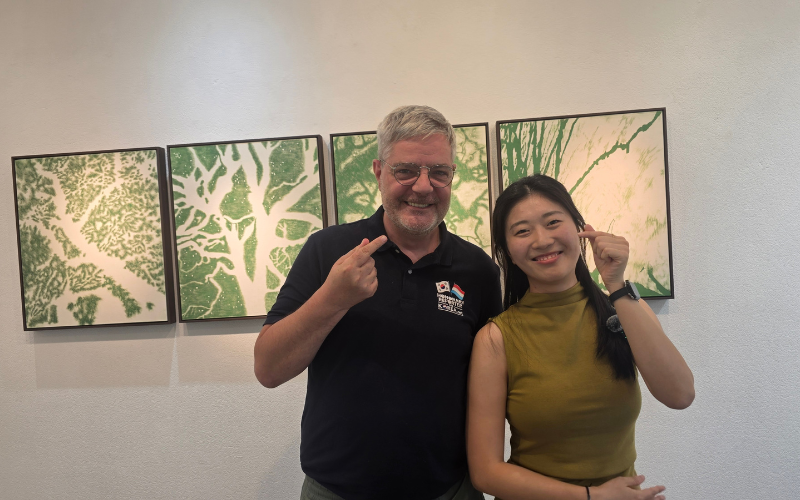
Her paintings don’t try to impress at first sight. They approach you quietly, almost discreetly, and yet they stay with you long after you leave the room. Standing in front of her pieces, I felt the same calm strength she carries when she speaks: a sincerity rooted in nature, memory, and the subtle emotions that shape everyday life.
During our conversation, Biro Kim shared her thoughts about the exhibition, her creative process, and the ideas behind the recurring forms and colors in her work. What follows is a glimpse into an artistic universe built on silence, patience, and the desire to leave a lasting resonance in the viewer’s mind.
1. How would you describe the core theme and message of the exhibition “RESONANCE”?
Biro Kim: “RESONANCE expresses the idea that different perspectives and forms of expression can meet and create a single, shared vibration. I try to resemble the nature I observe. Nature remains quietly in its place, yet it constantly changes and grows. My work also aims to approach viewers gently, leaving a lasting resonance deep within their hearts rather than speaking loudly.”
2. What is the meaning behind the recurring forms and colors in your work?
Biro Kim: “The trees that repeatedly appear in my paintings are beings that hold time and memory, and they serve as symbols reflecting both nature and humanity. To express this, I developed my own technique called ‘Sooppil (Forest Brush)’. Sooppil is inspired by the traditional ink techniques galpil (dry brush) and geonpil (broken brush), transforming the texture, flow, and vitality of the forest into brushstrokes. The repeated brushstrokes do not aim to depict the shape of a tree, but rather to layer the time, memory, and flow of life contained within the forest onto the canvas.
The black ink, which spreads and seeps while its tones shift, captures the breath of nature and the passage of time, while the green used in the painting symbolizes life, growth, and the connection between humans and nature.”
The black ink, which spreads and seeps while its tones shift, captures the breath of nature and the passage of time, while the green used in the painting symbolizes life, growth, and the connection between humans and nature.”
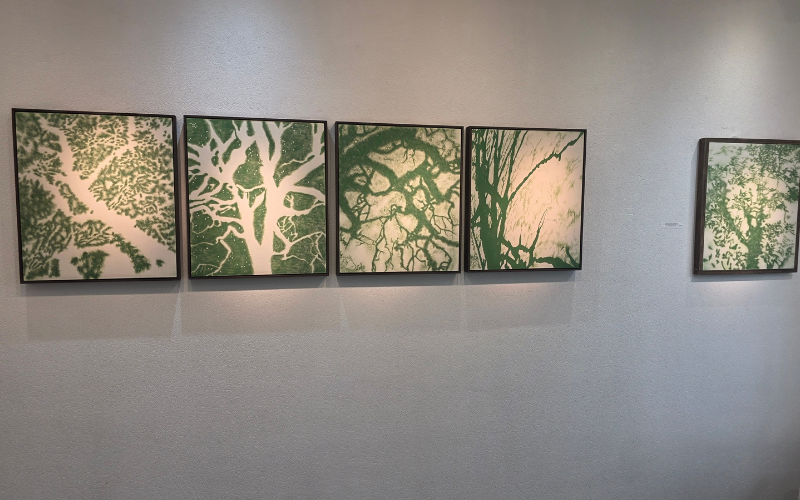
Exhibition space view © Jason Edwards
3. What is the most important element for you when creating a work?
Biro Kim: “For me, the most important element is emotion. Art is a way of conveying inner feelings that are difficult to express in words. Just as musicians express through sound and writers through language, I try to capture invisible emotions and moments through painting.”
4. Why did you choose the title “RESONANCE”?
Biro Kim: “RESONANCE reflects the idea that different artistic perspectives can meet and create a shared vibration. Since the works of various artists come together in one space and form new sensations and stories, I felt the title suited this exhibition very well.”
5. What was the most challenging part of preparing for this exhibition?
Biro Kim: “The biggest challenge was presenting my work in a foreign country, outside the spaces I am familiar with. I felt both excitement and tension, wondering how my work would be received in a different cultural and linguistic environment. But communicating with viewers in a new space made the experience deeply meaningful.”
6. Are there experiences or artists that have significantly influenced your artistic world?
Biro Kim: “Rather than one specific experience, the small moments and emotions encountered in everyday life are the most important sources of my work. The feelings and memories that arise during ordinary days accumulate and eventually become artworks.
Among the artists I respect, I admire Park Neung-saeng the most, who continuously presents new possibilities for Korean painting. I have been greatly influenced by his perspective on nature and his way of interpreting traditional ink painting in a contemporary manner. I also draw much inspiration from the deep natural expressions and compositional approach of Western painter Cha Gyuseon.”
Among the artists I respect, I admire Park Neung-saeng the most, who continuously presents new possibilities for Korean painting. I have been greatly influenced by his perspective on nature and his way of interpreting traditional ink painting in a contemporary manner. I also draw much inspiration from the deep natural expressions and compositional approach of Western painter Cha Gyuseon.”
7. What do you hope viewers feel or think when they encounter your work?
Biro Kim: “I hope my paintings become a quiet space where viewers can reflect on their own emotions. Just as nature changes and grows, humans also accumulate various feelings throughout life. I hope viewers can pause for a moment in front of my work and revisit their own memories and emotions.”
8. Is there a particular work in this exhibition that you feel most attached to?
Biro Kim: “My most cherished work is Today, Forever to Tomorrow II (181.8 × 227.3 cm). Although it is not included in this exhibition, among the works currently displayed, I have a special affection for Portraits of Trees. Just as people have different faces and atmospheres, I believe trees also carry unique appearances and stories. In this space, their presence feels even more special.”
9. Could you share any upcoming projects or directions you are planning?
Biro Kim: “There are difficult moments in the creative process, but the joy and comfort I gain from painting motivate me to continue. I hope to keep creating sincere works and grow as an artist who paints for a long time. After returning to Korea, I will focus on preparing new pieces for my solo exhibition scheduled for November this year.”
10. Finally, is there a message you would like to share with international visitors and Korea.net readers?
Biro Kim: “Thank you sincerely for taking the time to visit the exhibition and look at my work. I hope my paintings become a small bridge that connects memories and emotions beyond language and cultural differences. I will continue expressing the moments I discover in nature and in life with sincerity.”