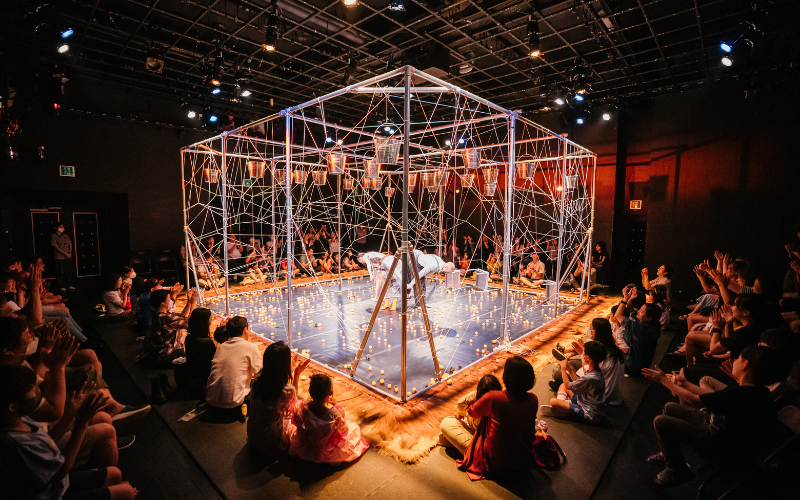

Every year, the ASSITEJ Korea Festival brings a special energy to the venues it settles in. Upon arrival, you don't just discover a program, but an atmosphere: children running between workshops, artists adjusting sets at the last minute, volunteers guiding families, and a warm bustle that gives the feeling that everyone is part of something bigger. You feel that the festival lives through the people who cross its path.
Covering this edition made me realize how important theatre for young audiences is in Korea. It is not a "minor sector" or a secondary domain: companies take risks, test new forms, and tell stories that touch children as much as adults. I saw artists explain their work with disarming sincerity and pedagogical teams talk about theatre as an essential tool to help young people understand their emotions, their environment, and sometimes themselves. You quickly realize this festival is not just a cultural event: it is a space where Korea transmits something deeply human to its younger generations.
To go further, I had the opportunity to interview the President of ASSITEJ Korea in writing on July 28. The encounter was simple, unpretentious, yet very rich. They didn't just discuss festival objectives or upcoming projects; they shared a personal vision, their way of seeing theatre's role in children's lives, and their hopes for the coming years. Through these words, we better understand the stakes, ambitions, and sensitivity behind this work—a perspective that gives this edition its full depth.
1. Introducing ASSITEJ Korea
President of ASSITEJ Korea: ASSITEJ Korea (Korean National Center of the International Association of Theatre for Children and Young People) is a non-profit cultural organization founded in 1982. It works for the development of performing arts for children and youth, as well as for strengthening international cultural exchanges.
As the Korean section of ASSITEJ International, the organization aims to guarantee all children and young people access to quality artistic works and to create an environment where imagination, creativity, and cultural sensitivity can flourish.
Today, over 200 companies, artists, producers, researchers, and performing arts professionals are members of ASSITEJ Korea. The organization carries out initiatives in creation, training, research, audience development, and international cooperation. It also introduces foreign shows to Korea, supports the international distribution of Korean works, encourages co-productions, and strengthens the international competitiveness of the sector.
ASSITEJ Korea organizes three major annual festivals:
- ASSITEJ Winter Festival (January): Dedicated to the best Korean productions for young audiences.
- ASSITEJ International Summer Festival (July): Presents works from all over the world and fosters artistic exchanges.
- National Children's Theatre Festival (November): Where children themselves become creators and performers.
Internationally, ASSITEJ Korea collaborates with over 80 national centers worldwide. Building on this momentum, Korea will host the 22nd ASSITEJ World Congress and International Performing Arts Festival for Children and Young People in 2027.
2. Particulars of the 2026 Festival
President of ASSITEJ Korea: Korea is preparing for the 22nd ASSITEJ World Congress in 2027. The 34th ASSITEJ International Summer Festival in 2026 serves as the first stepping stone toward this global event.
The festival maintains its core commitment: presenting high-quality Korean and international performances to children, teens, and families. However, the 2026 edition introduces a major innovation: the See&Do – Young Spectators Troupe program.
This program is based on the idea that children are not mere spectators, but active participants who observe, question, interpret, and express their own ideas. Each performance is accompanied by activities tailored to its themes and aesthetics, before and after the show, designed separately for lower and upper elementary students.
Before the show, children explore the universe of the performance through imagination-stimulating activities. After the show, they share their impressions through discussion, drawing, writing, movement, or other creative expressions.
See&Do seeks to recognize children's cultural rights and creative capacities. It embodies the vision of the 2027 ASSITEJ World Congress, centered around the theme "Children's Voices".
Slogan: Brave Futures
Theme: Children’s Voices, Asia and Possible Worlds
3. International Perception & Evolution
President of ASSITEJ Korea: It is difficult to formulate a definitive evaluation as no official feedback has been issued by institutions, but international exchanges and professional networks reveal key trends.
First, Korea is currently one of the most dynamic Asian countries in performing arts for young audiences. Creation and international exchanges are highly active, and the steady arrival of young artists is deeply appreciated.
Second, Korea benefits from constant generational renewal. While several European countries and Japan are seeing a decline in young artists entering the field, Korea continues to attract new creators, maintaining a living, evolving ecosystem.
Third, the diversity of works is frequently highlighted: diversity of audiences (from infants to teens), diversity of contemporary themes, and diversity of artistic forms (theatre, puppetry, object theatre, physical theatre, hybrid arts).
Although Korea does not yet produce a high volume of globally recognized "masterpieces," it regularly offers works well above the international average. The dynamism of emerging artists points to a promising and competitive future for Korean performing arts for young audiences.
4. International Exchange Programs
President of ASSITEJ Korea:
- ASSITEJ International Summer Festival: Held every July, it is Korea's primary platform for young audience performing arts, presenting global shows and hosting professional networking, showcases, and meetings for international programmers.
- Collaboration with ASSITEJ International & National Centers: Korean artists regularly take part in the World Congress, Artistic Gatherings, international workshops, and professional networks, nurturing co-productions and international tours.
- ATYA Network (Asia Theatre for Young Audiences): ASSITEJ Korea plays a key role in this Asian network connecting festivals and theaters, encouraging joint projects, forums, and young creator programs.
- Preparation for the 2027 ASSITEJ World Congress: To be held in Suwon, gathering over 80 countries. The 2026 festival serves as a testbed for new cooperation models and child participation programs.
5. Message to the Audience
President of ASSITEJ Korea: ASSITEJ Korea festivals are designed for babies, children, and teenagers, with or without disabilities. They also welcome adults who retain a sense of childhood curiosity and imagination.
We consider children essential partners in the artistic process. Adults are invited to look through children's eyes, share their laughter, questions, and emotions, and talk freely after the shows.
Live performance transcends generational boundaries: children and adults experience different things, but these differences enrich dialogue and mutual understanding. ASSITEJ Korea aims to create a festival where all generations can reflect, feel, and grow together.
6. Future Projects & Vision
President of ASSITEJ Korea: The main upcoming project is the 22nd ASSITEJ World Congress, which represents a major challenge. The key issue is how the citizens of Suwon will welcome this international festival.
After more than 30 years of festivals in Seoul, the Korean public knows the value of young audience performances. But for the first time, an event of this scale will be presented in Suwon. Beyond the number of performances, the essential thing is to see how citizens perceive the importance of performing arts for children and youth.
President Bang Ji-young hopes this festival will expand societal recognition of youth performing arts. These works are not mere entertainment: they nourish children's imagination, sensitivity, critical thinking, and empathy, influencing their development and shaping society's future.
She hopes citizens, schools, and decision-makers will recognize the importance of cultural access for children, translating this awareness into sustainable policies that allow every child to benefit from high-quality artistic works.