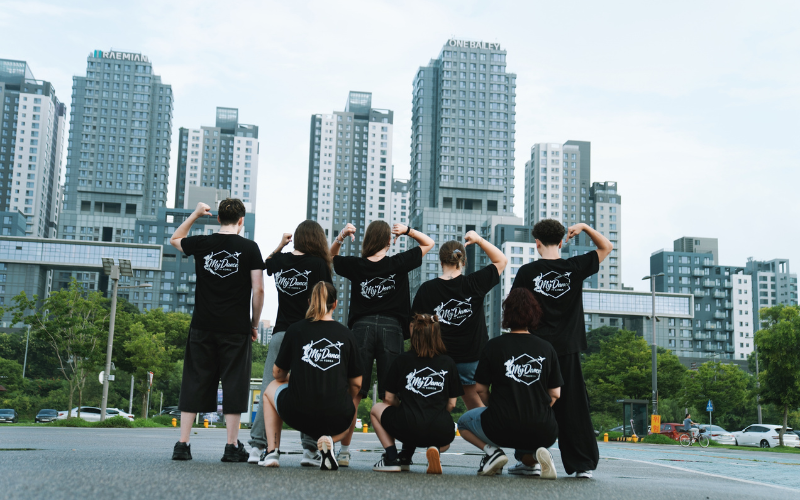
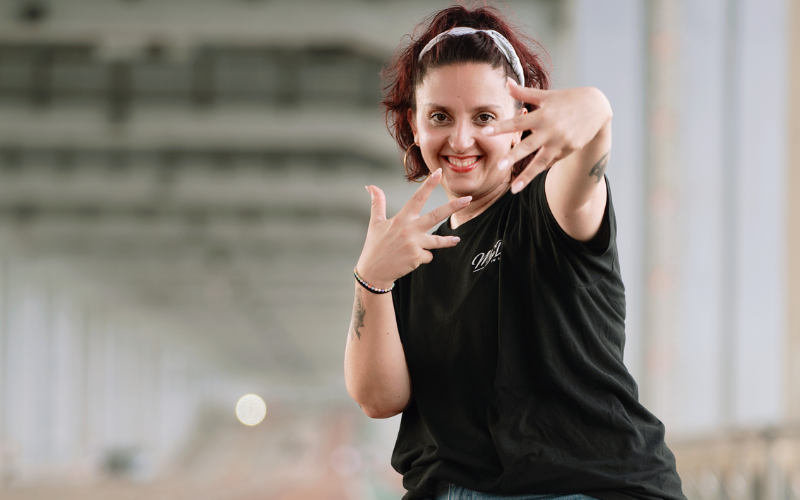
Mylène Desport never truly chose dance: dance chose her. From Angoulême, where she has taught for years, she has watched hundreds of students pass by—smiles, doubts, progress, and shows prepared amidst excitement and fatigue. For her, dance has never been merely a sequence of steps or choreography: it is a language, a way to push one's limits, to discover oneself, and to connect with others. And then there was Korea. A country that touched her far more deeply than she could have ever imagined, a place where dance is not a hobby but a true culture, an energy, a way of life.
When I discovered her project "MY’Dance in Korea", I immediately recognized that emotion that Korea evokes in those who encounter it. I too have felt this unique sensation: that blend of dynamism, gentleness, and creativity, this impression that every street, every studio, and every person has a story to tell. Korea is not a simple backdrop: it is an experience that grabs hold of you and never lets go.
This is precisely what Mylène wanted to convey: a journey where you dance, yes, but where you also discover Korea from the inside. Not just the studios, but the people, traditions, flavors, streets, and emotions. She wanted participants to leave with unforgettable memories, lasting moments, and impactful encounters. Listening to her, I found myself reliving my own memories of Seoul, Busan, and those moments when Korean culture envelops you without warning.
To build this project, she envisioned every detail: the identity of the trip, the objectives, the studios, and the atmosphere she wanted to transmit. Then "Hanguk en Voiture" and Kim Ah-ram arrived, bringing their knowledge of the country, their advice, and their field expertise. Together, they created a journey that feels like a breath of fresh air: a balance between dance, culture, and discovery, without ever rushing or getting lost. Just the right rhythm to let Korea enter everyone’s heart. And I know from experience how essential this rhythm is: Korea is best discovered when given the time to surprise us.
The hardest part? Finding that famous balance. How do you allow participants to dance in prestigious studios while leaving them time to discover Seoul, Busan, temples, markets, cafes, and landscapes? How do you coordinate transport, schedules, bookings, and unexpected events? It is immense, invisible, but essential work. And that is also what makes all the difference.
For this first edition, Mylène chose two iconic studios: 1MILLION Dance Studio and DEF Dance Skool. Two different universes, two teaching methods, two energies. 1MILLION is known worldwide for its choreographers and influence. DEF has been training trainees and future idols since 2002. She wanted participants to experience these atmospheres, learn from inspiring choreographers, and live what so many dancers dream of experiencing. Reading her account reminded me of my own visits to these places where creativity seems to vibrate right through the walls.
What does she hope participants will take away? Not just technical progress. She hopes they return transformed, more confident, more open, and more daring—thinking to themselves, “I lived something unique.” Because that is precisely what she wants to offer: an experience that changes something within you. And I fully understand that feeling: Korea has this power to transform you without you even realizing it.
Among the highlights, there is one she will never forget: a traditional Korean percussion workshop. The participants were touched, almost moved to tears, by the beauty of the instruments and what they represent. At that exact moment, they were no longer tourists. They were there, truly there, at the heart of Korean culture. Day after day, Korea became a second home to them. I smiled as she recounted this moment, because I too have experienced those times when Korean culture welcomes you as if you had always belonged there.
For Mylène, the growing interest in Korean dance and K-culture in France goes far beyond K-pop. People are discovering a demanding, creative, and warm culture. Social media opened a door, but the reality on the ground is even richer and deeper. It is this reality she wants to share. And it is also what I try to convey in my own content: Korea cannot be summed up just by what we see online—it must be lived.
Korea inspires her through its creativity, its high standards, and its ability to reinvent itself. With every trip, she returns with fresh ideas, renewed energy, and an even stronger desire to share. Over there, dance is an art, a commitment, a passion. And that passion is contagious.
As for the future, ideas are not lacking: new studios, new cities, exclusive meetings, cultural exchanges between Korean and French dancers, and even trips to other countries. Because for her, dance is a universal language. It transcends words, borders, and differences. It connects people. And that is precisely the spirit of "MY’Dance in Korea"—a spirit I deeply share, having seen firsthand just how much Korea can change a life.