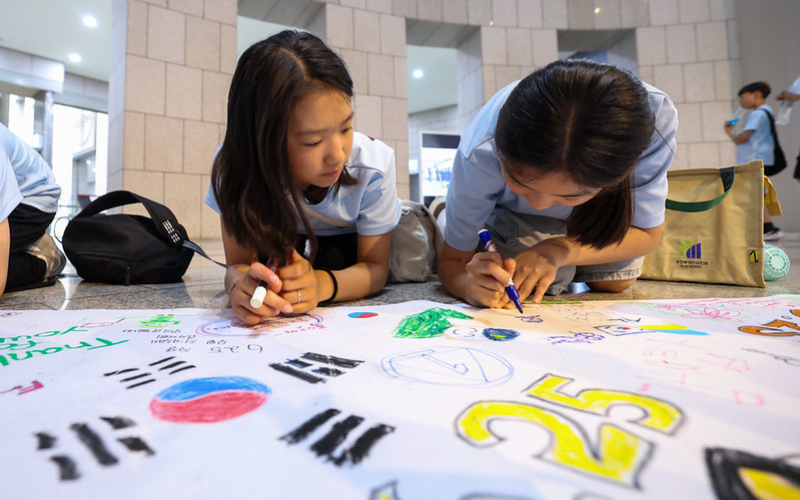
June 25 in Seoul felt like one of those days where history and the present quietly meet. At the War Memorial of Korea in Yongsan-gu, a long white banner was rolled out on the ground, and little by little, children gathered around it. No big speeches, no dramatic music — just kids with markers, crayons, and a kind of calm concentration that adults rarely manage to keep.
They started drawing whatever came to mind: flags, flowers, doves, hearts. Some wrote short messages, sometimes with spelling mistakes, sometimes with letters too big or too small. But every line felt sincere. You could see it in the way they leaned forward, in how carefully they chose their colors. Parents stood behind them, not telling them what to write, just watching. A few teachers explained why June 25 matters, but most of the emotion came from the children themselves.
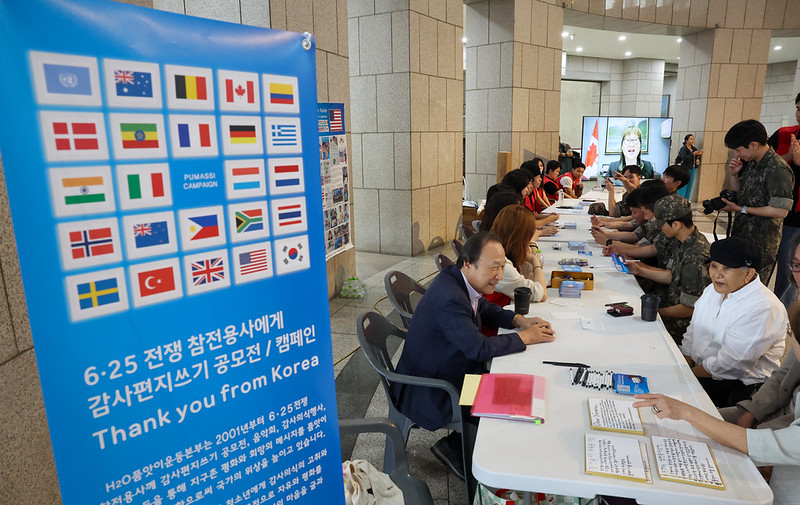
One little boy drew a soldier holding a Korean flag. A girl next to him wrote, “Thank you for protecting us,” in handwriting that slanted in every direction. Another child simply wrote “gamsahamnida" (Thank you - 감사합니다) and added a small heart. None of it was perfect, and that’s exactly why it touched everyone who passed by. Some veterans were there too. They didn’t talk much. They just watched. A few smiled, others looked down for a moment, as if the drawings brought back memories they didn’t expect to feel again. It was quiet, but not heavy — more like a moment of shared understanding between generations who never met but are still connected.
Looking at the children drawing on the banner, the sincerity of their expressions hits you right in the chest. In Europe, we say that “truth comes from the mouth of a child,” and here, you can see that truth in their drawings, in their songs, and in the way they try to say thank you with the few words they know.
This event wasn’t just about remembering the war. It was about passing something on — gratitude, respect, awareness. The children may not fully understand the scale of what happened in 1950, but they understand kindness. And sometimes, that’s enough to keep memory alive. For me, writing about this felt natural — almost like a responsibility. I’m from Luxembourg, a small country that sent 80 volunteer soldiers to help defend the Republic of Korea. Seeing today’s children thank those who fought for freedom reminded me that these connections, built in the hardest moments of history, still live on through simple, sincere gestures.