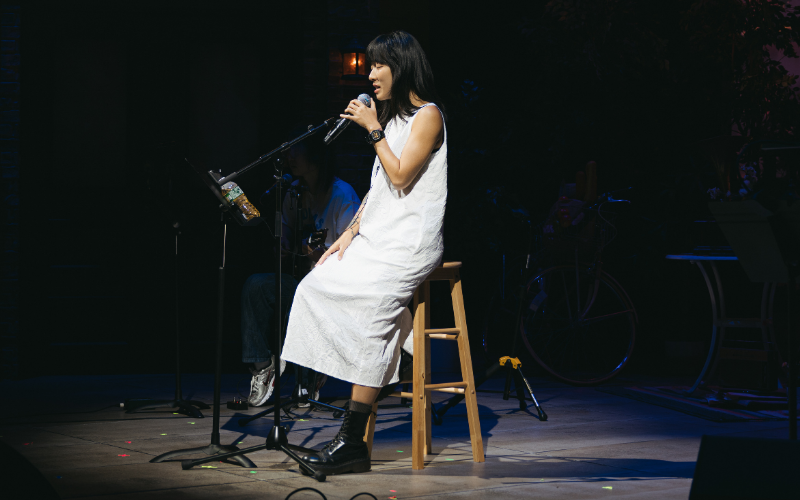
On August 19, 2026, Yozoh granted a written interview during her appearance at the K-Music Night concert, an event organized by the Korean Cultural Center New York (KCCNY), offering a rare glimpse into her artistic universe and the way she conceives music today. As an emblematic figure of the Korean indie scene, she has always distinguished herself by a particular sensitivity: a way of storytelling, singing, and feeling that never seeks to impress, but to touch with precision.
Through her answers, an artist emerges who moves forward calmly, far from noise and artifice. Her speech is measured, precise, sometimes almost minimalist, but each phrase carries a clear intention. Yozoh does not fit into a logic of performance or demonstration. She favors sincerity, nuance, and a form of gentleness which, with her, is never synonymous with fragility. On the contrary, this gentleness is a strength, a way of inhabiting music without distorting it.
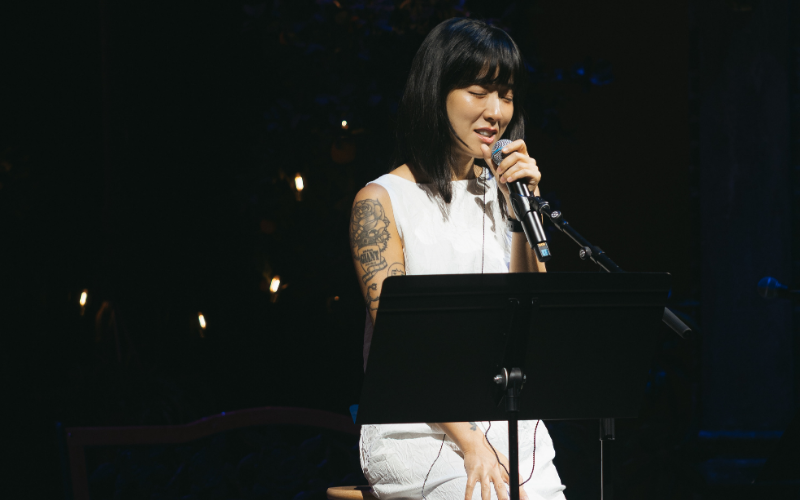
Credit: Jaegeun Park / KCCNY
The interview also reveals an artist attentive to discrete emotions, everyday details, and stories that do not seek to be extraordinary to be true. Her artistic approach relies on honesty: understanding what the song wants to say, what the words carry, and letting the voice transmit that without exaggeration. This way of working explains why her work continues to resonate with a varied audience, both in Korea and abroad.
Recalling her journey, Yozoh highlights transitions made of curiosity, encounters, and sincere choices. She dramatizes nothing, magnifies nothing. She simply recounts a path built with constancy and authenticity. The August 19 interview thus allows us to better understand an artist who, far from trends and expectations, pursues a personal, sensitive, and deeply human work.
1. Your work circulates between music and literature. How do these two universes influence each other?
Yozoh: “This always has a positive influence. For me, working on both writing and music sometimes feels like becoming ambidextrous. What satisfies me the most is being able to adjust the transparency of the message I want to convey. When I want to speak in a detailed, benevolent, and clear way, I use the techniques of literature; when I want to express myself in a vaguer, less explicit, or more opaque way, I use the techniques of music.”
2. Your performance created a very contemplative atmosphere. What emotions did you wish to evoke?
Yozoh: “I think it's simply because I am myself someone very contemplative, and showing myself naturally as I am led to this atmosphere.”
3. Your lyrics often explore inner life and moments of calm. How do you approach writing these introspective narratives?
Yozoh: “This connects a bit to my previous answer. When I have a story to tell, I first take the time to decide how far I want to unveil it and how to shape it. When I want to extend a story beyond its initial '100', I turn to writing; when I want to show only '50', I turn to music. The lyrics I let enter the world of music then become metaphorical, ambiguous, secret, sometimes voluntarily double-edged. I want people to understand my lyrics while interpreting them otherwise, to know and not know at the same time, to be able to get lost joyfully in this ambiguity. The song that best reflects this somewhat playful side of me is I Want to Make Fun (장난치고 싶어). I would be happy if you listen to it.”
4. Managing a bookstore is quite unique for a musician. How does this environment shape your artistic identity?
Yozoh: “Running a bookstore is, surprisingly, an activity that consists of 'listening a lot'. Under the pretext of selling books, I hear countless life stories. The question 'Which book would you like to buy?' naturally leads to 'What do you need?', 'How do you want to live?', 'What is worrying you?'. These are narratives I rarely heard when I only existed as a musician. I think all these stories, told by very different people, have guided me toward more humility and compassion.”
5. As an artist endowed with a literary sensibility, what does playing in New York represent for you?
Yozoh: “Having grown up in a small East Asian country, the world's major cities offered me an enormous amount of beautiful fantasies. New York is one of them. The New York of novels, films, and music has been like a good friend to me. Playing there is a bit like finally going to meet a pen pal with whom I've been exchanging letters since childhood — it's a simple joy and a sincere excitement.”
6. Are there any new musical or literary directions you wish to explore?
Yozoh: “I have never really made music with a clearly defined objective. I have always left a large place for chance, and that suits me, it amuses me. As for my future artistic orientations, I would like to entrust them to my future self, to my future world. If you interview me again one day, I can tell you more at that time.”