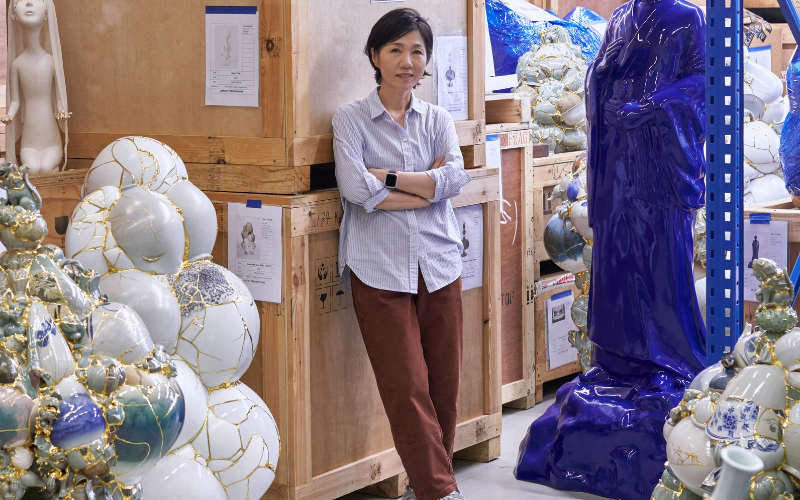
Following the interview with Haeyoung‑Yoomine Kim, exhibition curator at the Korean Cultural Center in Paris, who outlined the main axes of Colors of Korea, it was essential to focus on one of the artists who grant this exhibition its singular depth. Bringing together 34 Korean artists spanning diverse practices and generations, the event offers a rare overview of contemporary Korean creation. Among them, Yeesookyung holds a truly distinct place.
Her work is renowned for transforming ceramic fragments into entirely new creations, where memory, rupture, and reconstruction serve as central themes. Through her iconic Translated Vase series, she has developed an approach blending tradition, poetry, and reflection on what survives, vanishes, and reemerges. In Colors of Korea, her pieces continue this trajectory, introducing a sensitive dimension that offers a rich contrast to other works in the exhibition.
The artist agreed to answer several questions regarding her journey, her inspirations, and her perspective on how her work is received in France and across Europe.
1. Could you briefly introduce yourself and share how your artistic journey began?
Yeesookyung: “I have gradually expanded the scope of my practice to encompass a wide range of media—installation, sculpture, performance, video, painting, and drawing—guided by a rich and imaginative narrative sensibility. My work explores fundamental human questions, navigating themes such as past and present, life and death, reality and illusion, the sacred and the profane, the individual and the collective, as well as relationships between systems, societies, and different cultures. I draw upon personal experiences while taking inspiration from ancient mythologies and traditional stories.”
2. The artwork you present at Colors of Korea carries a powerful conceptual and emotional presence. What themes or ideas were you exploring in this piece?
Yeesookyung: “The Translated Vase series was first conceived in 2001. That year, while participating in the Albisola Ceramics Biennale in Italy, I discovered the poem Baekjabu, written by Kim Sangok in 1947. The poem celebrates the beauty of Joseon Dynasty white porcelain. A curator translated it from English into Italian and shared it with a local ceramic artist. My project involved asking that ceramic artist to create twelve vases in the style of 18th-century Joseon porcelain, relying purely on her imagination fed by reading the poem. The resulting works became hybrid creations, fusing time and tradition. Upon returning to Korea after the exhibition, I visited a ceramics workshop where I witnessed an unforgettable scene: a master ceramicist, dressed in traditional white clothing, walked slowly toward his wood-fired kiln, inspecting each piece with meticulous care. Suddenly, he began smashing several of his creations. I froze, unable to comprehend what was happening. I later learned that these masters, in order to preserve the rarity and value of true masterpieces, destroy their own pieces. And in a country whose history has been marked by destruction, it was rare for such delicate objects to survive. My role is to gather these discarded fragments and intervene to build new narratives. The shards assemble, proliferating infinitely to form new structures. I fill the cracks with 24-karat gold leaf—a choice inspired by the fact that in Korean, the words for ‘crack’ and ‘gold’ share the exact same pronunciation: Geum. From the beginning, the concept of translation has been central to my work. To me, translating does not mean faithfully restoring an original meaning, but observing what emerges through interpretation, displacement, or even misinterpretation. At times, the gaps created by translation open up space for new imagination and fresh narratives. Translated Vase does not aim to restore an original vase. I combine fragments coming from different pieces to create an entirely new form. My understanding of the work has also evolved over time. Previously, I viewed Translated Vase as a process of healing, reuniting broken fragments to grant them a new shape. More recently, I realized that I was never broken, nor was I ever useless. The shards in my work are already complete beings, carrying immense energy and a long history. They are liberated from the anxiety of having to match an original form or the destiny of remaining intact. In the same way, we are complete when we recognize our interconnectedness—to the universe, to the earth, and to one another. Thus, my work is not about repairing something broken, but about recognizing this connection.”
3. Many viewers describe your art as poetic and deeply symbolic. How would you define your artistic philosophy?
Yeesookyung: “Love and interconnectedness. The more I work, the more I reflect on the spirituality residing within each of us. In the creative process, I feel that all beings are linked, and once we recognize this connection, we are already complete. In that sense, our bodies are sacred temples, and each person’s energy is like a luminous crown. I believe love is proof that we are alive, a lifeline connecting us to one another. This also stems from the nature of my process: my work does not consist of breaking or taking away, but of assembling, uniting, and gently bringing things together. Though I am a finite and mortal being, I hope to infuse my works with all the beauty I have discovered, thereby coming a little closer to the mystery of eternal life.”
4. What influences you most in your creative process—personal experiences, Korean heritage, materials, or something else?
Yeesookyung: “It is mostly everyday emotions and scenes that spark my imagination, but I am also drawn to religious artifacts and art. I frequently visit museums and churches even more than art museums, finding a great source of inspiration there. What I wish to crystallize in my work, I believe, is the fleeting time of beautiful things—things whose beauty is all the more poignant because they cannot last. And where do all the invisible beauties of the world reside if not in temples, shrines, churches, and shamanic ritual spaces? I have always been particularly drawn to sacred statues and religious paintings. In this finite life, I feel my calling as an artist is to explore questions such as: Where do we come from, where are we going? What values endure? What is eternal life?”
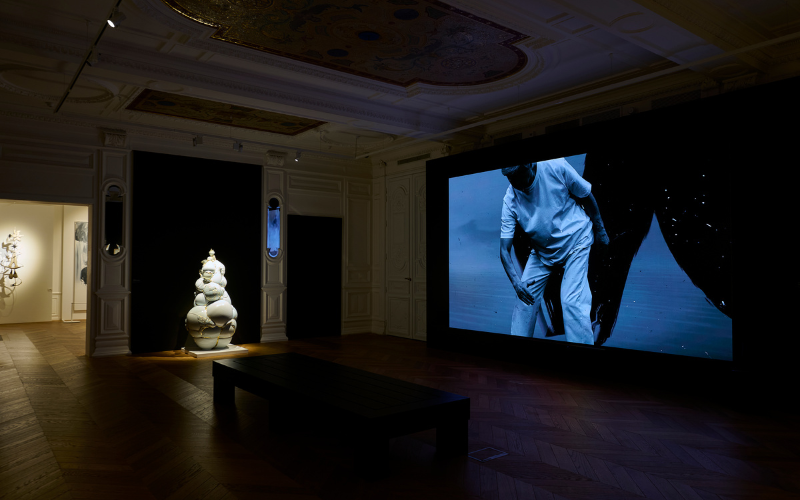
Detailed view of Yeesookyung's Translated Vase ceramic fragments © Korean Cultural Center
5. How do you feel about presenting Korean contemporary art to a French and European audience? Do you observe differences in interpretation?
Yeesookyung: “I am delighted to present Korean contemporary art in an art world long shaped by a Western, white, and male perspective. Although Korea, France, and Europe possess distinct cultural and historical contexts, I believe art holds the power to connect us beyond these differences.”
6. Could you share a memorable moment or challenge encountered while preparing for this exhibition?
Yeesookyung: “I don’t have a particularly memorable moment, as I tend not to look back. I prefer to focus on the works I still wish to create and the stories I want to tell. I am much more interested in what lies ahead of me.”
7. What message or feeling do you hope visitors take away from your artwork at Colors of Korea?
Yeesookyung: “When a vase breaks, it may mark the end of its life, but also the beginning of a new journey. While working, I often experience strange moments where randomly picked fragments fit together perfectly, as if by magic. And strikingly, this happens again and again. These moments grant me a form of enlightenment, revealing that we are all connected in the universe, just like these fragments. It goes beyond merely celebrating the imperfect and vulnerable aspects of the vase—it shows that everything has its place. In Translated Vase, the act of connecting fragments and reshaping them beyond their original forms becomes a metaphor for how misinterpretation can open new pathways of understanding. My process starts with fragments, often pieces from master ceramicists reproducing porcelain according to traditional methods. These ceramics carry considerable energy and tension, born of the earth, shaped by water, and transformed by fire into new entities. Yet, when a vase breaks, it loses its original function and perceived value. But at the moment of rupture, it is liberated from the constraints of its initial form and utility. To me, fragments are like seeds of a new life. Their cycle of rise and fall concludes, allowing them to enter a new phase of growth and transformation. By organically weaving and reconstructing these shards, each work becomes a site of resurrection, each vase encapsulating its own time and space.”
8. Do you have upcoming projects or artistic directions you wish to explore?
Yeesookyung: “Currently, I am conducting research on female folktales and mythologies from Southeast Asia, though it will likely take a few years before the work is ready to be produced and presented. Concurrently, the metaverse and AI are becoming inescapable environments shaping our perception of time and space. I believe it is essential to understand them, and I am exploring AI as a new space where I can expand my work as a storyteller.”