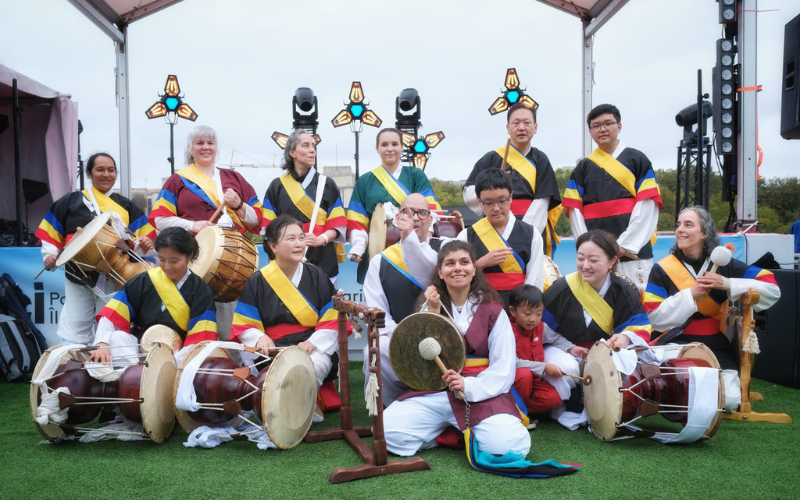
In recent years, I’ve noticed something that genuinely makes me happy: more and more people are showing interest in Korea beyond K‑pop and K‑dramas. There’s a growing curiosity for traditional culture, music, and heritage, and as someone who tries to highlight these aspects through my work, I find it both encouraging and meaningful. It’s one of the reasons why I wanted to speak with Wolyoil Samulnori.
Samulnori is built around four instruments that each bring a distinct color to the performance: the sharp, leading sound of the kkwaenggwari, the balanced rhythm of the janggu, the deep pulse of the buk, and the resonant warmth of the jing. Together, they create a musical structure that grows, accelerates, and pulls the audience into a very physical experience. It’s a form of traditional Korean percussion that deserves to be better known, especially here in Europe.
As Wolyoil prepares for the HEEMANG Festival—where they will also support the organization—I reached out to their leader by email on June 29, 2026, to learn more about their journey, their practice, and the way they bring these rhythms to life in France. What follows is the full interview.
Can you introduce Wolyoil Samulnori and explain what inspired you to create this group?
Wolyoil Leader: “Wolyoil is both a group and an association practicing Samulnori, traditional Korean percussion. The oldest members of the team were already playing Samulnori in another group at the time, and we decided to create a new ensemble to get closer to what is done in Korea, with more discipline. Above all, it is our love for Korea and its arts that brought us together.”
How did you discover Samulnori, and what attracted you to this traditional Korean art?
Wolyoil Leader: “It happened completely by chance. The group I mentioned earlier, “Olsou,” used to rehearse right across from my home. I attended several rehearsals, and little by little, the driving rhythms spoke to me more and more and sparked my interest. I knew very little about Korea at the time, and it is thanks to Samulnori and the Koreans I met that I continued—now for 18 years.”
How is your team structured today, and how do you choose instruments or roles?
Wolyoil Leader: “Samulnori is the performance of four instruments, so we have at least four players for the four instruments: kkwaenggwari, janggu, buk, and jing. But we are more than four; usually at least seven, and depending on the occasion, between ten and fifteen. Everyone has their preferred instrument but may be asked to play another depending on needs and the number of players. As part of the original team, I was trained to play all four. Typically, we have 3 buk, 3 janggu, 2 jing, and 1 or 2 kkwaenggwari. But we can go up to 5 buk, 7 janggu, 3 jing, and 2 kkwaenggwari. As the leader, I play the kkwaenggwari, but my original specialty is the buk.”
What makes Samulnori unique for a European audience?
Wolyoil Leader: “It’s the shamanic rhythms, similar to heartbeats. It always starts very softly, and the audience is gradually carried along as the speed increases. It’s unlike anything else. It’s not music that makes you want to dance like African percussion, but music that makes you want to shout and cheer, like during a race—that’s the difference.”
How do you prepare for a performance?
Wolyoil Leader: “Every Saturday we have a two‑hour rehearsal for beginners, semi‑beginners, and advanced players, and on Monday evenings, rehearsals for expert players. Additional rehearsals are organized before events when possible. We assign roles and instruments depending on the number of players, the pieces we will perform, and the variations we plan to add. The speed of execution as well, because it is our trademark—playing pieces at a sustained tempo, as is done in Korea, to make it as impressive as possible. We always have energy because we love playing, and it usually shows on stage.”
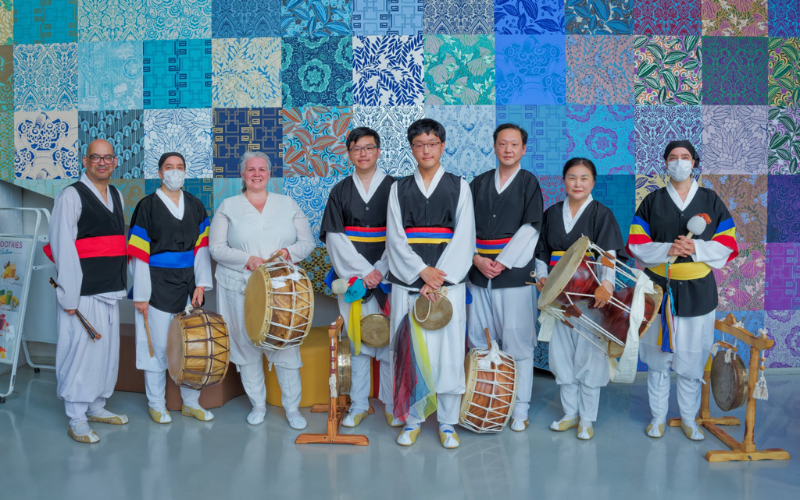
© Wolyoil Samulnori
What does your participation in the HEEMANG Festival represent for you?
Wolyoil Leader: “We are part of the organizing team—it’s a first for us. And we are performing for our friend A‑Jung Lim, the organizer. The venue is exceptional, and we hope to reach a new audience to help them discover Korea and its cultural richness.”
Have you planned something special for this festival?
Wolyoil Leader: “Yes, on Saturday late afternoon we will accompany Korean martial arts on stage—a very dynamic performance to showcase the best of what Korea has to offer.”
What message do you want to convey to the public?
Wolyoil Leader: “Korea is a wonderful country with so much to offer. Many people only know it through dramas and K‑pop, but there are so many beautiful things, like Samulnori. We invite people to be curious about Korea and all its aspects, especially its traditional music. And they can join us easily without being afraid of not knowing how to play. Samulnori is accessible at any age.”