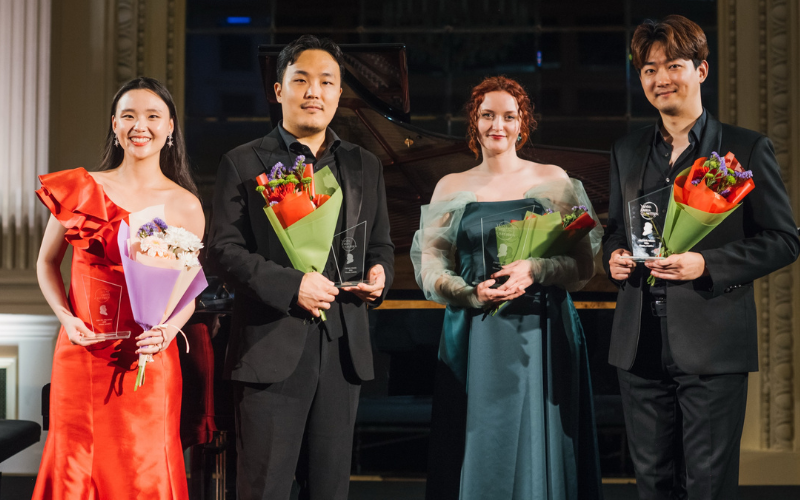
The Vienna Opera Competition 2026 took place this year within the subdued, timeless ambiance of the Grand Hotel Wien's Ballsaal. Young singers from various countries presented their craft before an international jury, each bringing their own distinct style, strengths, and vulnerabilities. Open to artists aged 18 to 32, the competition requires two selected arias, with an optional Mozart piece. Following selection, finalists are invited to Vienna for a concert on August 1st, broadcast live on YouTube. The event offers over 10,000 euros in prizes, but above all, a rare opportunity to perform in a hall steeped in history.
This year, several Korean artists particularly caught the attention. It has been noticeable for a few years now: Korea trains many exceptionally solid young singers, and their presence in European competitions is becoming almost commonplace. But here, in Vienna, they truly marked the evening.
© Vienna Opera Competition
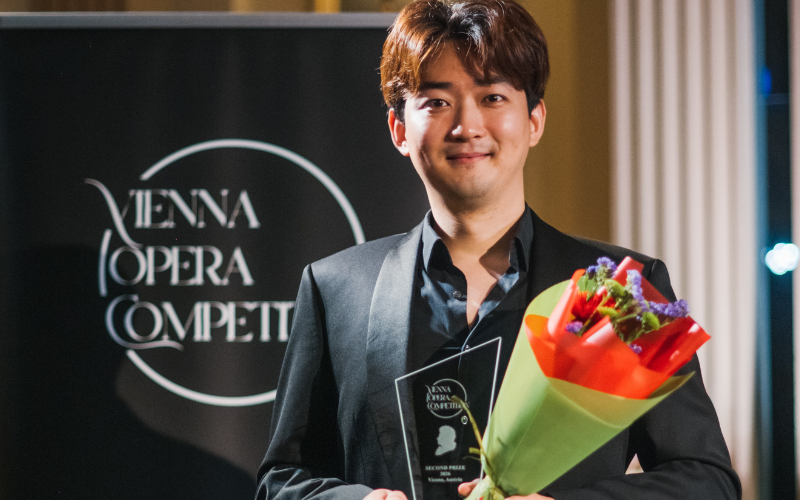
The Second Prize was awarded to Junoh Lee, whose interpretation struck with its clarity. He sang with a very clean line, free of excess, but imbued with a true musical intention. One senses in him a very precise, almost meticulous way of working, yielding a remarkably stable stage presence.
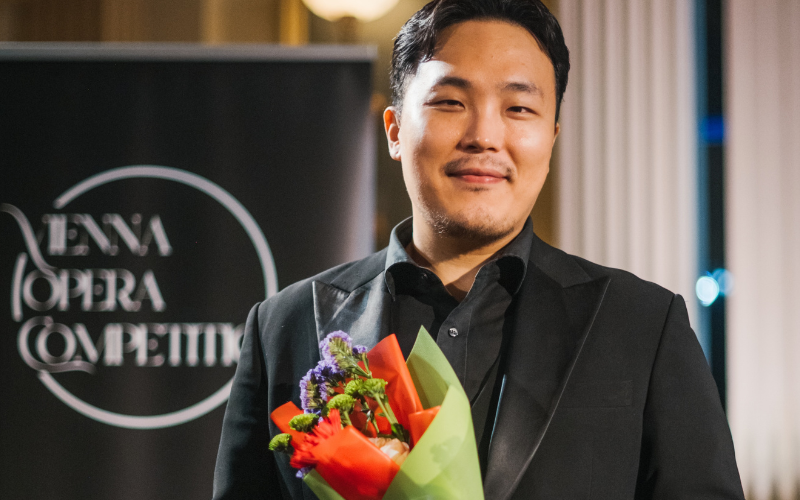
Junoh Lee - Second Prize Winner © Vienna Opera Competition
The Third Prize went to Mattia Hwaeum Lee, who brought a different color. Her voice possesses a unique light, alongside a stage demeanor that puts everyone at ease. Her performance was not ostentatious, but deeply sensitive, featuring thoughtfully crafted nuances. She is the type of artist noted for her tranquil presence.
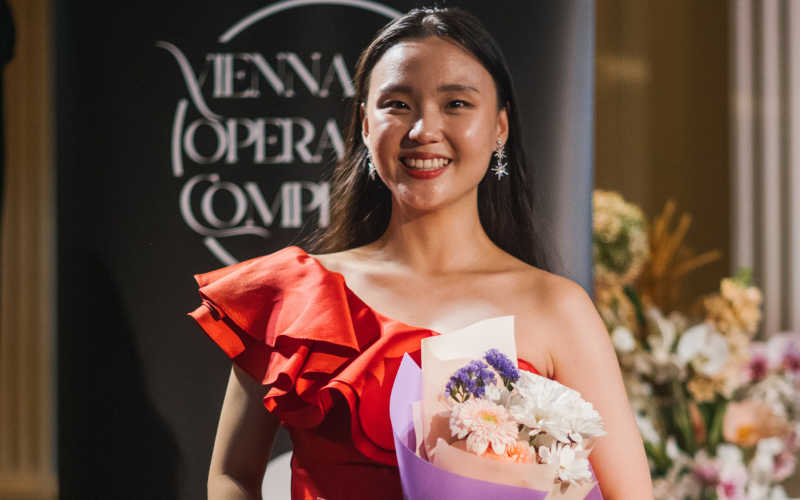
Mattia Hwaeum Lee - Third Prize Winner © Vienna Opera Competition
The Mozart Interpretation Prize was attributed to Hyejin Han, undoubtedly one of the moments that most deeply moved the audience. Mozart demands an almost surgical precision, yet also a lightness difficult to capture. She succeeded in combining both, with a remarkably natural phrasing. Nothing felt forced, which likely convinced the jury.
Seeing three Korean artists rewarded in the same edition is by no means trivial. It illustrates how dynamic the Korean lyric scene is, with a new generation arriving in Europe equipped with profound seriousness and a genuine desire to anchor themselves in the classical tradition. The Vienna Opera Competition 2026 is a simple yet clear illustration of this phenomenon.
Beyond the prizes, the event enabled finalists to perform in a venue that matters and to network with industry professionals. For Korean artists, this recognition in Vienna represents a significant step toward an international career. The performances of Junoh Lee, Mattia Hwaeum Lee, and Hyejin Han demonstrate that Korea continues to dispatch artists capable of asserting themselves on the most demanding stages.
In the coming weeks, the three Korean laureates will also be met for a series of interviews offering a deeper understanding of their backgrounds, their beginnings in singing, and their experiences during this 2026 edition. These conversations will offer a more personal view into their work, their ambitions, and how they approached this Vienna experience. The interview below was conducted in digital format on August 15, 2026, with Jesús León, Director of the Vienna Opera Competition – Artistic & Organizing Team.
Q1. Could you present the mission and vision of the Vienna Opera Competition?
Jesús León: “The Vienna Opera Competition was created with the mission to discover exceptional young opera singers and, above all, to offer them a meaningful platform at an important moment in their artistic development. Vienna possesses an extraordinary lyric tradition, and our vision is to connect this tradition to the next generation of international artists. We wish for the competition to be more than a simple occasion to award prizes. Our objective is to create opportunities for young singers to be heard by professionals of the international opera world, to establish relationships, and to cross an important milestone in their careers.”
Q2. How are candidates selected for the different stages of the competition?
Jesús León: “The selection process begins with an international application and video pre-selection. This year, we received over 250 applications from young singers around the world. From these applications, singers were selected through several stages, paying particular attention to vocal quality, technique, musicality, interpretation, individuality, and artistic potential. Finally, eight exceptional singers were invited to Vienna for the Final, where they performed their program live in front of our international jury. For us, it is essential that the final decision does not rely solely on the beauty or power of a voice, but on the complete artist we see on stage.”
Q3. What level of artistic excellence did you observe among participants this year?
Jesús León: “The level in 2026 was remarkably high. The eight finalists represented different countries, vocal ranges, musical traditions, and personalities, but they shared an impressive level of preparation and commitment. What was particularly encouraging was the individuality of the singers. Opera needs artists who have something personal to communicate, not just technically accomplished voices. This year, we heard several young artists who already possess a very strong artistic identity.”
Q4. What qualities do you look for in young opera singers today?
Jesús León: “Of course, vocal technique is fundamental, but a successful career today requires much more. We look for musicality, stylistic understanding, linguistic preparation, stage presence, emotional communication, professionalism, and above all, individuality. A singer must make us feel that there is a reason why they must sing this particular aria. Technique gives the artist freedom, but personality and communication are what allow the public to remember them. We also value curiosity, discipline, resilience, and the ability to collaborate. Opera is never created by a single person; it is an art built by collaboration.”
Q5. Was there a particular moment during the 2026 edition that left a mark on you?
Jesús León: “For me, one of the most memorable moments was the Final itself. After starting with over 250 applications, seeing the eight finalists finally standing on stage in Vienna and presenting themselves before the jury and the public was very special. There was also a wonderful spirit of support among the finalists. Although it was a competition, one could feel they respected each other as colleagues and artists. And, of course, the moment when the prizes were announced was extremely moving — not only for the laureates, but for everyone who had followed their journey.”
Q6. How does the competition support laureates in their careers after the event?
Jesús León: “This is an extremely important area for us. A prize should not simply represent the conclusion of a competition; ideally, it should mark the beginning of something new. In addition to financial rewards, we seek to connect laureates and remarkable participants with professionals of our international network and to create, when possible, opportunities for future performances and collaborations. Through our activities in Vienna and our relations with artists, casting directors, conductors, institutions, and other partners, we wish to continue following the development of our laureates beyond the competition itself.”
Q7. What are the main challenges related to organizing an international lyric competition in Vienna?
Jesús León: “Vienna is perhaps one of the most inspiring cities in the world to organize an opera competition, but this also creates a very high level of expectation. One of the biggest challenges is bringing together singers, jury members, pianists, venues, partners, sponsors, production teams, and audiences from different countries in a highly concentrated period. At the same time, maintaining artistic integrity is essential. Every singer who reaches this level has invested years of work into their career, so we have the responsibility to create a professional, respectful, and transparent environment in which every artist has the opportunity to present their best work.”
Q8. How do you envision the evolution of the competition in the coming years?
Jesús León: “We wish for the Vienna Opera Competition to continue developing internationally while preserving its personal character. Our ambition is not simply to become bigger, but to become increasingly significant for the artists who participate. We hope to develop more collaborations with opera houses, casting directors, festivals, orchestras, foundations, artist agents, and cultural institutions so that participation can lead to concrete professional opportunities. We also want Vienna to remain at the heart of the competition. There is something unique in the fact that young singers from all over the world come to a city that has played — and continues to play — such an important role in the history and present of classical music and opera.”
Q9. What message would you like to convey to young artists around the world?
Jesús León: “I would encourage young singers to remain curious, patient, and courageous. An artistic career is rarely a straight line. Competitions, auditions, successes, and disappointments are all part of a much longer journey. It is important not to measure oneself solely through prizes or immediate results. Develop your technique, study languages, understand the music and the text, listen to great artists, and learn from the people around you — but at the same time, discover what makes your own artistic voice unique. The world of opera does not only need beautiful voices. It has needs for artists who have something genuine to say.”