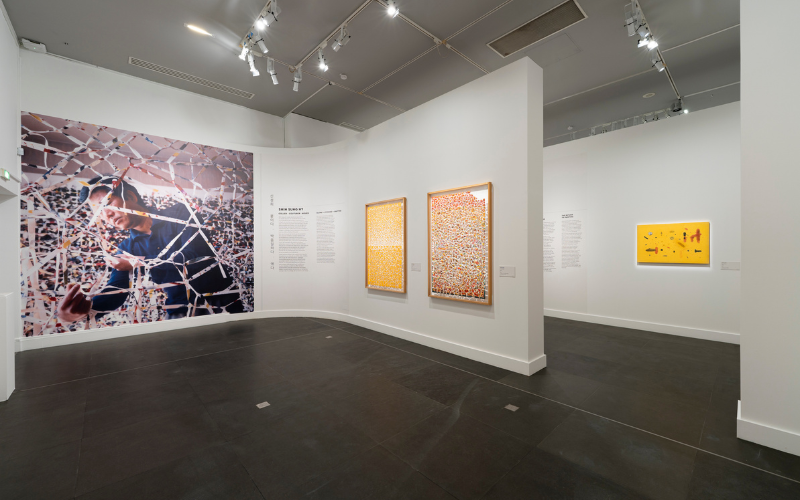
While visiting the Musée Cernuschi to follow initiatives related to Korean art in France, the exhibition dedicated to Shin Sung Hy stood out as an essential subject to explore. The artworks, made of torn, resewn, or knotted canvases, immediately catch one's attention, demonstrating a highly distinctive way of approaching painting. They also reflect the path of an artist who worked in France for many years, often outside of the most visible public channels.
To gain a clearer perspective on this exhibition and Shin Sung Hy’s place in the Franco-Korean artistic landscape, I conducted an interview with Mael Bellec, curator at the Musée Cernuschi, who was not present during the physical visit. His insights offer a deeper understanding of the significance of this presentation and the unique nature of the artist's work.
1. What felt most important in Shin Sung Hy’s work to justify an exhibition at the Musée Cernuschi?
Mael Bellec: “The Musée Cernuschi has been working for over 80 years on the presence of Asian artists in France, and last year we created a Study and Resource Center on this very subject. In this context, the decision to dedicate an exhibition to Shin Sung Hy was an obvious choice. Shin Sung Hy worked in France for 30 years and produced a singular body of work of undeniable quality, yet he did not receive the recognition in his host country that his art deserved. The goal of this exhibition is both to introduce a far too overlooked artist to the general public and to take a first step toward a serious institutional reevaluation of his work in France.”
2. Which aspects of his artistic approach do you find most essential for European audiences?
Mael Bellec: “For European audiences, a key entry point is the dialogue Shin Sung Hy established with the French art scene, particularly with the Supports/Surfaces movement. It is not just about introducing or reintroducing a Korean artist; it is also about allowing the audience to claim a part of the work of a visual artist who observed French creators, engaged in a physical dialogue with them, exhibited regularly in Paris, and sometimes claimed his connection to France in a way that was as naive as it was grandiloquent—notably through references to the French tricolor flag. In short, he is an artist who belongs as much to Korean art history as he does to French art history.”
3. How does the theme of 'resurrection' fit into the reading of his work?
Mael Bellec: “The term ‘resurrection’ comes from the recently published book on Shin Sung Hy in French: La peinture de la résurrection (The Painting of Resurrection). I understand the choice of this term because Shin Sung Hy’s creative process involves a symbolic putting to death of the painting, before creating a new work from the disconnected elements of the original creation. For my part, I more readily use the terms ‘deconstruction’ and ‘reconstruction’—first, to avoid the spiritual connotations of the word ‘resurrection,’ and second, to suggest a link with Supports/Surfaces, whose members were heavily influenced by Jacques Derrida and his concept of ‘deconstruction.’”
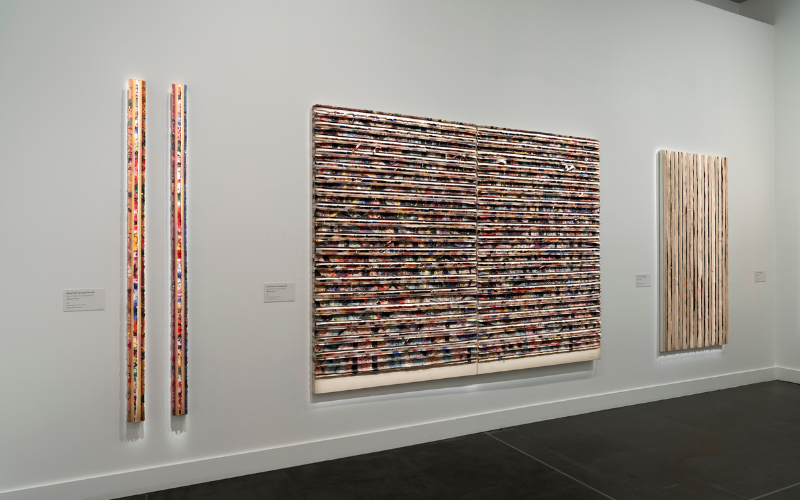
Masterpiece detail at Musée Cernuschi © Musée Cernuschi – ParisMusées / Nicolas Borel
4. Is there a specific work or series that perfectly summarizes his artistic universe?
Mael Bellec: “The Nouages (Knottings) series, spanning from 1996 until the artist's death in 2009, remains his iconic series. It is a de facto culmination point, as Shin’s death closed his body of work on this series. But it is also a production perfectly aligned with the research he conducted for nearly three decades. The artist himself mentioned that the way he tore his canvases was a questioning of contemporary art, and the knot was his response. I would be tempted to add that the knot is, in fact, the answer to all the plastic questions Shin Sung Hy had been asking himself since the 1980s.”
5. How do you perceive Shin Sung Hy’s legacy in contemporary Korean art?
Mael Bellec: “I do not know if I would use the word legacy. Shin Sung Hy is a somewhat singular figure. He has clear connections with the artists of the Dansaekhwa (Korean monochrome) movement, notably through his way of interacting with painting materials and opting for long, meticulous execution processes. But in some aspects, he remains more attached to painting in its classical definition. We tend to forget this because of the techniques he used, but Shin Sung Hy loved painting and color. Paradoxically, while deconstructing painting more than his Korean peers, he was also often more attached than them to its classical definition. As a result, he does not belong to any specific movement that would still exert a strong influence on Korean art today. His legacy is one that can only be claimed by isolated artists, in a way.”
6. What elements of his work are most representative of his artistic identity?
Mael Bellec: “His work seems particularly marked by a singular disposition: he was inclined to perceive strong binary oppositions—between front and back, between painting as a two-dimensional surface and a three-dimensional object, between the desire for deconstruction and reconstruction—and then attempt to resolve these contradictions. This is what led him to define the core principles he applied for three decades: painting, cutting up the painting, and reconstituting it by reassembling its fragments.”
7. How should we interpret the central theme of 'resurrection' in his work?
Mael Bellec: “Interpretation is as much a scholarly question based on factual knowledge and historical criticism as it is a matter of individual sensitivity when facing an artwork. Everyone is free to interpret and feel what they wish in front of his works. If I try to put myself in Shin Sung Hy’s shoes, I would point out that he once hesitated to call one of his series Apocalypse before abandoning the title. To my knowledge, this is one of the very few instances where Shin used vocabulary with symbolic and religious connotations. Most of the time, he spoke in purely painterly terms. From that perspective, resurrection is that of the painting itself, which regains continuity and coherence despite its initial fragmentation.”
8. What technical or stylistic choices particularly set his work apart?
Mael Bellec: “Broadly, we can distinguish three main types of techniques used by Shin Sung Hy from the early 1980s onward:
• Collages: pieces of painted cardboard glued onto plexiglass or to one another;
• Couturages (Sewings): assembling torn canvas strips by sewing them back together to reconstruct both the painting and its support;
• Nouages (Knottings): made of thin strips of painted canvas tied to one another.
Across these three very different techniques, we consistently find the same guiding principle that gives cohesion to his entire life's work: painting, deconstructing, reconstructing.”
9. What legacy does he leave today in the Korean and international art scene?
Mael Bellec: “Unfortunately, Shin Sung Hy passed away prematurely. Dying in 2009, he did not witness the major international rise of contemporary Korean art that occurred between 2013 and 2015. This is likely one of the reasons why he is not as widely known as some of his Korean contemporaries. However, his artistic legacy will depend on the interest that new generations of artists show in him. From my point of view, it is too early to draw a definitive conclusion about his influence. On a symbolic level, though, he leaves behind the model of an artist finding his path between two poles: his homeland and his host country. He managed to create entirely new work in this in-between space, successfully adding a page to the art histories of both nations. I believe this can serve as a profound model for members of the Korean diaspora.”