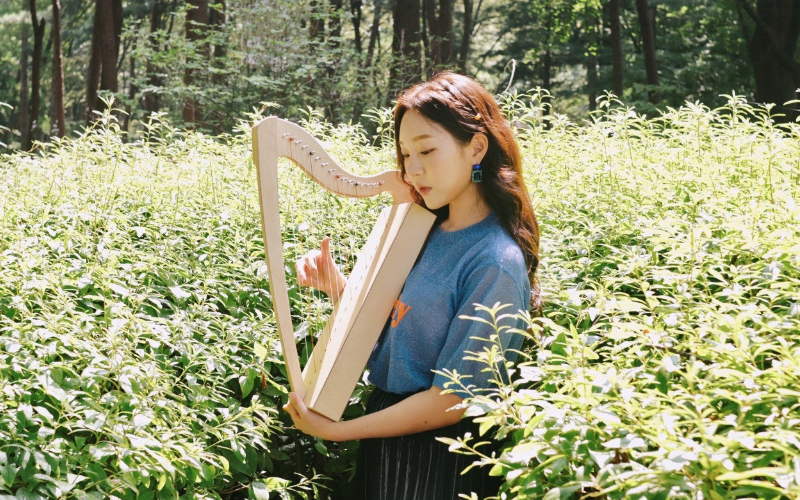
Shim So Jeong belongs to that generation of Korean female musicians moving forward with a sincere curiosity and a will to carve out their own path. Trained for nearly twenty years in the most demanding schools of the classical world, she could have followed a predictable trajectory: academic concerts, established repertoires, a career built on continuity. Yet one day, a simple question turned everything upside down: "What kind of music do I really want to make?"
This interrogation opened a door to a much vaster universe. The harp, an instrument often associated with gentleness and elegance, becomes in her hands a field of exploration. She makes it converse with electronic textures, Korean rhythms, pop sounds, and modern colors. She sings, composes, experiments, and transforms a traditional instrument into a vector of power, contrast, and identity.
This approach has led her to a major challenge: Korea's Next Wave, the official selection program for Korea's representative at Eurovision Asia 2026. For this international stage, she is preparing a performance that goes beyond mere musical presentation. She is building a world, a narrative, and an aesthetic where the harp is no longer a frozen symbol but a central element of a contemporary story. Her song EHERADIYA revisits a traditional Korean sound to project it into a modern pop landscape, creating an unexpected encounter between heritage and innovation.
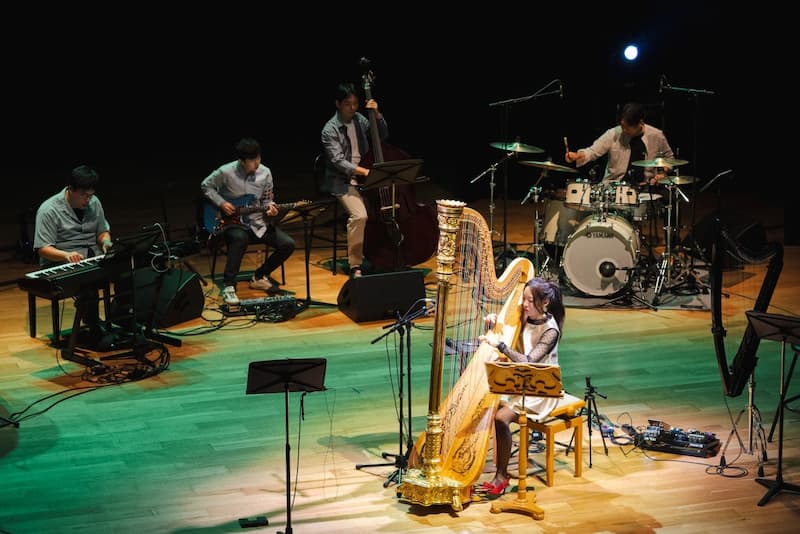
Shim So Jeong. Photo credit: © Shim So Jeong.
1. Can you briefly introduce yourself and explain how you began your musical journey?
Shim So Jeong: “Hello. I am Shim So Jeong, a harpist, singer, and songwriter. I play the harp, I sing, and I create my own music. I started playing the harp in childhood, and it has been nearly twenty years that I live with this instrument. I studied at Yewon Arts School, Seoul Arts High School, and then the College of Music of Seoul National University, before completing my master's degree at the Eastman School of Music in the United States. For a long time, music meant playing well. Understanding a score, interpreting the composer's intent, and producing the best possible sound on stage. But one day, I began to feel that this was no longer enough. 'I asked myself: what kind of music do I really want to make?' This question, simple in appearance, was difficult for someone who had lived so long in classical music. I then began to compose my own pieces and add my voice. I hadn't planned to become a harpist and singer-songwriter: I simply followed what I wanted to do, and one day I found myself in front of my harp singing my own songs. Today, I like this blurry frontier: I am a classical musician, but not only in classical; I am a singer-songwriter, but with the harp at the center of my music. My journey is perhaps a continuous search: how to connect what I have done the longest with what I want to do the most now.”
2. Why did you choose the harp, and how would you describe your musical style?
Shim So Jeong: “At first, it was very simple: the harp was beautiful, and its sound was beautiful. But after twenty years of practice, I feel like I am fighting against the 'overly pretty' image of the harp. When you bring a harp on stage, people already imagine the rest: an elegant dress, a sweet melody, an angelic image, classical. I also like that harp, but I am curious about what comes next. 'Must the harp necessarily be only pretty?' In my music, I use not only the acoustic harp but also the electric harp, pop sounds, electronic textures, band elements, and I mix voice and harp. Recently, I have also started to incorporate Korean rhythms and sound colors, because I am an artist born and raised in Korea. I don't pretend to invent a new genre. I simply want to push back, little by little, the limits that people unconsciously associate with the harp.”
3. What are your recent or ongoing projects?
Shim So Jeong: “Right now, I feel like three completely different people live inside me. (laughs) My main project is Korea's Next Wave, the selection program for Korea's representative for Eurovision Asia 2026. I am not just preparing a song: I am creating a complete universe in a few minutes, with music, performance, staging, and narration. In parallel, I am leading an International Harp Association (IHA) project with about twenty harpists: WORLD HARP SYMPHONY, an orchestral reinterpretation of world musics with a large harp ensemble. And as a solo artist, I am also preparing new pieces and a concert that will fully showcase my music and my harp. All this stems from the same question: 'How far can the harp go?'”
4. As a harpist, what did you experience working in the Korean music industry?
Shim So Jeong: “To be honest, popular Korean music is not a pre-paved terrain for harpists. In classical, the role of the harp is clear. But a harpist who composes, sings, and performs as an artist... there are few models. Before, this made me anxious: difficult to define a genre, a market, a comparison. Then my vision changed: 'The absence of a path does not mean that one is wrong, but perhaps simply that no one has walked much here yet.' The harp is rare, but this rarity is a possibility. Korea is a rapidly evolving music market where genres and visuals constantly mix. In this context, appearing with an unexpected instrument like the harp is fun and stimulating. I don't want to make the harp 'familiar' at all costs: I want to use it creatively, in my own way.”
5. What message would you like to convey to your international fans?
Shim So Jeong: “I am always surprised and touched to receive messages from people listening to my music abroad, especially in countries I hadn't imagined. What I love most in music creation is that moment when people who share neither language nor background can connect through a few minutes of music. 'The first thing I want to ask is: how did you find me?' (laughs) I am deeply grateful to those who discover my music and keep listening to it. I would now like to meet the audience directly on stage, in different countries. One day, after a concert in your city, I would like to be able to say: 'Finally, we meet in person.' ”
6. What are your goals and plans for the future?
Shim So Jeong: “I want to make my artistic identity clearer and unified. I have long been a classical harpist, and now I compose and sing. I wish these two facets to be perceived naturally as a single color: the music of Shim So Jeong. I also want to perform more abroad, collaborate with artists from different countries, and see what the harp can become in other cultures and genres. I think I haven't shown all I can do yet. For me, this is only the beginning.”
7. How were you selected for Eurovision Asia 2026?
Shim So Jeong: “What has always fascinated me in Eurovision are the performances that allow remembering an artist in a few minutes, thanks to their culture, identity, and sometimes unexpected ideas. When I discovered Eurovision Asia and Korea's Next Wave, I thought: 'On this stage, I don't need to play the harp in a well-behaved way.' I am a classical harpist, singer-songwriter, I use acoustic and electric harp, and I integrate Korean elements. On Eurovision, this complexity becomes a strength. I applied, I was selected, and I am now preparing the stage for Korea's Next Wave.”
8. What does representing Korea mean to you on this stage?
Shim So Jeong: “I asked myself a lot: 'What should one show when representing Korea?' Today's Korea contains an immense musical diversity: tradition, K-pop, electronics, and even my music as a harpist singer-songwriter. I am a Korean artist who has played a Western instrument for twenty years, and who now integrates the Korean language, rhythms, and sounds into it to carry them onto an international stage. It is not a museum Korea that I want to show, but the living Korea of 2026: the music that a Korean artist is actually creating today.”
9. Can you present the song or performance you are preparing?
Shim So Jeong: “The song is titled EHERADIYA. For a foreign audience, this word will probably sound strange. In Korea, it's a traditional sound used in folk songs or work songs, to give energy or sustain the rhythm. I wanted to see how this ancient sound would resonate on a 2026 stage. So I integrated the energy of 'eheradiya' and Korean rhythms into a modern pop sound. The song mixes Korean and English, harp and traditional instruments, band and electronic textures. The performance also uses the image of the harp as a narrative element. It doesn't look like what people imagine when they hear 'harp'. I prefer the public to discover the surprise directly on stage.”
10. What do you focus on the most when preparing an international stage?
Shim So Jeong: “A few minutes is very short. Most spectators don't know me: they don't know where I studied, how many years I played, nor what I have already published. And that's not necessary on stage. So I set a criterion: 'Even without the sound, the image must intrigue; even without the image, the music must be recognizable as Shim So Jeong.' I want a stage where everything — music, performance, visual elements — forms a single story. I don't want the harp to be a simple accessory, nor the Korean elements to seem decorative. If the public simply reacts by: 'Wait... is that a harp?' Then they will want to know more, search for my name, discover 'eheradiya', and explore my music. If, after the show, someone says: 'Who was that Korean artist with the harp?' Then I will have succeeded.”
We exchanged in writing on August 19, 2026, during an interview where the artist shared with sincerity her journey and vision. © Shim So Jeong