
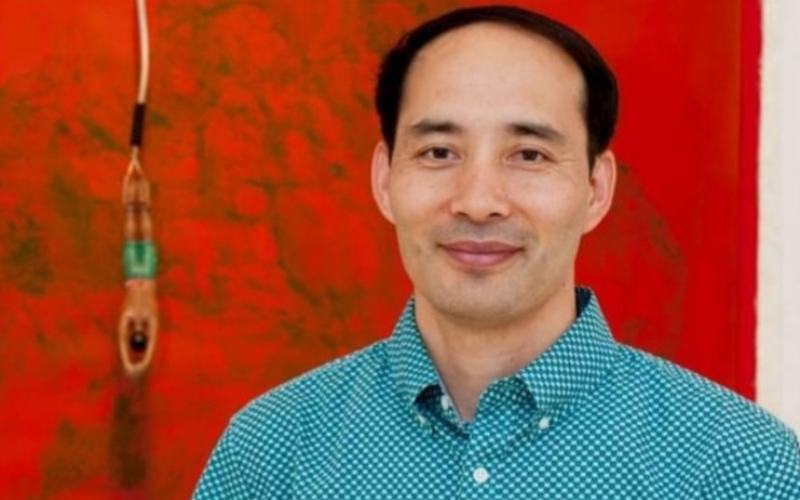
First discovered in Luxembourg, the work of Professor Park Neung Saeng immediately caught my attention. Behind his monumental urban landscapes and masterful use of traditional Korean painting techniques, I sensed a deeper story — one shaped by memory, observation, and decades of artistic research.
To learn more, I reached out directly to Chungnam National University in Seoul and obtained an exclusive interview with the professor (9 July 2026). With great generosity, he shared insights into his artistic journey, his influences, and the projects that continue to shape his work today.
1. Could you briefly introduce your artistic background and the influences that shaped your current style?
Professor Park Neung Saeng: “I completed my undergraduate and master’s degrees at Chungnam National University, then earned my PhD at Sungshin Women’s University. Throughout my career, I received several major awards, including the Dong-A Art Award, the Grand Prize at the Geumgang Art Exhibition, the Special Prize at the National Art Exhibition of Korea, the Lee Dong-Hoon Art Award, and the Segye Ilbo Art Award. I also participated in national and international residency programs such as Changdong National Studio, Nanji Studio, Geumcheon Art Factory, and residencies in New York, China, and Germany. These experiences led to invitations from public museums, biennales, and galleries in Beijing, Berlin, London, Paris, and Luxembourg, helping promote the value of Korean painting worldwide. My artistic world is rooted in my childhood in the countryside. The contrast between rural landscapes seen from mountain peaks and urban forests observed from rooftops created emotional impressions that shaped my work. These experiences, combined with research on traditional and contemporary artists, led me to develop my own interpretation of ‘urban landscapes’ within Korean painting.”
2. What themes or emotions do you aim to convey through your work?
Professor Park Neung Saeng: “Korea’s rapid industrialization transformed its urban landscapes, and my work collects traces and records of these changes. Cities and nature form psychological spaces for human experience. My paintings express the complex imagery formed through urban encounters. By walking through cities, observing, and contemplating, I create panoramic compositions where multiple viewpoints coexist. My goal is not physical reproduction but mental reconstruction — perceiving the world through the ‘mind’s eye.’ I want viewers to experience nature and the city beyond the visible, encouraging imagination and active participation.”
3. Could you explain your unique artistic approach and creative process?
Professor Park Neung Saeng: “Modern urban spaces present diverse and sensory forms. To express this, I begin with drawings inspired by everyday life and urban environments. These drawings evolve into reconstructed compositions that emphasize movement and shifting perspectives. My method focuses on ‘moving viewpoints,’ creating panoramic scenes where multiple perspectives coexist. This is not fixed-point realism but the experience of phenomena — a mental representation rather than a physical one. I also travel internationally, observing cities abroad. The emotions and impressions from these places become part of my creative process.”
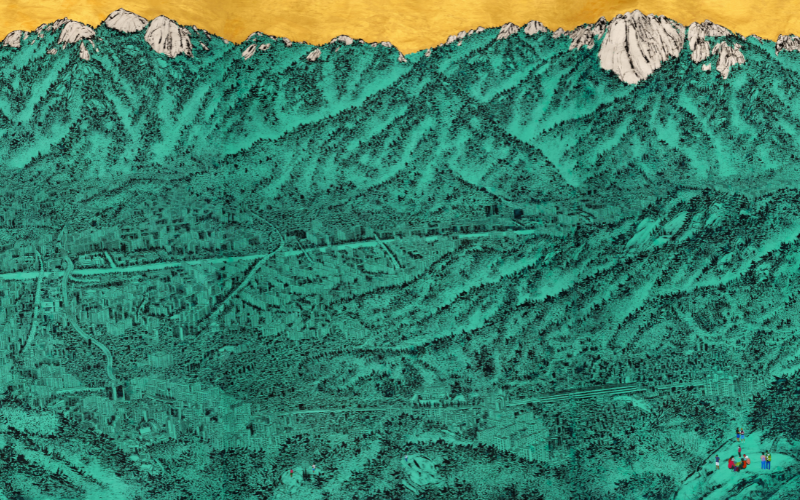
Panoramic landscape detail © Park Neung Saeng / Baekhap Cultural Foundation Collection
4. Is there a work that holds special meaning for you or marked a turning point in your artistic journey?
Professor Park Neung Saeng: “During my undergraduate years, visiting the China Academy of Art inspired me to pursue large-scale works and develop a stronger artistic identity. Winning the Grand Prize at the Geumgang Art Exhibition in my first year of graduate school gave me confidence and a sense of mission as an ink painter. Being selected for the 6th Changdong National Studio residency in 2006 opened many opportunities for exhibitions and helped establish my position as an artist.”
5. How do you view the future direction of Korean contemporary art on the international stage?
Professor Park Neung Saeng: “Rather than focusing solely on what is ‘Korean,’ ‘traditional,’ or ‘modern,’ I believe the key is how artists breathe life into their materials. To promote the identity of Korean painting and K-Art globally, cultural content research, international exchange, and national support are essential. Discovering and supporting outstanding artists will help expand Korea’s unique artistic language in the global art market. My mission is to continue creating sustainable Korean painting that connects tradition and modernity.”
6. Are there any current or upcoming projects you are working on?
Professor Park Neung Saeng: “Since graduating, I have continued working with pride in Korean painting. My 2026 solo exhibition at the Kumho Museum of Art presented 30 years of work, including the completion of my 20-year project ‘Seoul Landscape.’ This monumental 60-meter panoramic work connects mountain ranges surrounding Seoul, forming a 360-degree depiction of the city. I plan to expand this project to Korea’s six major cities and various landscapes around the world, promoting the excellence of Korean painting internationally.”