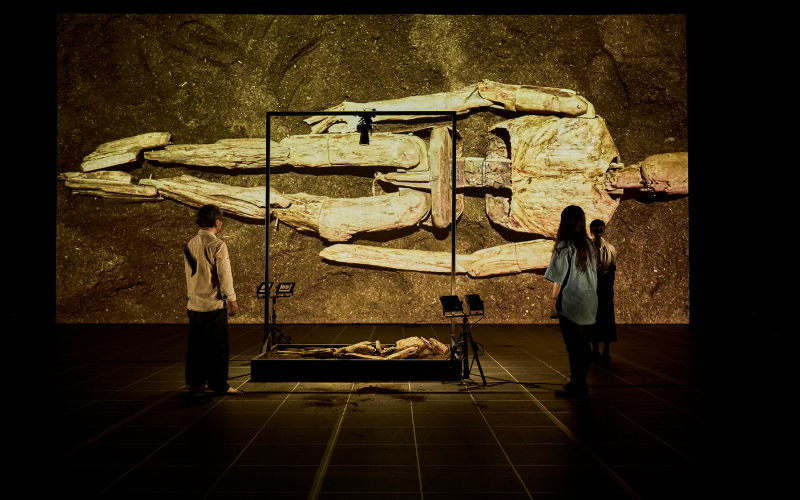
Lee Kyung-sung was present this year at the Festival d’Avignon, sharing work that never leaves the audience indifferent. Quietly yet intensely, his presence brought a rare depth of attention to human stories. Those who discovered his work in Avignon often spoke of an experience that stays in the mind, because it touches on simple, human, and sometimes hard-to-name things. His passage at the festival happened quietly, yet with a true intensity, carried by a way of looking at stories and people with a rare degree of attention.
The interview we conducted with him took place via email on August 5, 2026, as Lee was currently in Brazil for another project. Despite the distance, he responded with great generosity, taking the time to explain what an invitation to Avignon represents for him, what he takes away from this edition, and how he works when far from his team. His answers are direct, sincere, and free of stylistic pretense: one feels someone who reflects deeply without seeking to theorize his work.
Through this exchange, we discover an artist who moves forward calmly, observes what happens around him, and transforms these observations into stage material. His time in Avignon was not about spectacular flair: it forms part of a continuity—that of a creator simply seeking to understand the world and share it with the public. This interview allows us to better grasp what drives him today and what he hopes to convey through his theatre.
1. What central message did you wish to convey to the audience with this work?
Lee Kyung-sung: “Island Story, presented at the 80th Festival d’Avignon, tells the story of the bereaved families of the Jeju April 3 uprising and massacre, who recovered the remains of their loved ones more than 70 years later beneath the runway of Jeju Airport. Rather than delivering a single message, I wanted to pose a question: how can we empathize with the pain of people who seem so distant from us? We explored this idea by listening to the suffering of others and participating in a collective act of mourning.”
2. What was the most difficult part of the directing process?
Lee Kyung-sung: “Presenting this work to an international audience, with spectators coming from vastly different linguistic and cultural backgrounds, was a major challenge. We had to find effective ways to convey the complex historical context of Jeju 4.3, while managing a large amount of surtitles in a clear and readable manner.”
3. Is there a memorable moment or anecdote with the actors that particularly touched you?
Lee Kyung-sung: “One of the most memorable moments was visiting the home of Mrs. Ko Young-ja, a 4.3 survivor, alongside the actors. She is over 80 years old and lived through almost unimaginable experiences. What touched me most was the warmth, love, and life force that she still carries within her.”
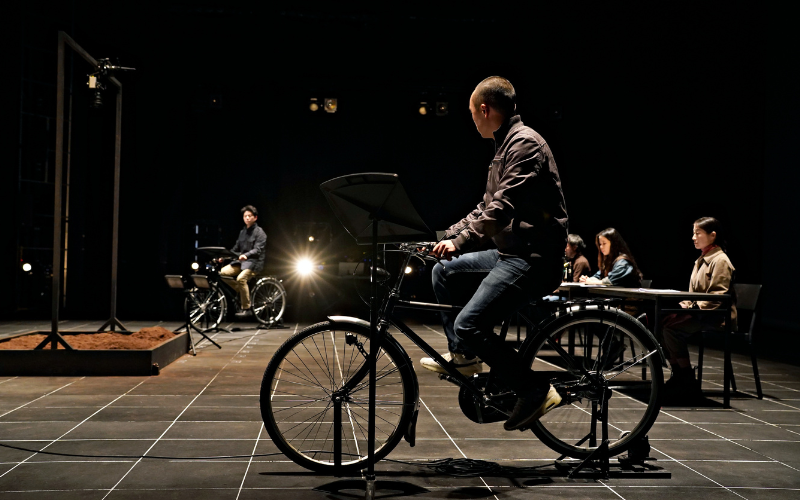
© Sang Hoon Ok
4. What artistic choice did you consider the most important for this creation?
Lee Kyung-sung: “Although the work deals with a tragic history, I did not want to impose sadness on the audience. We experimented with acting approaches that allowed the actors not to imitate real people, but to serve as mediators between the families' accounts and the audience. For instance, the actors listened to interview recordings while repeating the witnesses' words, creating a respectful distance between the lived suffering and its transmission on stage.”
5. What is your definition of a “good show” or “good theatre”?
Lee Kyung-sung: “To me, a good performance is one that does not simplify life, but reveals its complexity. Theatre should not be didactic, but should offer a space where we share questions about existence. We do not go to the theatre simply to hear that good triumphs over evil.”
6. Have you noticed differences between Korean audiences and international audiences?
Lee Kyung-sung: “When addressing topics related to Korean society, Korean audiences often react more emotionally because they are already familiar with the historical and social context. International audiences generally approach the work from a more aesthetic angle. But with Island Story, I felt that spectators reacted both artistically and emotionally, probably because we live in an era where wars and massacres are visible everywhere around the world.”
7. Could you share your future projects?
Lee Kyung-sung: “For several years, I have been meeting former long-term political prisoners in Korea who refused to renounce their convictions. I am deeply impressed by the strength of their principles and curious to understand what shaped them. This leads me to explore questions such as: What does it mean to live according to one's convictions today? How are beliefs constructed through lived experience? These will be the themes of my next creations.”
8. A final word for readers of Korea.net?
Lee Kyung-sung: “Theatre offers a unique energy, different from cinema or streaming platforms. It is an art of human encounter that enriches our lives. I hope many people will go to the theatre this autumn and discover performances that touch them deeply.”