Lee Jun-oh, a Korean bass-baritone, recently distinguished himself at the Vienna Opera Competition through a sensitive and deeply thoughtful interpretation.
Even though he did not have much time, he made himself available for a written interview on August 21 to answer a few questions. For him, the stage is not only a place of performance, but a space where passion, artistic intention, and collaboration meet. During the final, he felt not only the energy of the singers, but also that of the teams who carry this competition with sincerity, giving the event an almost collective dimension.
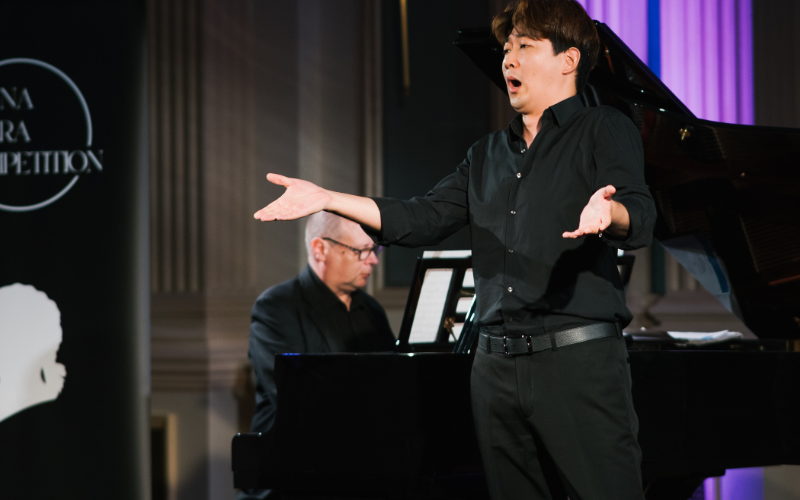
Vienna Opera Competition. Photo credit: © Vienna Opera Competition.
In his preparation, the artist chose to focus on the very essence of the works: understanding why a composer expresses an idea in the form of an aria rather than a duet or a recitative, and searching for the desired color and atmosphere in each passage. This approach led him to select Mozart’s Leporello aria, which he reinterpreted by addressing the public directly, transforming the stage into a space for artistic experimentation.
Inspired by the artists he meets daily—singers, conductors, directors, actors, dancers—Lee Jun-oh sees in every exchange a source of evolution. For him, growing as a singer does not just mean mastering technique, but embracing a vaster art, nourished by the gestures, emotions, and visions of other creators.
Grateful to the Korean and European publics who support classical music, he wishes to continue offering a sincere, living, and constantly evolving art.
1. First of all, can you share your impressions after this prize and what you felt on the final stage?
Lee Jun-oh: “I am grateful and happy to have received such a significant prize. From rehearsal to the final, I not only felt the passion of the singers, but also the expectation and energy of the staff members who sincerely love this competition. It gave me the impression of not participating in a competition, but of stepping on stage to complete a single project together.”
2. While preparing for this competition, what aspect did you focus on the most?
Lee Jun-oh: “Of course, the part of technique and vocality is important, but for this competition, I wanted to put a new emphasis on interpreting the composer's intention. Why did he want to express this passage in the form of an aria rather than a duet or a recitative? What type of color or atmosphere did he wish for in this section? It was with these reflections and this exploration that I prepared my performance.”
3. Why did you choose the repertoire performed in the final, and what does this piece represent to you?
Lee Jun-oh: “I would like to explain why I specifically chose Mozart's Leporello aria. In this piece, Leporello explains to Elvira the infidelities of his master, Don Giovanni. Normally, Elvira must be present on stage for this work, but for the competition, I thought about an interpretation where the 'addressee' would be the public. I wanted to experiment with this approach and test my own interpretation on stage.”
4. Who are the mentors or musical inspirations that have most influenced your journey?
Lee Jun-oh: “I often draw my musical inspiration from all the people I meet in my daily life and work. Whether singers, conductors, directors, actors, or dancers, observing their thoughts, emotions, gestures, and expressions helps me grow not just as a singer who sings well, but as an artist who embraces a vaster art.”
5. A final message for readers in Korea and in Europe?
Lee Jun-oh: “I am always grateful to the many artists and fans who love the magic of classical music—this music that recreates works decades or centuries old, and reinterprets them with the sensitivity and perspective of our era. I will continue to greet you with beautiful performances and fine art.”