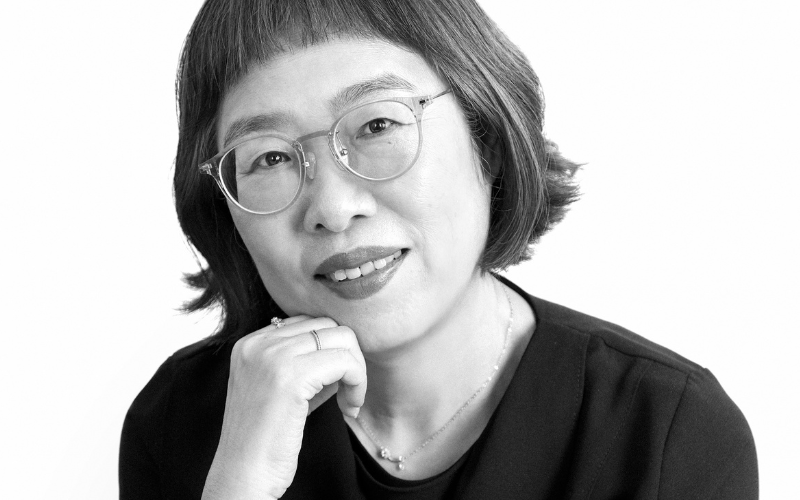
Today, we take a journey to Korea to meet an author we were deeply eager to feature: Lee Geum-yi. On August 11, we had the opportunity to exchange thoughts with her during a digital interview. Despite the distance of a screen, her unassuming warmth, unvarnished sincerity, and perceptive gaze on human emotion were immediately felt. She tells stories simply, without artifice, and that is precisely what touches her readers.
Lee Geum-yi narrates Korea through the lived experiences of its people. Rather than relying on complex theories or abstract rhetoric, she writes about ordinary families, children, and everyday individuals navigating a country that has undergone staggering transformation. What makes her work striking is that these stories—though deeply rooted in Korean history and society—carry universal emotions: love, loss, loneliness, self-discovery, and the persistent desire for a better tomorrow. This intrinsic universality is undoubtedly why her books travel so seamlessly across borders.
Having written children's and young adult literature for over forty years, Lee understands the inner worlds of children and teenagers better than anyone. She notes that while writing, she strives to return to the exact age of her characters, refusing to judge or preach from an adult perspective. Instead, she positions herself at their eye level, adopting their genuine voice. Above all, she emphasizes the sheer joy of reading—for without pleasure, no message can truly take root.
Her internationally acclaimed novel The Picture Bride introduced her powerful voice to global audiences. Detailing the lives of "picture brides" who traveled to Hawaii over a century ago, the book touches upon universal themes: migration, diaspora, female solidarity, and quiet courage. It stands as a prime example of her ability to weave Korean history into shared human emotions. Today, Lee Geum-yi stands as a major voice in contemporary Korean literature, demonstrating that when storytelling is sincere, it connects hearts across languages and boundaries.
1. Korean literature is drawing global attention. Why do you think Korean stories resonate so deeply with international readers?
Lee Geum-yi: “In a relatively short period, Korea has navigated colonization, war, division, rapid industrialization, and democratization. Korean literature deeply carries the emotional lived experiences of individuals who survived these upheaval times. While these stories are grounded in distinctively Korean realities—family dynamics, community structures, intergenerational relationships—they inherently contain universal human emotions: love, loss, conflict, reconciliation, and the hope for a better life. It is precisely this universality within specificity that allows Korean literature to touch readers around the world.”
2. What is most important to you when writing for children and young adults?
Lee Geum-yi: “There is an age gap of more than fifty years between my readers and myself. To bridge this distance, I believe I must mentally become the same age as my characters while writing. I refuse to evaluate, judge, or instruct them from an adult viewpoint. My goal is to view the world from their perspective and convey their authentic voices with total sincerity. Furthermore, I place immense importance on the joy of reading; even the most profound message loses its weight if the reader cannot immerse themselves in the story. I strive to write compelling narratives that allow readers to feel, reflect, and see the world in new ways.”
3. Many international readers encounter K-culture (music, dramas, films) before Korean literature. Does this influence how they read your books?
Lee Geum-yi: “Yes, certainly. K-pop, cinema, and dramas build familiarity with Korea and naturally guide readers toward literature. In the past, writers had to explain background context extensively; today, many readers approach literature with existing curiosity and baseline knowledge. However, literature reveals dimensions of Korea that mainstream K-culture often leaves unseen: deep history, nuanced daily life, intergenerational shifts, and quieter realities. If K-culture serves as an inviting doorway, literature acts as a window offering a deeper look into the lives and hearts of Korean people.”
4. Your works frequently explore emotion, growth, and human relationships. How do you hope foreign readers connect with these themes?
Lee Geum-yi: “I believe foundational human emotions are fundamentally universal. Even across different societies, cultural landscapes, and languages, the core experiences—loving, hating, conflicting, growing, feeling lonely, or being lost—are shared by everyone. My hope is that international readers won't merely view the book as 'how Koreans live,' but will recognize themselves or their loved ones within the characters. Discovering a familiar emotion inside a unfamiliar setting dissolves borders between people, which I consider one of the primary purposes of literature.”
© Lee Geum-yi
5. What has been the most meaningful moment in your encounters with overseas readers?
Lee Geum-yi: “When I wrote my early works, I never imagined they would one day be translated and read overseas. I am continuously moved when readers from different countries understand and feel the exact emotions I intended to convey. What touches me most isn't when readers say they learned about Korean history or culture, but when they share that they found comfort by recognizing themselves in the characters. To me, that is living proof that literature connects people across languages, borders, and time. These interactions continuously expand my own understanding of humanity.”
6. Which book would you recommend to a reader discovering Korean literature for the first time?
Lee Geum-yi: “I recommend The Picture Bride (published as Aloha, My Mothers in Korean). The novel follows Korean laborers who moved to Hawaii a century ago and the 'picture brides' who joined them. Built upon historical facts, it illuminates the courage, solidarity, and hardships of these women. By connecting Korean historical specificity with universal themes of migration, diaspora, family, and community, it serves as an accessible entry point for international readers.”
7. Does Korean children's and YA literature possess a distinct identity?
Lee Geum-yi: “Korean youth literature is intimately tied to the nation's turbulent history: war, division, poverty, rapid urban growth, democratization, globalization, and digitalization. These rapid societal shifts profoundly shaped the lives of young people. Today, Korean youth often face immense academic and social pressure; writers attempt to depict this stark reality while seeking hope and possibilities for personal growth. Additionally, our youth literature focuses heavily on relationships—family, peers, school, and society—exploring the coexistence of traditional and modern values. It also addresses contemporary themes such as multiculturalism, gender, climate crises, and digital society, posing universal questions through the lens of Korean youth.”
8. What message would you like to share with foreign readers who are beginning to explore Korean literature?
Lee Geum-yi: “I hope readers will not find Korean literature overly intimidating or foreign. Even if historical or cultural elements are unfamiliar, I encourage following the characters and their stories; you will inevitably encounter familiar emotions within a different life. Korean literature is vast, spanning ancient tales to contemporary works, and many incredible books remain to be translated. Children's and YA literature, in particular, can move adults just as deeply as younger readers. A book is a small world, but it allows us to enter a life we otherwise would never have known. I hope discovering Korean literature is a joyful journey that expands your vision of others and yourself.”