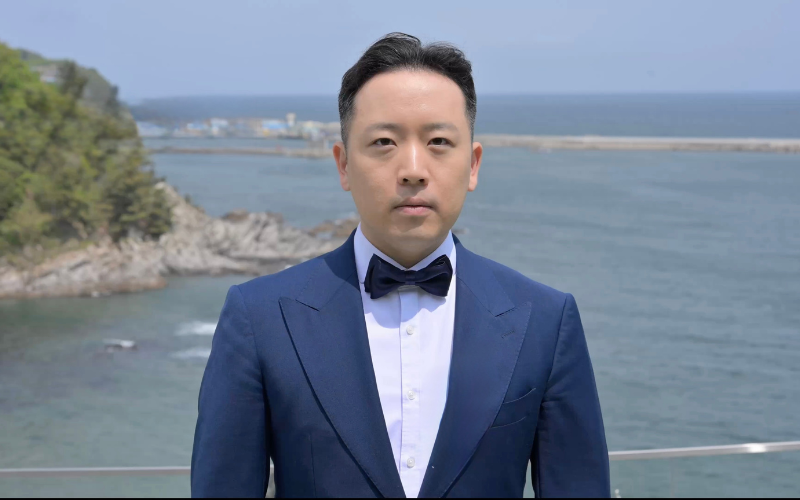
MBC East-Gangwon journalist June-ho Lee discusses his award-winning documentary, tracing a 200 km coastal journey across Gangwon to investigate climate change, historical maritime traditions, and the last surviving colony of golden saury seaweed near the DMZ. The documentary directed by June-ho Lee, a journalist at MBC East-Gangwon, belongs to a rare category: works evaluated as an environmental geopolitical thriller set on the Korean Peninsula, a region that still carries the pain of North-South division.
Discovering his documentary under these conditions allowed me to grasp the human, scientific, and geopolitical dimensions of his investigation. We follow a journalist advancing along the coasts of Gangwon as one advances through a narrative: with caution, curiosity, and an almost instinctive attention to the details that the sea reveals or conceals. From Yangyang to Sokcho, by way of a beach located in the Demilitarized Zone (DMZ), his lens guides us through landscapes where history, ecology, and geopolitics intersect.
This work has already received major recognition: the Grand Prix at the 17th Korea Broadcasting Journalist Awards, often considered the Korean equivalent of the Pulitzer or Peabody Award. The documentary was subsequently re-adapted into a feature film to reach an international audience. It was officially invited to the SCINEMA International Science Film Festival—the largest science film festival in the Southern Hemisphere—where it will be presented to students during National Science Week in Australia. It was also invited to DokuBaku, a festival located at the crossroads of East and West that selects documentaries capable of capturing global attention. Finally, it was screened last June at the 9th Korea International Ocean Film Festival (KIOFF) at the Busan Cinema Center.
1. You film the sea in an immersive way, as if the viewer were standing right beside you. Why did you choose this approach?
June-ho Lee: “Producing this documentary was an immense personal challenge. For 1 year and 4 months, I explored a 200-kilometer stretch of Gangwon's East Sea. I shot the vast majority of the footage—underwater, land, and aerial—myself, taking on the roles of both narrator and first-person investigator. This is not a blockbuster with a massive budget; it is a project born from a persistent little question, executed with extremely limited resources. But I believe this raw, first-person struggle is precisely what brought deep authenticity to the audience. In an era saturated with AI-generated images, I am convinced that documentaries driven by raw human authenticity will command even greater attention. For context: this raw cinematic story served as a decisive catalyst. After viewing the film, the newly formed Climate and Environmental Cooperation Division of the South Korean Ministry of Unification officially declared to me that they would push to draft a ‘Joint Inter-Korean Ecological Survey’ once inter-Korean relations improve.”
2. Why did you begin your investigation in the coastal village of Gopo?
June-ho Lee: “The geographical setting of the documentary is Gangwon Province, a region directly bordering North Korea. As mentioned in the film, this seaweed was once widely distributed throughout Gangwon's waters. Gopo is located at the southernmost tip of this maritime area. Because the documentary follows a linear 200 km coastal path, this quest naturally had to start at its southernmost anchor point: Gopo.”
3. You establish connections between Joseon-era maritime traditions and today’s sea. Why was this historical dimension important?
June-ho Lee: “Humanity is destined to live alongside nature. Thus, the process of searching for this legendary marine plant inevitably led to unearthing a forgotten human culture. It was not a forced connection, but an organic inevitability.”
© June-ho Lee, Journalist & Director
4. In the rough waters of Yangyang and Goseong, you search for saury seaweed. What does this scene reveal about the current state of the sea?
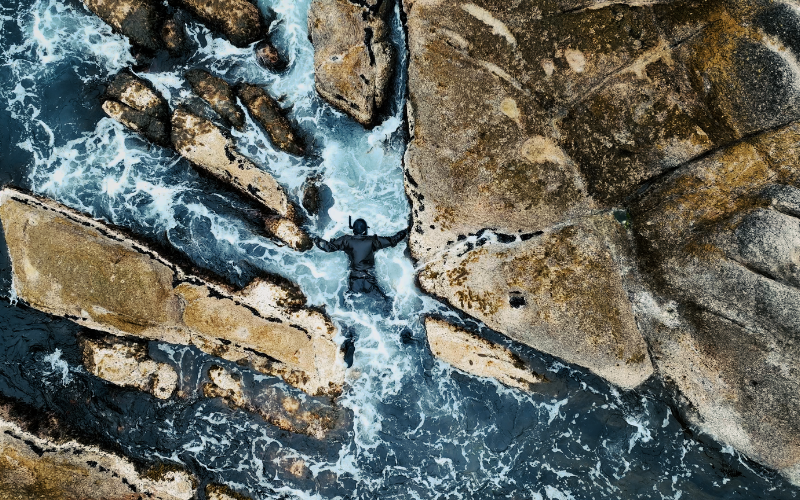
June-ho Lee: “To clarify the geography: the location where I shout that I finally found the seaweed is Gangneung. The scene where I am swept by waves near the rocks was filmed in Goseong, the northernmost point on the Korean coast. Finding the seaweed in Gangneung reveals a grim ecological reality: it proves that the waters in the southern part of the Korean Peninsula have now become an environment where cold-water marine life can virtually no longer survive.”
5. In this “underwater forest,” you find no seaweed at all. Is this a sign of ecological shift?
June-ho Lee: “Yes. Despite meticulous exploration of Yangyang and Sokcho, I found nothing. Saury seaweed has become an endangered entity, falling victim to a fatal combination: the macro-trend of climate change, and human variables like relentless coastal development.”
6. You discover juvenile pufferfish, a highly sensitive species. Why did you include this moment?
June-ho Lee: “I wanted to show the intrinsic connection between fish and marine forests. Just as Pacific saury historically attached their eggs to this specific seaweed, young pufferfish use these underwater forests as a vital sanctuary to escape predators.”
7. How did your collaboration with Professor Hyung Geun Kim influence your investigation?
June-ho Lee: “Professor Hyung Geun Kim, recently retired from Gangwon National University, is a veteran marine botanist who spent decades diving and studying various seaweeds. However, even he had never specifically studied saury seaweed—it had become a ghost, largely forgotten even by academics. My relentless field work, combined with his rigorous academic support, made the discovery of this plant possible. In a way, you could say I inherited his lifelong passion for the sea.”
8. A few days later, you continued your observations in Sokcho. What differences did you notice?
June-ho Lee: “Sokcho is located further north than Gangneung, where I found the seaweed. In the end, I only discovered it in Gangneung and Goseong. Despite exhaustive exploration of Yangyang and Sokcho, I found nothing. The seaweed is disappearing, a victim of rapid warming and human development.”
9. In your view, what are the most visible signs of climate change along the Korean coastline?
June-ho Lee: “The East Sea is a closed geographical basin, trapped between Russia and Japan. Branches of the warm Kuroshio Current enter it and remain trapped there. Consequently, the temperature rise is phenomenal. Over the past 50 years, the sea surface temperature has risen by approximately 2°C, which is more than double the global average.”
10. You discuss climate change from a beach located inside the DMZ. Why choose such a symbolic location?
June-ho Lee: “The Korean Peninsula carries an immense historical tragedy. While Europe experienced a divided Germany, Korea has endured a North-South separation for over 70 years. This location choice was not intentional: it was a geographical inevitability. The northern stretch of Gangwon's coast terminates at the 38th parallel, a heavily militarized zone. Miraculously, after relentless searching in the South, I discovered the last surviving colony of this seaweed just below that division line. Knowing that this final stronghold could soon disappear—just as it did further south—I feel deep pride in having been able to capture its only visual record.”
Conclusion: A Dream for the Future
June-ho Lee concludes with a vision that transcends the boundaries of filmmaking:
June-ho Lee: “If I have one ultimate dream as a filmmaker, it is for inter-Korean relations to improve so that the ‘Joint Inter-Korean Ecological Survey’ can become a reality. I dream of expanding the scope of my documentary into the inaccessible waters of North Korea, using this ecological pursuit as a medium to help the North and South understand each other and collectively pave the way for peace.”
A dream where ecology becomes a bridge between two nations separated for over seven decades.