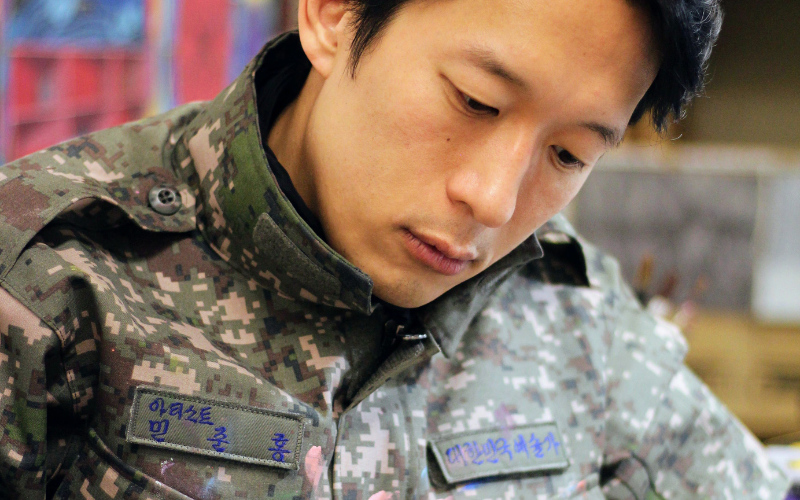
In the bustling heart of Europe’s most iconic art hubs, Korean artist Joonhong Min has carved out a unique space where discarded fragments of the city find a second life. Born in Seoul during the rapid industrial growth of the 1980s and trained at the prestigious Slade School of Fine Art in London, Min’s work bridges the hyper-efficiency of Korea with Europe’s reflective artistic traditions.
Upon hearing that Min was exhibiting in Paris, I traveled there immediately to experience his works in person. Seeing his creations allowed me to fully grasp the scale and emotion of his artistic language—a journey essential to understanding the man behind the fragments. Min’s art does not simply depict skyscrapers or abandoned sites; it documents the “biography” of materials cast aside by the capitalist machine. By collecting and reimagining these urban by-products, he offers a poignant critique of modern life while seeking a form of cultural comfort in an ever-changing landscape.
What was the main motivation or the “spark” that led you to leave Korea and establish yourself as an artist in Europe?
“I have had a special interest in art since childhood, and I always found joy in drawing and creating. This passion led me to pursue a fine arts degree in Korea. After completing my education, I felt a strong desire to experience a broader artistic landscape in the birthplace of contemporary art. This led me to London, where I studied at the Slade School of Fine Art before officially beginning my career as a contemporary artist.”
In your experience, what are the biggest differences—both positive and challenging—between daily life in Korea and life in Europe?
“Korea’s rapid growth defined its characteristics: efficiency, systematic structure, and speed. While this leads to convenience, it can also result in a standardization of individuality. In contrast, many social aspects of Europe remain tied to tradition. Because historical value is prioritized, speed may be lower, but for me as an artist, this environment provides a foundation for internal reflection and self-exploration.”
Is there something from your home country that you miss deeply and haven’t been able to find in Europe?
“Because of my appearance, I sometimes feel a certain tension in Europe. Even in global cities like London, I occasionally encounter hostility or racial discrimination. In those moments, I long for the ‘racial comfort’ I felt in Korea, where I shared the same physical characteristics as those around me.”
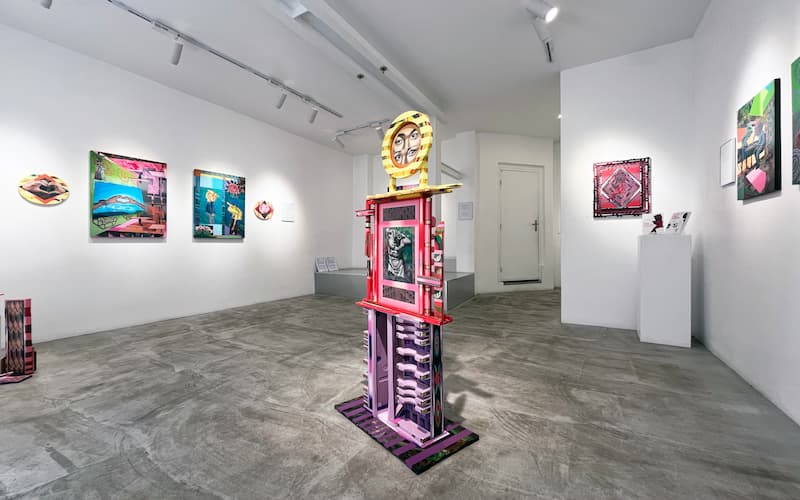
Exhibition view of Joonhong Min's works © Joonhong Min
How do you choose the materials or the specific fragments of the city that you use in your creations?
“Seoul is where I was born and raised. The skyscrapers, abandoned buildings, and construction waste are entities I share a love-hate relationship with. I believe the fate of this waste resembles that of human beings—used within the capitalist system and discarded once their utility is exhausted. I bring these materials to my studio and document them; I consider this my own way of mourning these disappearing entities.”
Does your Korean heritage act as a silent guide when you create, or has your style become more universal?
“Initially, I thought the global urban vocabulary was my only language. But working abroad, I realized that ignoring my heritage was a self-imposed limitation. I now seek to integrate traditional Korean iconography not as exotic curiosities, but as another layer of the city. I am fascinated by how objects once imbued with spiritual values transform into mere commodities within the capitalist system.”
What is the one thing you want the public to remember most about your artistic vision?
“I believe art is less about providing answers and more about posing questions. I would be satisfied if viewers asked themselves: ‘What kind of world do we live in?’ and ‘What way of living each day is truly right for me?’ Provoking those internal questions is enough.”