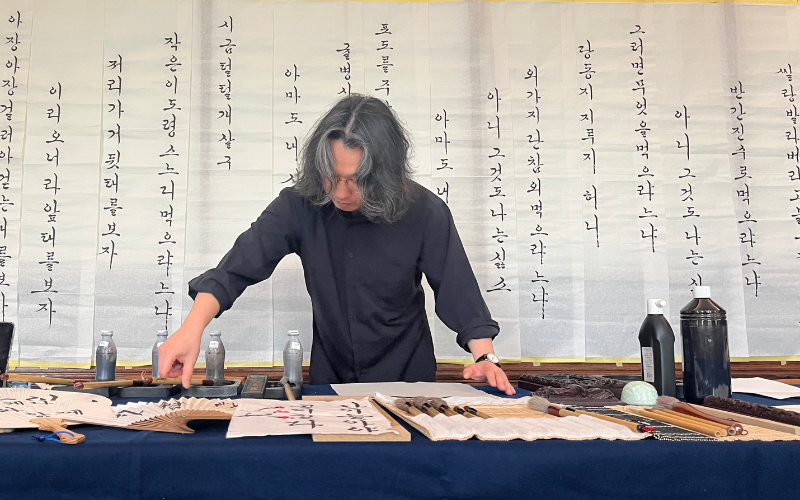
There are artists whose presence is felt even before discovering their works. Jeounghee Kim is one of them. Shaped across Korea, Belgium, and France, his path reflects a creator moving with rare sincerity, guided by deep curiosity and an almost instinctive loyalty to his materials. Glass, hanji, calligraphy: nothing is chosen by chance. Each material becomes a language, each gesture a way to question what lies on 'the other side'—that subtle boundary between what is seen and what is felt.
The interview, conducted in writing on August 5, revealed an artist seeking not to impress, but to understand. Kim speaks of his work with surprising gentleness. He claims nothing, imposes nothing: he explains, shares, and narrates. Behind more than a hundred exhibitions in fourteen countries, international selections, and workshops in prestigious institutions, one discovers a humble, patient, and quiet man with remarkable artistic clarity.
What immediately strikes is his choice of words. During our exchange, he wrote as he sculpts: slowly, precisely, allowing each phrase to find its place. One senses a deep respect for time, process, and matter. He observes the world without rushing or seeking dominance, moving with a childlike curiosity to touch, experiment, and begin again. His works are not merely objects to contemplate; they are fragments of life, traces of journeys, doubts, efforts, and a constant drive to bridge cultures through light and matter.
In an artistic landscape often dominated by speed, Jeounghee Kim reminds us that slowness can be a strength, patience can become a style, and sincerity can be a driving force. When guided by authentic vision, art becomes a bridge between cultures, experiences, and sensibilities.
1. To begin, could you tell us how your artistic journey began and what inspired you to work with glass and hanji?
Jeounghee Kim: “I began studying Korean calligraphy (Hangeul) at nine years old under a master I followed for four years. Early on, winning second prize in a competition organized by the Seoul Southern District Office of Education reinforced my passion. I have never stopped practicing since. Later, entering the Department of Environmental Sculpture specializing in glass at Namseoul University, I discovered ceramics and glass. Seeking to move away from traditional paths to explore a more contemporary approach, I turned to glass sculpture—a discipline that was still rare at the time. Today in France, I mentor students preparing for art school admissions. I often tell them: 'When you develop your strengths, your weaknesses become less visible and can even become assets.' Asking this of myself, I realized my strength lay in the intersection of hanji and glass. Their union became a primary language of my artistic expression.”
2. Your work combines two very different materials: glass and hanji. What draws you to this combination?
Jeounghee Kim: “Hanji and glass share a common history: in their respective cultures, both were long used as materials for windows. Hanji allows the 'other side' to be perceived indirectly through light, temperature, humidity, sounds, and silhouettes; it suggests rather than reveals. Glass offers direct, almost immediate perception. By bringing together these two familiar materials, I aim to question what 'the other side' means in each culture and how viewers choose to observe it.”
3. Could you describe your creative process?
Jeounghee Kim: “For glass, I purchase plates that I cut, assemble, and glue to form a solid block, which I then sculpt using diamond grinding wheels and various polishing tools. For hanji, I first write characters in ink, then twist the paper to create cords or knots. I subsequently apply an ink I prepare and age myself, enabling rich, deep nuances. This technique expresses both the strength of Korean calligraphy and the density of the ink.”
4. You have participated in over 100 exhibitions across 14 countries. How have these experiences shaped your artistic vision?
Jeounghee Kim: “Applying for calls for entries in different countries requires understanding their artistic sensibilities, which is an educational experience in itself. I do not limit myself to a single discipline—working across glass sculpture, photography, painting, and installation keeps me from being confined to one category. Furthermore, when selected in a country unfamiliar to me, I prefer to deliver my works in person. Discovering unknown environments constantly enriches my perspective.”
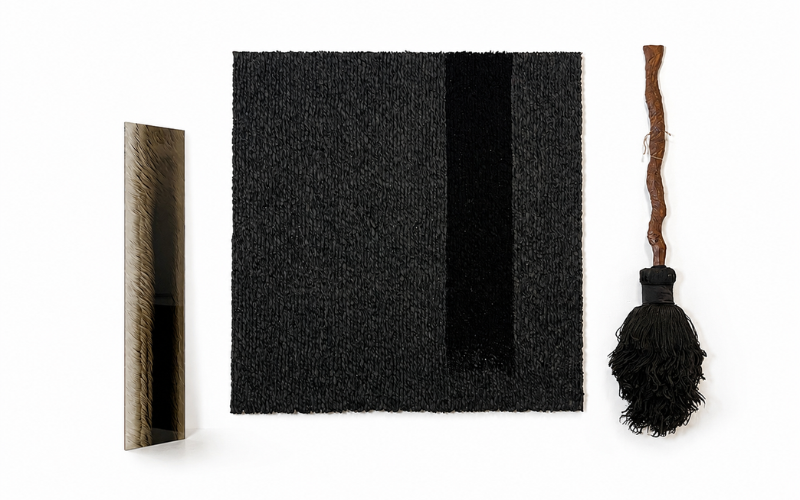
Close-up view of Jeounghee Kim's material explorations © Jeounghee KIM
5. More than 50 of your exhibitions resulted from competitive selections. What do these recognitions mean to you?
Jeounghee Kim: “It is difficult for artwork to be universally recognized, but being selected by juries in numerous countries suggests my work possesses a force capable of touching different sensibilities. These recognitions reassure me that twenty years dedicated to art have not been in vain. They encourage me to continue and open new opportunities, particularly with galleries. I will continue entering open calls, for the artist I am today and the one I aspire to become.”
6. Is there a specific exhibition or project that left a lasting impression on you?
Jeounghee Kim: “In calligraphy, the workshops I led on April 11 and 18, 2026, at the Guimet National Museum of Asian Arts in Paris were deeply meaningful. I was officially invited as the first Korean artist to present such an event at the venue where I most dreamed of presenting Korean calligraphy. In glass sculpture, being selected in 2017 among the six Young Belgian Talents at the Affordable Art Fair Brussels was a major highlight, especially as I was then a master's student at the Royal Academy of Fine Arts in Brussels. The most challenging experience was entering the competition at the DOX Centre for Contemporary Art in Prague. After two rejections, I was selected on my third attempt. I transported my works via overnight bus in the rain without finding a restaurant, eventually eating my prepared meal in a restroom. After a twenty-hour sleepless journey, I questioned if an artist's life required such hardship. That evening, I took another twenty-hour bus back. This experience taught me resilience and to appreciate the journey as much as the result.”
7. What message do you wish to convey to the public?
Jeounghee Kim: “I hope the convergence of my experiences across Korea, Belgium, and France encourages visitors to reflect on the concept of 'the other side,' which runs throughout all my work.”
8. Are you currently preparing new projects?
Jeounghee Kim: “Beyond Belgium, I have conducted calligraphy workshops in France, Italy, and Romania. This year, my workshop program was selected as an official 2026–2027 offering at the Guimet Museum—a first for the institution—and I am preparing these sessions with great enthusiasm. I also hope to expand these workshops to additional countries.”
9. Do you have a message for Korea.net readers?
Jeounghee Kim: “Today, participating in events dedicated to Korean culture or dining at Korean restaurants—which have multiplied significantly in Paris—has become natural. Amid this enthusiasm, some present a superficial image of Korean culture, treating it primarily as a commercial venture. I hope that within this growing landscape, more people will discover an authentic, profound, and high-quality Korean culture.”