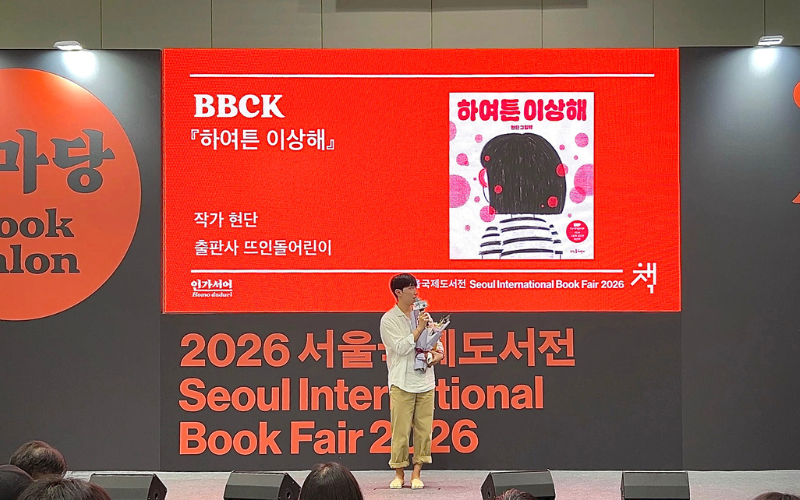
Meeting Hyundan gives the impression of entering a universe where time slows down. She talks about her work with great simplicity, as if her stories took shape naturally. Behind this gentleness lies a remarkably fine gaze: a gaze that observes without judging, that listens, and that constantly questions how different people can share the same space.
Hyundan does not seek the extraordinary. She starts from the everyday: scenes we cross without paying attention, questions no one asks. Her books are born from these ordinary moments—a spontaneous 'It's mine!', a familiar game opening a reflection on difference, an encounter transforming our way of seeing the other. These simple moments take on a new dimension in her stories.
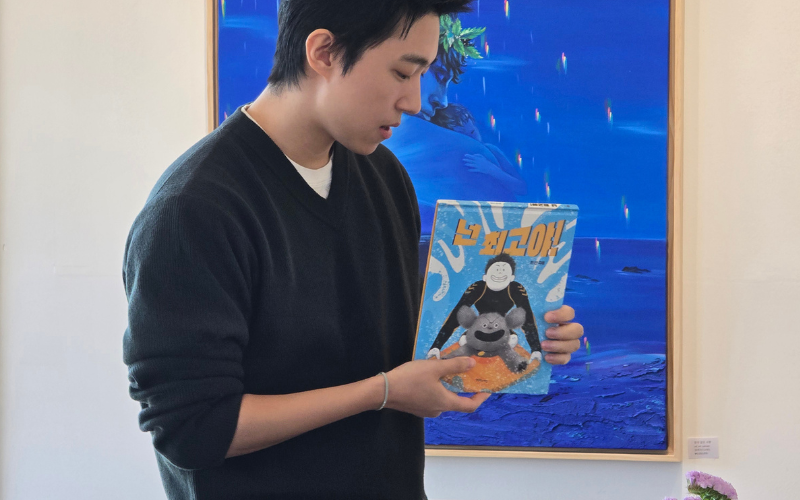
© 현단
What marked me most in our exchange is the way she naturally links her personal experiences to her work. The time spent with a friend wearing leg braces, the questions that emerged from it, the emotions accumulated over the days... all this nourishes her writing without ever being exaggerated. It infuses her stories with sincerity and gentleness.
The online interview took place on August 11, 2026. Hyundan shared her journey, her sources of inspiration, and how she builds her books. She also explained how she voluntarily leaves spaces in her narratives so readers can project their own meanings. A simple, authentic, and deeply enlightening conversation.
1. Could you introduce yourself and tell us what led you to create picture books?
Hyundan: “My name is Hyundan, an author and illustrator of picture books in Korea. I have published six books so far and also collaborate as an illustrator for other authors. Since childhood, I have loved drawing. I studied communication design at university, then illustration in master's to deepen my practice. Over my research, I realized what I loved most was not just creating images, but inventing stories and transmitting them. That's how I discovered the picture book, a medium capable of bringing together my ideas, narratives, and drawings. Around the same period, I shared the daily life of a friend wearing leg braces. This proximity confronted me with the reality of disability, a subject I had never deeply reflected on. This led me to question how different people can live together in the same society. Looking back, discovering the picture book and the birth of these questions naturally came together. Since then, difference and coexistence have been at the heart of my work.”
2. What are your main sources of inspiration?
Hyundan: “My inspiration comes from the everyday. I think our days are already full of stories, questions, and sometimes even answers. I try to carefully observe what we find too familiar to pay attention to: games, gestures, relationships. Most of my stories are born from these simple scenes. For example, 'One, Two, Three, Sun' (Korean title: The Mugunghwa Flower Has Bloomed) starts from a very well-known game in Korea. I wondered how a visually impaired person could participate. Rather than adapting someone to existing rules, I imagined a game where the rules change so everyone can play together. 'This is my territory!' was born from a frequent phrase: 'It's mine!'. A mundane scene opening a reflection on possession, competition, sharing, and coexistence. For me, seeking inspiration is not finding something extraordinary, but looking more closely at what is already there.”
3. How would you describe your literary universe?
Hyundan: “If I had to summarize my universe, I would say it's a world where different beings coexist. I don't think differences should be erased, nor that everyone must understand everything about the other. We have different appearances, thoughts, and experiences, and some things may remain uncomprehended. Despite this, I believe we can live together, just as we are. In my books, conflicts are not resolved in a spectacular way. I prefer to show how different characters find small ways to co-exist. I would like readers to close my books thinking: 'It's normal to be different' or 'We don't need to be identical'. I don't seek to create a perfect world, but a world where everyone can exist freely.”
4. What message do you want to convey through your works?
Hyundan: “Most of my books talk about difference and coexistence. Our society evolves quickly, but our perceptions don't always follow. When we begin to understand one difference, another appears. Many forms of 'difference' still remain hard to grasp. You cannot understand everything in advance. That's why I think it's essential to first accept the existence of the other, naturally. We already live surrounded by different people. This attitude must be built from childhood. Rather than giving direct lessons, I want to calmly show how different people live together. I hope readers will see difference as a natural reality, not as something strange or threatening.”
5. How does your creation process unfold?
Hyundan: “When I notice an interesting situation or question, I note it down. Then, I imagine how to transform it into a story through characters and events. I don't decide the end in advance. By imagining the characters' reactions, the story sometimes takes unexpected directions. Once the narrative thread is established, I build the text and images together. In a picture book, turning the page is part of the narrative, so I think about what the text says, what the image shows, and the moment the reader has to turn the page. During the work, I remove phrases or add scenes. The book is built slowly, between text and illustration.”
6. How do text and image interact in your books?
Hyundan: “For me, text and image do not explain each other: they respond to each other. The image can tell what the text doesn't say, and the text can complete what the image doesn't show. I avoid repetitions. If an image is enough, I remove the text. If the text carries the narration, the image fades slightly. Text and image influence each other: a phrase can inspire a scene, and a drawing can modify a phrase. Creating a picture book is not adding images to a finished text, but building a space where text and image leave room for the reader to create meaning.”
7. Have you received any striking feedback from readers?
Hyundan: “I often meet children in schools or libraries. We read together, discuss, draw, or do activities related to the book. What always amazes me is that children notice details I didn't expect—an expression, a gesture—or interpret the story in a totally new way. These moments deeply touch me. Writing a book does not fix its meaning: once in a child's hands, it meets their experience and becomes a new story. Meeting children allows me to see my books through their eyes. Their questions and interpretations nourish my future projects.”
8. What does presenting Korean picture books to international readers represent for you?
Hyundan: “Picture books use a visual language that crosses linguistic and cultural borders. Presenting a Korean picture book abroad is not just making a book known: it's sharing the daily life of Korean children, their games, their relations, their emotions, and the questions present in Korean society. The themes I address—difference and coexistence—do not concern Korea alone. These are universal questions. I hope children elsewhere can feel a bit of Korean life and that the questions in my books become shared questions. I am always curious to see how my works will be interpreted in other cultures. These encounters broaden my vision and enrich my universe.”
9. What message do you want to convey to readers discovering your books?
Hyundan: “Our world still has many challenges to meet. We often think adults must solve them, but I believe children play an essential role in building today's world. Children approach complex questions with simplicity, creativity, and without prejudices. They change the rules, and do not see difference as an obstacle. Their gaze has immense force. Rather than transmitting the world as adults built it, it is important to imagine the future with children. By listening to and respecting their ideas, we can create a society where more people live happier lives. I am eager to see the changes children will bring to the world. I hope they will think freely, imagine without limits, and express their voices. As an author, I want to listen to those voices and move forward by their side.”