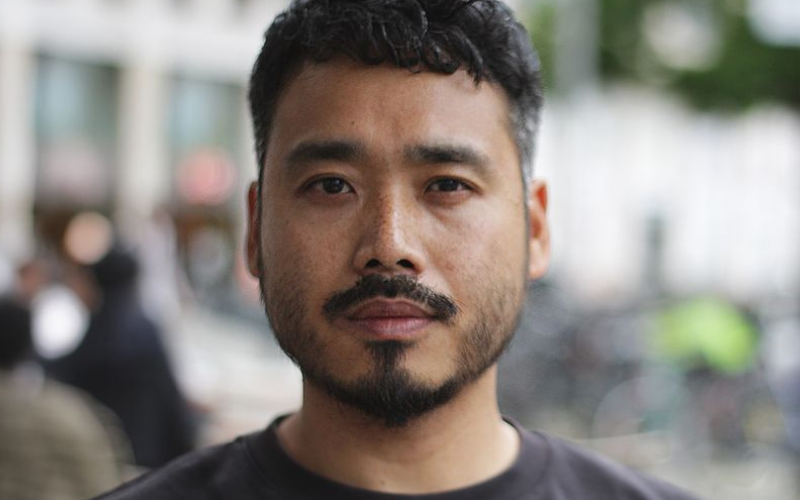
A few days after the opening of the Kunst IN 2026 exhibition at the Korean Cultural Center Berlin, I had the opportunity to speak with artist Hojin Kang through a video call. Although we did not meet in person during the exhibition, it felt important to introduce his work and perspective to readers, offering insight into the ideas and experiences behind his installations.
Born in Germany to Korean parents, Hojin Kang creates installations that merge technology, migrant memory and inner perception. His works invite visitors not only to observe but to physically experience the space, revealing how personal history and contemporary technological culture shape his artistic language.
1. What does it mean to you personally to present your works at the cultural department of the Korean Embassy?
“It feels like a full-circle moment. My parents came to Germany as guest workers in the 1970s, and I was born here. Later, I chose to pursue art, and now I have the opportunity to show my works in the cultural department of the Korean Embassy. It feels a bit like showing the mothership what has happened in the diaspora over the past decades. Yes, it really is a circle closing.”
2. Your works combine technology, migrant memory and meditation. How has this approach evolved throughout your artistic development?
“Technology has always fascinated me. As a child, I loved playing outside, but I also loved playing Game Boy. In recent years, something has shifted. I look less at the technology itself and more at what it does to us as a society and as human beings. The focus is increasingly on the human.”
3. Many of your installations respond to the body or the presence of the audience. What role does the visitor play in your artistic concept?
“An absolutely central role. My works only function through the physical experience in the space. The presence of the visitors is essential.”
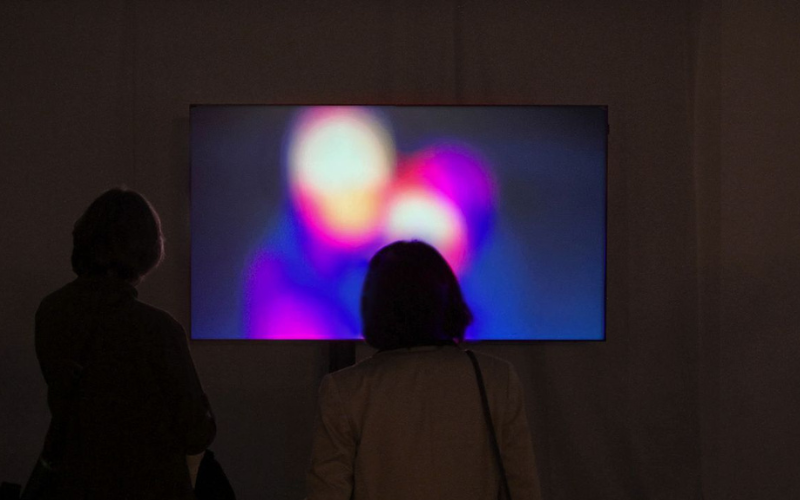
© Hojin Kang — Exhibition view
4. How did you experience the exchange with the other artists in the Kunst IN 2026 exhibition?
“The exchange was good but rather minimalistic. Each artist was very focused on preparing their own work. After the initial kick-off meeting, everyone worked intensely on their installations.”
5. Your works often deal with silence, perception and inner states. What message do you want to convey to the audience?
“Especially today, in times of AI, wars, multiple crises and a lot of external noise, it is important to look inward. That is what I try to convey: the inner gaze and inner connectedness.”
6. Do German and Korean visitors perceive your works differently?
“I am not sure if there are real cultural differences. People bring their own emotional state into the work. Two people can see the same installation and perceive something completely different. The difference is more individual than cultural.”
7. Is there a work in the exhibition that holds special meaning for you?
“If I had to choose one, it would be the thermal-imaging piece. It is a three-minute sequence showing intimate moments of my family and myself. Thermal cameras are usually used for surveillance and border control, to separate people. I use it as a medium of closeness, showing what warmth between people looks like.”
8. What projects are you currently working on?
“At the moment, I am trying to rest a little. The past months were full of exhibitions. I currently have a solo show in Neukölln, a group exhibition in Pasadena, California, another group exhibition in Treptow‑Köpenick at Galerie Adlershof, and a real‑time AI installation at the Stadtgalerie Saarbrücken. But of course, I am already planning the next steps. The next work will be another iteration of the thermal‑imaging series. I already presented a new version in Neukölln. It is a project that continues to evolve.”