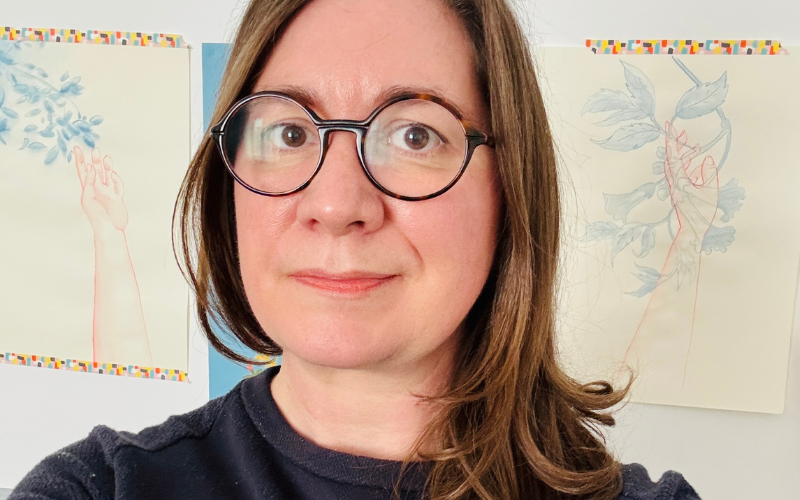
101 nuances de coréen (101 Nuances of Korean) is a project quite unlike any other. Behind this book lies a story of friendship, curiosity, and sensitivity that has bound Caroline Ruth-Masson to Korea for more than twenty years.
Her approach to the Korean language did not stem from a passing trend or pop-culture phenomenon, but from a personal bond built over time, culminating in a memorable trip in 2023 where she reunited with her friend and discovered a country whose gentleness and delicacy moved her deeply.
Drawing from those memories, she created watercolor illustrations and paired them with poetic vocabulary—far removed from traditional academic textbooks. Her artistic vision won over Larousse Publishing and subsequent readers. Today, the book continues its journey in iconic cultural landmarks, including the Louvre Museum, where it is now featured in the "Asia" section. It stands as a heartwarming recognition, especially in this year celebrating the 140th anniversary of diplomatic relations between France and Korea.
To explore the origin of this project, her artistic intention, and how Caroline Ruth-Masson perceives the Korean language, we interviewed her by email on August 8, 2026. Her perspective, both intimate and open, sheds light on her deep connection with Korean culture.
1. What inspired you to create 101 nuances de coréen, and how did this project come to life?
“Caroline Ruth-Masson: I have been connected to Korea for about 24 years, thanks to my Korean friend with whom I studied Fine Arts at the University of Paris. Today, we are soul sisters. During her studies, she introduced me to her culture, gastronomy, and language. I didn’t discover Korea through K-dramas or K-pop, but through a deep friendship. I started by teaching myself Hangeul, then a few words. She returned to her country after finishing her studies, but we kept in touch and continued sharing our cultures. I was finally able to visit her in the summer of 2023. That trip was unforgettable—both for our reunion and for discovering this magnificent country, where I felt immense gentleness, sensitivity, and respect. During my travels, I immerse myself in the culture by taking photos, observing everything around me—sometimes even with my eyes closed—and making watercolor sketches. Upon returning, nourished by these impressions, I began creating illustrations paired with two or three Korean words. It was a way to cherish my memories and learn sensitive, poetic vocabulary. In doing so, I created what I couldn't find in stores. The editorial director at Larousse was touched by this gentle and curious approach to language. That is how the project took shape: born initially for myself, it became, thanks to Larousse, a book that readers seem to truly cherish.”
2. Among the nuances you selected, which one best represents the spirit of the Korean language?
“Caroline Ruth-Masson: The lantern nuance (연꽃 = lotus, 등 = lantern). In Korea, lanterns symbolize light, hope, and inner awakening. They carry wishes and prayers for peace, health, or happiness. In my book, I illustrated the colorful lanterns of Bulguksa Temple in Gyeongju. Through the empty space in the illustration, I wanted to convey the calm and inner silence I felt, as well as the gentle breeze carrying wishes and good thoughts away.”
3. Which nuance was the most challenging to explain or illustrate?
“Caroline Ruth-Masson: My friend and I sometimes struggled to find the exact right word. We particularly hesitated over the term corresponding to 'melancholy'. The word 우울 (uul) expresses a state of sadness or gloominess, similar to saying: 'I feel a bit sad or down today.'”
4. How did you balance the linguistic and artistic aspects of the book?
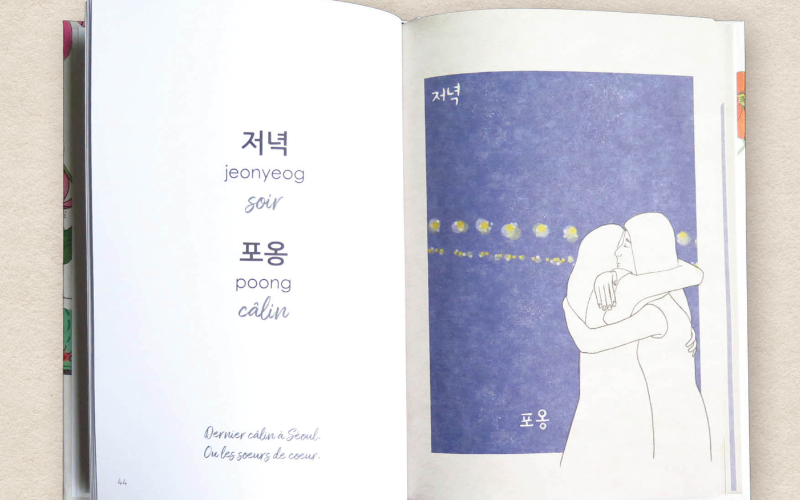
“Caroline Ruth-Masson: It all begins with a drawing—a memory or a feeling. The words follow naturally to accompany the illustration. They first come to me in French, then I translate them, sometimes with my friend’s help. My goal was to learn a useful word, like a color, and pair it with one or two more sensitive, poetic words. For example, instead of simply writing 'spring', I chose 'gentle spring' (고운 봄) to describe an atmosphere. The short sentence accompanying each illustration provides a more poetic understanding of the image and the Korean words.”
© Caroline Ruth-Masson
5. How has your perception of Korean culture evolved throughout the creation of the book?
“Caroline Ruth-Masson: As I progressed with this project, I realized that the Korean language is extraordinarily subtle and full of nuances. Things aren't always said directly: they are suggested, left to be guessed. Feelings, context, and sincere emotion hold a vital place. This delicacy touched me deeply.”
6. What feedback from readers touched you the most?
“Caroline Ruth-Masson: Several responses deeply moved me. Some readers wanted to gift the book to Koreans to help them learn French vocabulary—something I hadn't anticipated. Teachers want to share it with their students to show that a language can be approached differently than through textbooks: through curiosity and poetry. During a book signing, someone shared that they wanted to gift the book to an adult of Korean origin, adopted as a child in France, who wished to learn their native language. She thought this book would be a gentle way to begin. That touched me enormously.”
7. Why do you think the Korean language generates so much interest and emotional attachment among French speakers?
“Caroline Ruth-Masson: The public connects with the Korean language through K-dramas, K-pop, or webtoons. Immersion is therefore emotional rather than academic. Expressions like 진짜 (jinjja) or 괜찮아 (gwaenchana) have become familiar, even for non-Korean speakers. K-culture opens a window onto a culture where emotion and tradition blend seamlessly. Hangeul—being highly graphic, logical, and easy to learn—also plays a key role. And of course, the melody of the language discovered in series, films, and music greatly contributes to this attachment.”
8. Your book is now available at the Louvre Museum. How did you experience this recognition?
“Caroline Ruth-Masson: I am delighted that, for the 140th anniversary of France-Korea relations, Korean culture is being highlighted through exhibitions, festivals, concerts, and books. I am thrilled that my work can participate in this exchange. It was first sold in two of my favorite bookstores: Librairie Le Phénix and the Guimet Museum bookstore, where I also hosted a signing. It is also available on boutiquedemusees.fr, providing wonderful visibility. After a conversation with a bookseller at the Louvre, he felt the book had its rightful place in their 'Asia' section. It is a great honor, and I am equally touched by messages from small neighborhood bookstores that made it their personal favorite.”
9. Are you planning to continue your work around the Korean language?
“Caroline Ruth-Masson: I don't have an ongoing project around the Korean language at the moment, though I have a few ideas. I would love to write short, easy-to-read phrases in Korean accompanied by soothing illustrations. My current personal project follows the same principle, but around the Greek language, which I share step by step on Instagram. I don't know if future projects will be published: I create them for myself first, and I would be delighted if they eventually become books. Instagram: @bycaroligne.”