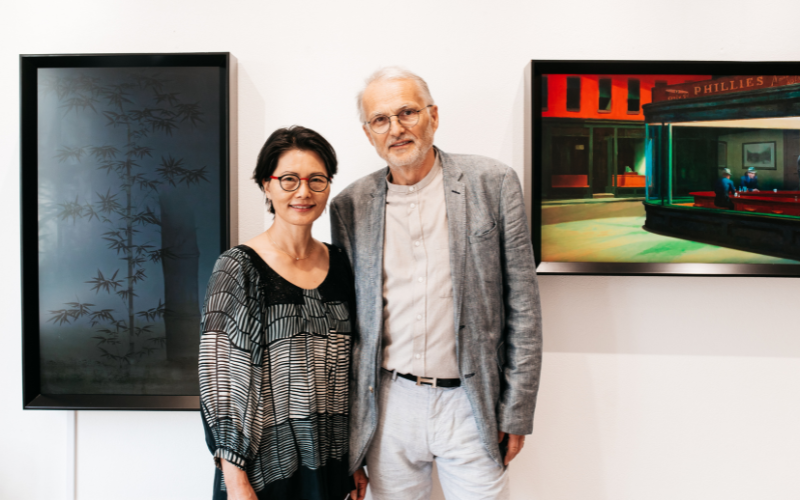
Luxembourg may be a small country, but it often surprises you with the cultural treasures you can find here. As the only Honorary Reporter of Korea.net based in Luxembourg, I’ve learned to notice every place where Korea quietly leaves its mark. One of the most meaningful of these places is ArtsKoCo — a gallery founded in 2016 that has become a bridge between Korean contemporary art and the European public.
Stepping inside ArtsKoCo doesn’t feel like entering a traditional gallery. It feels like entering a story — one built with passion, dedication, and a deep love for Korean creativity. Over the past ten years, Orie and Christophe Duplay have shaped a space where Korean artists can be seen, appreciated, and celebrated far beyond their home country.
To mark the gallery’s 10th anniversary, I sat down with the founders to learn more about their vision, their mission, and the unique role they play in bringing Korean art to Luxembourg. The interview was conducted by email on July 10, 2026.
1. Can you introduce ArtsKoCo and the vision behind the gallery?
ArtsKoCo: “ArtsKoCo was founded in September 2016 by Orie and Christophe Duplay with a clear mission: to promote emerging Korean artists in Europe. Born and raised in Korea, Orie wanted to create a space that would bring Korean contemporary art to Luxembourg. The gallery is part of a broader cultural initiative led by the association Friends of Korea in Luxembourg, which has organized invitations of Korean artists and dance companies, as well as the Korean stand at the annual International Bazaar held every November. As Orie is heavily involved in the association’s activities, Christophe has taken on the management of the gallery, while Orie remains the artistic director and travels regularly to Korea to visit art fairs and discover new artists.”
2. How do you select the artists you exhibit?
ArtsKoCo: “Half of the artists represented by ArtsKoCo are Koreans who have come to Europe, often to France, where visa regulations previously favored students enrolling in fine arts programs. Many of them are part of associations that exhibit regularly in Paris. Others live in Germany, Italy, or elsewhere in Europe. The other half consists of artists recruited directly from South Korea, with Orie traveling there twice a year on average to visit relevant art fairs. Ultimately, the selection is a matter of artistic taste rather than strict criteria. The only exclusion concerns artists who are already well-known and have signed exclusive contracts with other European galleries covering Luxembourg.”
3. What role do you hope to play in promoting Korean art in Europe?
ArtsKoCo: “A role that matches our size and our means. We observe that many galleries in major European cities are closing due to a lack of visitors and buyers — including in Paris, where we recently conducted a test. Some artists try to bypass galleries and sell online, with mixed results. Other galleries lack a clear artistic identity. ArtsKoCo has chosen, with very few exceptions, to represent only Korean artists. We may be the only gallery in Europe with such a strong and exclusive identity. On rare occasions, we have presented a European artist, for example in a duo exhibition of sculptors working with Carrara marble.”
Featured artwork at ArtsKoCo © ArtsKoCo
4. What themes or values do you aim to highlight in your exhibitions?
ArtsKoCo: “We aim to reflect the diversity of contemporary art in Korea — in techniques, styles, and artistic approaches. We particularly highlight the talent, dedication, precision, and meticulous work often associated with Korean artists. The themes belong to the artists themselves; we do not impose any preferences. That said, a gallery must also attract and satisfy its collectors. Some appreciate the sobriety of artists influenced by the Dansaekhwa movement, with recurring monochrome motifs, such as Hyunjoung Lee, who is not strictly confined to monochrome. Others seek color or techniques specific to Northeast Asia, such as the lacquer works of MyeungHee Park, the pointillist paintings with embedded epoxy reliefs by Seock Son, or the pigment-and-marble-powder techniques of Sunmi Kim. Between painting and sculpture, we present works by Hoon Moreau using precious woods, crystal, gold leaf, and ink, as well as ink-and-pigment works on traditional Korean Hanji paper. Other artists use tinted plexiglass or unique materials and techniques — such as Chanmo Kang, faithful to Buddhist artistic traditions, or Professor Nung Saeng Park, who reinvents Joseon-era techniques with contemporary themes. Sculptor Heang Gyun Lee works with marbles from around the world, especially Carrara. Each artist is unique in inspiration and technique, which makes our work both challenging and fascinating.”
5. How does the Luxembourg public respond to Korean art?
ArtsKoCo: “The Luxembourg public responds with great enthusiasm. Luxembourg City’s population is composed of about 70% foreigners from all over the world, making the audience here truly international. Despite the city’s small size — a capital, yes, but a hundred times smaller than major European capitals — our success has been continuous, even during the Covid years.”
6. What are your upcoming projects (exhibitions, collaborations, events)?
ArtsKoCo: “This month (July 2026), we are hosting two PhD students from Chungnam University in residence, with their opening on July 15. They will also meet fellow residents currently in Munich and Paris. We will celebrate our 10th anniversary from September 23 to 25, presenting one artwork from each of our major artists, limited by the gallery’s space. Starting October 21, we will present an exhibition dedicated to MyeungHee Park and her stellar lacquer works, just before she is shown at the historic Salon d’Automne, created in 1903 and held at Place de la Concorde from October 28. Finally, our participation is once again confirmed — for the tenth time — at Luxembourg Art Week, from November 19 to 23. Other projects are underway and will be announced soon.”
7. In your opinion, which Korean artists deserve more international attention?
ArtsKoCo: “All of our artists. We choose them because we believe they deserve recognition — for the reasons mentioned above, and also because their talent is more resistant than others to the rise of AI, which imitates and absorbs artistic creativity without imagination. Naming one would make the others jealous, and rightly so. They all deserve it.”
8. What is the biggest challenge for a Korean gallery in Europe today?
ArtsKoCo: “Creating a gallery today is already a challenge, in an era of digitalization, disintermediation, and AI systems that copy and mimic artistic creativity. A Korean gallery must identify and promote artists who can renew themselves and stay ahead of AI imitators. Korean artists are still largely unknown in Europe. A gallery must therefore gather and attract an informed — or sometimes uninformed — audience and show them that these artists are not the stars of European auctions, do not have agents promoting them to institutions or major galleries, and are not supported by Western billionaire groups. They rely solely on their talent and the continuous efforts of their galleries. But these challenges also bring opportunities. The Korean Wave extends far beyond cinema, K-pop, cosmetics, or literature (including Han Kang’s Nobel Prize). We are confident that this wave will continue to expand into all sectors — including contemporary Korean art.”